
By Peyton Mills

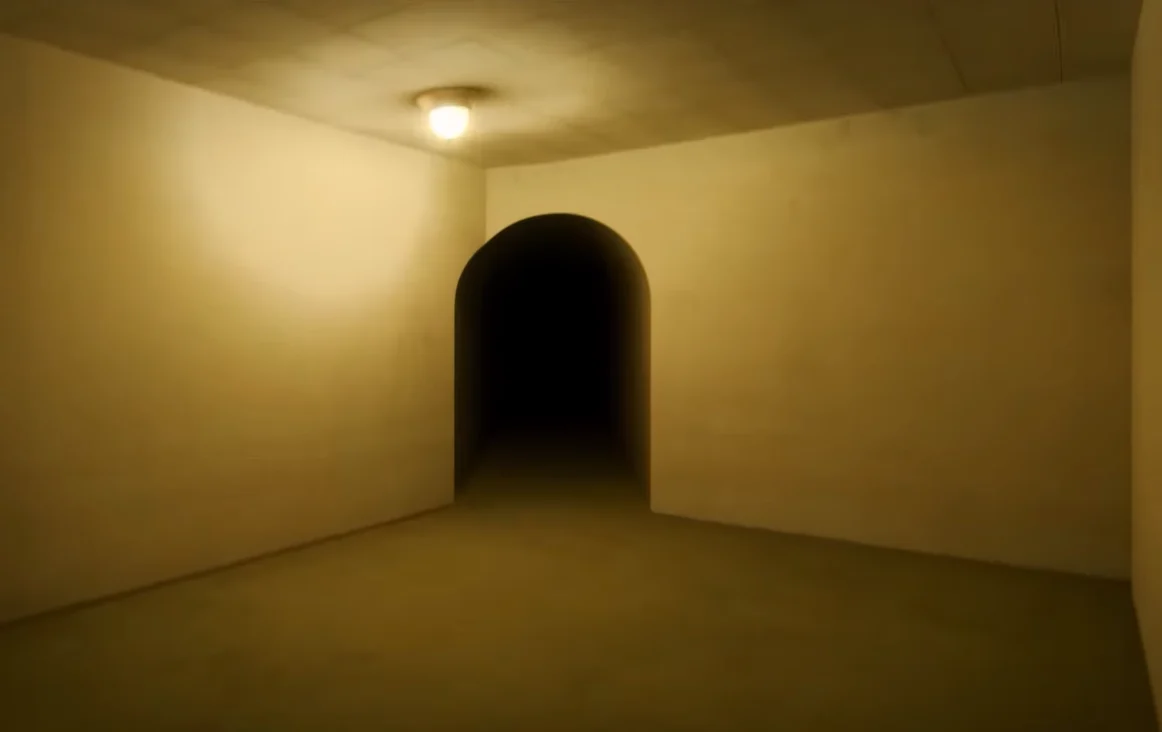
“It’s massive in there, [with] all these rooms,” Chiwetel Ejiofor’s Clark says of the Backrooms in the first teaser for 20-year-old Kane Parsons’s film of the same name. An apt description. Originally published by an anonymous message board user on 4chan on May 12, 2019, the Backrooms in its original conception was “nothing but the stink of old moist carpet, the madness of mono-yellow, the endless background noise of fluorescent lights . . . and approximately six hundred million square miles of randomly segmented empty rooms[.]” To reach this functionally-limitless yellow purgatory, one had to slip through a crack in reality—an unfortunate occurrence known as “no-clipping,” a term drawn from the video gaming community that refers to a player’s ability to pass through solid objects. To make matters worse, the original 4chan post referred to some monster “wandering . . . nearby[,]” though as with nearly everything early Backrooms, the post kept the monster’s identity amorphous. Perhaps the most influential part of that original post, however, was the image that accompanied the text: a crooked view of a maze of carpeted rooms, bathed in a sickly yellow and devoid of all signs of human life. As the narrator of Charlotte Perkins Gilman’s “The Yellow Wallpaper” might describe the Backrooms’ distinctive hue, “It is the strangest yellow, that wallpaper! It makes me think of all the yellow things I ever saw—not beautiful ones . . . but old foul, bad yellow things.”
The Internet clearly agreed with that assessment. By April 2020, a Backrooms wiki had already cropped up, allowing users to write their own lore on the endlessly repeating rooms in a collaborative fiction project that is still expanding today. Then, on January 7, 2022, Kane Parsons uploaded a found-footage-style short film on YouTube centered on a filmmaker no-clipping into the Backrooms. In the first week, that short film received over 15 million views, launching a new viral resurgence of Backrooms content and springboarding Parsons’s career more broadly. In the wake of that first short film, Backrooms content exploded on YouTube, comprising everything from newfound footage-style films and analysis videos to music. Communities of Backrooms enjoyers appeared on Reddit, the Backrooms wiki continued to grow, fans began creating Backrooms video games, and the Backrooms entered the public consciousness with news articles focusing on those endless yellow walls and Parsons’s efforts in bringing them to life. That initial success led to a full YouTube series created by Parsons, with its own individual lore that differed drastically from the creative work appearing on the Backrooms wiki. Whereas the wiki writers began crafting new Backrooms areas, filled with monsters and perils of all sorts, Parsons used his monsters sparingly, preferring to stick closely to the aesthetic of the original 4chan image and post. Those decisions clearly paid off. Parsons’s first Backrooms video has now amassed 78 million views in just four years, with each subsequent video garnering millions of individual views, as well.
Today, the Backrooms are just one flavor of liminal spaces, a type of in-between space popular in online horror communities and known to elicit discomfort, disorientation, or unease. Derived from the Latin word limen, meaning “threshold,” liminal spaces are those transitional areas between locations, frequently evinced by parking lots or long, empty corridors. Oftentimes, when discussed online, these spaces are dark, lonely, or filled with repeating architecture, and they are usually places where people should be but no longer are. In short, a liminal space is “familiar, ordinary even” but that nonetheless “feels off.” Take the Backrooms, for example. In both the original 4chan image and Parsons’s series, the Backrooms use familiar, ordinary architecture: fluorescent, office-building-esque lighting; carpeting; sheetrock and wallpaper. There is something oddly comforting in that familiarity, like a memory half-remembered, but the Backrooms feel off, as well. They are devoid of life, repeating their walls and rooms in ways that make little sense and disorient those unlucky enough to be trapped within them. They are the perfect example of the liminality that has captured the minds of online horror fans throughout the 2020s.
With the release of A24’s Backrooms, however, I’ve struggled to articulate my love for this particular blend of horror to those unacquainted with it. While liminality and the Backrooms clearly have an online presence, they also defy distillation. It is difficult to give an elevator pitch for the unacquainted that captures the quiet unease of liminality. Such horror seems better experienced than explained. And yet, it is this very blend of horror—an anxious existentialism—that has troubled humanity since the dawn of our existence. Liminal spaces in general and the Backrooms in particular are simply the latest permutation of this horror, repackaged for a digital audience.

As far back as 1851, Herman Melville described just such a horror in a very different context through the eyes of the eccentric sailor Ishmael, the narrator of Moby-Dick. In Chapter 42, having learned recently of a great and dangerous white whale, Ishmael began to analyze his own feelings about that whale, Moby Dick. While the whale was undoubtedly large and ferocious, to Ishmael, what made it the most terrifying was its ghostly color: as Ishmael explained at the start of his musings, “It was the whiteness of the whale that above all things appalled me.” In determining why its whiteness made Moby Dick especially terrifying, Ishmael began by drawing contrasts between human associations with the color white. Across the globe, he explained, “whiteness refiningly enhances beauty, as if imparting some special virtue of its own,” and was utilized to represent “many touching, noble things[,]” like purity, justice, royalty, divinity, peace, youth, and innocence. To Ishmael, then, whiteness was inextricably bound up in those parts of human life that we hold most dear: our senses of morality, justice, and worship, and the meaning we ascribe to our existence. And yet, Ishmael goes on to say that “there lurks an elusive something in the . . . idea of” whiteness that “strikes more of panic to the soul” than any other color.
To illustrate his point, Ishmael turned to nature, “God’s great, unflattering laureate.” Ishmael took great pains to walk the reader through the most terrifying and ferocious animals, climes, and locations on our planet, always returning to their whiteness as a key facet of their terribleness. He talked of polar bears and of white sharks, of the hideousness of the white pallor of death, of the ways that the White Mountains and the White Sea stick in the minds of terrified travelers more than the Blue Ridge Mountains or the Yellow Sea. At many points, Ishmael himself seemed confused about the phenomenon he was speaking of. Surely, he wrote, “whiteness is not confessed to be the prime agent in exaggerating the terror of objects otherwise terrible[.].” In part this confusion may be traced to the paradox of whiteness, how Ishmael simultaneously viewed the hue as “the most meaningful symbol of spiritual things” and also “the intensifying agent in things the most appalling to mankind.” The paradox, however, was also the answer to his musings. Ishmael argued that there must exist worldly evidence of the mystic, “the invisible spheres” that give life meaning and answer mankind’s existentialism, and that whiteness was the color that forced mankind to face oblivion more fully than perhaps anything else in life. Perhaps, then, humanity revered whiteness because “by its indefiniteness it shadow[ed] forth the heartless voids and immensities of the universe[.]” Faced with annihilation, humanity turned whiteness into something pure, perfect, and just—the symbols of the religious worldviews that answered the anxiety that the whiteness inevitably shook forth. But divorced from those familiar comforts, whiteness stood alone as it was: the base hue of the universe and all its living things, “the concrete of all colours[,] . . . a dumb blankness” at once full of meaning and at the next filled with no meaning at all.
The Backrooms inherit the symbolism behind Ishmael’s white whale in a world almost entirely different than that inhabited by mid-1800s whalers. In many ways, the symbolism undergirding Ishmael’s musings is no different from the Backrooms. For example, just as Moby Dick stripped the human symbology of whiteness of its comforts, so too do the Backrooms strip the familiarities of modern architecture of its comforts. Those mono-yellow walls feel and look familiar, retaining a form we understand while simultaneously stripping the familiar architectural form of its orienting function. The result is the disorientation, unease, and discomfort characteristic of liminal spaces. But in an increasingly digital world, the Backrooms are a symbol representing fears that reach far beyond the simple architectural components that compose them or the loneliness they exhibit.
In 2026, humanity on a global scale faces Ishmael’s existentialism in everyday ways Melville could have never anticipated. Today, that fear screams out of devices so ingrained in our daily lives many of us can scarcely imagine life without them. And accompanied by those devices are new, particularized forms of orientation to reality that mirror physical urban architecture. Built into our digital systems are similarly digital signs and markers that orient even users unfamiliar with how the Internet works, in the same ways that real-world signs and markers do for those navigating real-world cities. In many ways, then, most modern humans lead two overlapping lives—one physical and the other digital—each oriented with stylistically unique symbols built to serve similar functions. We understand what each street sign represents and asks of us, in the same way that we understand what the basic keys, boxes, cursors, and buttons placed in our digital spaces represent and ask of us. These symbols thus serve to orient us by making an implicit promise that, amid the whirlwind of life, reality still basically makes sense. The signs demarcating certain streets will always lead to those streets; corridors will always lead purposefully to rooms with real and distinct purposes; and the search bar will always take us to the websites we seek. In short, the physical and digital architecture experienced by modern humanity promises that its form and function will always remain congruent, that we can always understand and navigate these environments. The Backrooms are the divorce of those familiar forms from their promise of function.
Indeed, what immediately strikes most viewers of Backrooms imagery is how the scenery is almost right. The carpeting, the wallpaper, the fluorescent lighting, and even the colors all feel familiar. We know these parts of the built environment. Indeed, we see places that look almost like the Backrooms nearly every day. But at the same time, the Backrooms simply do not feel right in subtle ways, and it is primarily that almost rightness that makes us uneasy. Because the Backrooms hit us with a weird déjà vu: “I should know this place, but I don’t.” The architecture makes no sense. Rooms hold nothing. Corridors lead in circles or nowhere at all. Everything we take as a certainty about the orientation of our reality becomes uncertain. In short, we know the architectural forms of the Backrooms, but we have lost the ability to understand or navigate them: the architecture has lost its orienting function.

If the horror of the Backrooms could merely be reduced to its architecture, however, it would be difficult to explain the Backrooms’ near-global appeal. After all, the Backrooms imagery most familiar to online horror aficionados is primarily grounded in Western architecture, the types of building materials and signage familiar in the United States and not necessarily elsewhere in the world. Instead, the Backrooms are intimately tied to the digital ages of the late 2010s and early-to-mid 2020s, with the success of Backrooms largely attributed to its popularity among Gen Z. This digital link between the Backrooms and its general audiences should come as no surprise. On their surface, while the Backrooms seem to borrow the existentialism of Ishmael and the imagery of more traditional horror works like Mark Z. Danielewski’s House of Leaves—an experimental horror novel that charts a film-that-may-not-exist about a house that is bigger on the inside and the obsession that ensnares its researchers—the Backrooms’ architecture is a metaphor all its own. Because in the modern-day, as much of humanity’s lives are lived digitally as they are physically, and in those digital worlds, the symbols and spaces make their own promises to users. The horror of the digital age, then, has often hinged on those promises being broken in various ways.
As a result, the arc of the Backrooms’ popularity makes more sense in the context of the online horror tropes that spawned them. In the earlier days of the Internet, the first whirlwind of digital horror took the form of “creepypasta,” a word that comes from the 4chan-derived “copypasta,” a term used to describe viral blocks of text that were copy-and-pasted repeatedly by users. Creepypasta, then, were often short, user-generated horror stories shared online and spread by other users. The most famous creepypasta is arguably Slender Man, a faceless humanoid creature first mentioned in an online forum before he launched into mainstream appeal, but many famous creepypasta are related to cursed or haunted versions of video games or other digital spaces. In Minecraft, for example, a 2010 forum-based creepypasta created the legend of Herobrine, an entity that looked like the player character with white eyes. Herobrine, according to the creepypasta, would stalk the player, create unusual structures, and strip trees of their leaves. In a rudimentary way, what made the story of Herobrine so scary to many Minecraft players was the way he divorced the game’s form from its function. In Minecraft, the gameplay makes its own implicit promises to players: there are only so many monsters, and they act in specific, repeated ways. Herobrine violates those tenets in ways that demonstrate real agency inside the game and beyond the player. He has the form of the rest of the game, but he doesn’t behave the way the rest of the game’s monsters do. Thus, he shouldn’t exist—but the creepypasta says, maybe he does.
The story is similar across other creepypasta from the early ages of the Internet. In “Pokémon Black,” another creepypasta from 2010, a user details finding a bootleg copy of a Pokémon game that plays somewhat normally, except for the presence of a mysterious Pokémon known only as Ghost that allows the player to kill opposing trainers and Pokémon. “Ben Drowned” is a creepypasta about a copy of Legend of Zelda: Majora’s Mask haunted by the ghost of a young boy named Ben. And in “Super Mario 64,” the author details purchasing a cursed copy of the game of the same name, full of weird glitches and images of himself and his family dying. The unifying thread in many of these early digital-space-centered creepypasta is the way they twist the familiar comforts of their spaces into something horrifying. For example, in “Super Mario 64,” the author begins by detailing all the familiar forms of Super Mario 64, the real-world game. They write, “The screen turned on with the familiar Mario face that you could stretch and twist aimlessly,” but over the course of the creepypasta, that familiarity became increasingly distorted. The game would skip cutscenes, had no music, lacked certain graphics, and featured unusual and threatening text in place of its usual cheery phrases. And the deeper the divorce between the game’s usual form and function became, the more unnerving it became to the author.
Today, creepypasta have become more meme than genuine horror trope, but that shift is due in large part to the evolution of digital horror’s focus on more expansive aesthetic and storytelling efforts. Growing in popularity at the same time as the Backrooms, analog horror is a mostly-Internet-only horror genre characterized by its distinctive use of analog recordings, including “VHS tapes, television broadcasts, emergency alerts . . . and public access television” to tell ambiguous, often slow-burn storylines. Generally, analog horror storylines begin with benign recordings before adding in disturbing elements to build mounting dread. Similarly, the early 2020s have seen the rise of “weirdcore” images and videos, which use “primitive digital graphics, low-fidelity photography, and image compression” to elicit “confusion, disorientation, dread, [or] alienation” in its viewers. What underlies these flourishing tropes, genres, and aesthetics is the same basic existentialism that disturbed Ishmael viewing Moby Dick, but instead of nature, those fears are now refracted back through broken recordings, television static, glitchy video game menus, and uncanny images.

The Backrooms, intentionally or not, have taken residence at the crossroads where older and modern conceptions of humanity’s existentialist fears intersect. Steadily, the horror tradition has picked up and injected existential horror into the perfect mediums to unnerve contemporary readers and viewers. In the mid-1800s, nature and religion were that medium, with the whiteness of Moby Dick expertly twisting the purity and justice humanity relied upon into grotesque caricatures of themselves. Over time, humanity stopped confronting those fears merely within the vastness of nature and instead found themselves face-to-face with it inside their homes. In Gilman’s “The Yellow Wallpaper,” for example, the narrator slowly slips into madness as she is confined to a room lined with yellow wallpaper. That wallpaper, so familiar yet so unusual, begins to take on a life and meaning all its own for the narrator. She begins to smell its scent and to see its patterns everywhere, and by the end of the story, she views herself as having come from inside the yellow wallpaper, as well. And in Danielewski’s House of Leaves, the Navidson family’s entire home is invaded from the inside out when a new doorway opens into impossibly large and repeated spaces, with familiar-but-unfamiliar architecture. Today, those fears have migrated once again from the physical home into the digital spaces humanity now occupies, into our forms of entertainment and connection—a sort of new wilderness made up of processors, servers, and motherboards instead of trees, oceans, and mountains. But while the Backrooms’ siblings—creepypasta, analog horror, and weirdcore—often keep the horror contained to the digital systems themselves breaking, the Backrooms invert the horror by applying the logic of the digital to the physical world.
Even in that first 4chan post, the Backrooms used the language of video games to explain the horror. “If you’re not careful and you noclip out of reality,” that post began, “you’ll end up in the Backrooms[.]” Immediately, then, the original conception of the Backrooms was doing something unique as a horror trope: applying the logic of our digital systems onto the real world. Instead of a horror confined to a game cartridge, a website, or a recording, the Backrooms blended the modern unease of digital systems with the older fears radiating out from the wilderness and uncanny architecture. This blend sits at an unusual intersection of humanity’s existentialism, understanding how those fears have existed and evolved and effectively overlaying one over the other. The Backrooms understand the older version of the fears Melville discussed, how wilderness strips away the meaning of humanity’s symbols, while acknowledging how those fears have reached into our homes and the most intimate parts of our lives. They understand the ever-shifting impermanence of our digital spaces, the anxiety that restlessness can produce, and as a result, the existentialism that roars forth from the application of that digital logic onto the physical world. More than simply asking what happens to us when our comforting symbols are picked at and pulled away, the Backrooms ask us to confront something more fundamental: what if our physical reality is as fragile as its digital analogue?
Viewed in this light, the Backrooms stop being scary merely due to their almost right architecture. Instead, the Backrooms pose an ancient question—how can humanity orient itself in an uncaring universe?—at a time when our orientation rests more on interfaces and algorithms than the stars and the skies. At a time, quite simply, when our orientation in the world is more nebulous than ever. The Backrooms are thus scary because they reflect the instability of the digital projected out into the physical world, where we cannot escape facing it. No longer must humanity venture into reality-breaking places, full of white whales, yellow wallpaper, or impossible interior spaces; instead, no matter where you are, you could no-clip into a maze of rooms that have lost their function, a world that looks like places you know but that you cannot understand. Like the Internet, that “house of leaves moments before the wind,” the Backrooms represent modern humanity’s digital-focused existentialism on a grand scale: maybe, they tell us, the entire world could lose its orienting function, and sweep you up with it.
The Backrooms, then, were simultaneously seeded in the fertile ground of the Western literary canon while growing worlds beyond that canon. While they adopt an ancient human fear that we might give everything to understand the universe and in turn find we mean nothing at all, they do far more than simply repackage that message. In part, it is true, the Backrooms are about the obsession of Moby-Dick, the annihilation of the Navidson family in House of Leaves, and the assimilation of Gilman’s narrator with her yellow wallpaper; after all, Backrooms is all about recursive memory and how it destroys us. But the Backrooms are hardly reducible to any one of those themes. And how could they be so simple, being a product of the digital age? As Bo Burnham sang in “Welcome to the Internet,” his meditation on our digital age, “Could I interest you in everything all of the time?”
Perhaps the beauty of the Backrooms is that they can support such wide-ranging themes, motifs, and interpretations. A single image of a maze of mono-yellow walls can spawn a whole series of environmental storytelling with an array of monsters, an exploration of destructive and recursive memory, and found-footage stories documenting capitalist efforts to commodify an interdimensional world—and none of it feels out of place. But the core of the Backrooms’ horror remains fundamentally the same in all its variants: by its very existence, the Backrooms break the implicit promise of reality that it will make rational sense, violating the old maxim that “form ever follows function” at a universal level. In doing so, the Backrooms digitize humanity’s oldest fears, updating and evolving them for a modern audience. In a brave new world defined by its carefully constructed systems, the Backrooms spit at and trample over the order humanity attempts to curate. Like Ishmael facing the white whale, the Backrooms force us to stare eternity in the face. And eternity, systematically divorcing the forms of our systems from their orienting functions, laughs at us.
Works Cited
- A24, Backrooms | Official Trailer HD | A24, YouTube (Feb. 24, 2026), https://www.youtube.com/watch?v=tKGhxMi50y8.
- Carlos Aguilar, Kane Parsons is 20. Here’s How He Made A24’s Biggest Summer Movie, the Spooky ‘Backrooms’, AOL (May 14, 2026), https://www.aol.com/articles/kane-parsons-20-heres-made-100000639.html.
- See generally Backrooms, IMDb (last accessed May 20, 2026), https://www.imdb.com/title/tt26657236/?ref_=ttfc_ov_bk.
- The Backrooms Origin Story of Black August, Medium (Sept. 28, 2025), https://medium.com/@thebackrooms.online/the-backrooms-origin-story-of-black-august-20a39ae6a260.
- Id.
- No Clip, GiantBomb (last accessed May 20, 2026), https://giantbomb.com/wiki/Concepts/No_Clip.
- See The Backrooms Origin Story, supra note 4.
- Id.
- Charlotte Perkins Stetson, The Yellow Wallpaper (Project Gutenberg 1892).
- FAQ, The Backrooms Wiki (last updated Sept. 24, 2025), https://backrooms-wiki.wikidot.com/faq.
- The Backrooms (Found Footage) – 4 Years on from Kane Pixels First Backrooms Video, Medium (Jan. 8, 2026), https://medium.com/@thebackrooms.online/the-backrooms-found-footage-4-years-on-from-kane-pixels-first-backrooms-video-2f3b6c2b3dad.
- See generally, Kane Pixels, The Backrooms, YouTube (last accessed May 21, 2026), https://www.youtube.com/playlist?list=PLVAh-MgDVqvDUEq6qDXqORBioE4Yhol_z.
- Compare id. with Home, The Backrooms Wiki (last updated May 11, 2026), https://backrooms-wiki.wikidot.com/start.
- See generally Kane Pixels, The Backrooms (Found Footage), YouTube (Jan. 7, 2022), https://www.youtube.com/watch?v=H4dGpz6cnHo&list=PLVAh-MgDVqvDUEq6qDXqORBioE4Yhol_z&index=1&t=213s.
- Liminal Space Meaning: The Psychology of In-Between, Meridian Univ. (Apr. 12, 2026), https://meridianuniversity.edu/content/liminal-space-meaning-the-psychology-of-in-between.
- See Ross Stringer, Exploring Liminal Spaces: Why Are These Images Unsettling?, Medium (Apr. 29, 2022), https://medium.com/@rossstringer/exploring-liminal-spaces-why-are-these-images-unsettling-9ef562d767a9.
- Liminal Space Meaning, supra note 21.
- See Herman Melville, Moby-Dick 14 (Thomas Crawford ed., Dover Giant Thrift Editions 2003) (1851).
- Rebecca Rubin, ‘Backrooms’ Box Office: 5 Takeaways After Kane Parsons’ Horror Hit Obliterated Opening Weekend Expectations, Variety (June 1, 2026), https://variety.com/2026/film/box-office/backrooms-box-office-kane-parsons-1236763407/
- Home, Creepypasta (last visited July 20, 2026), https://www.creepypasta.com/.
- Slender Man, Slender Man Wiki (last visited July 20, 2026), https://theslenderman.fandom.com/wiki/Slender_Man.
- Herobrine, Minecraft Wiki (last visited July 20, 2026), https://minecraft.wiki/w/Herobrine.
- Pokémon Black, Creepypasta Wiki (last visited July 20, 2026), https://creepypasta.fandom.com/wiki/Pok%C3%A9mon_Black.
- Ben Drowned, Creepypasta Wiki (lasSuper Mario 64, Creepypasta Wiki (last visited July 20, 2026), https://creepypasta.fandom.com/wiki/Super_Mario_64.t visited July 20, 2026), https://creepypasta.fandom.com/wiki/BEN_Drowned.
- Analog Horror, Aesthetics Wiki (last visited July 20, 2026), https://aesthetics.fandom.com/wiki/Analog_Horror.
- Weirdcore, Aesthetics Wiki (last visited July 20, 2026), https://aesthetics.fandom.com/wiki/Weirdcore.
- The Backrooms Origin Story of Black August, supra note 4.
- Bo Burnham, Welcome to the Internet, on Inside (Deluxe) (Attic Bedroom, Corp. 2022).

Peyton Mills is a Kentucky-based writer whose work has appeared in numerous legal and governmental publications. When he isn’t writing, you can find him outdoors in the Bluegrass state or curled up with a spooky story.

Leave a Reply