
for 2020, as well as the Best Horror Novel of the Year from Authors on The Air and was a finalist for American Book Fest’s Best Book Award- Horror, 2020. Her novel Pretty/Ugly won
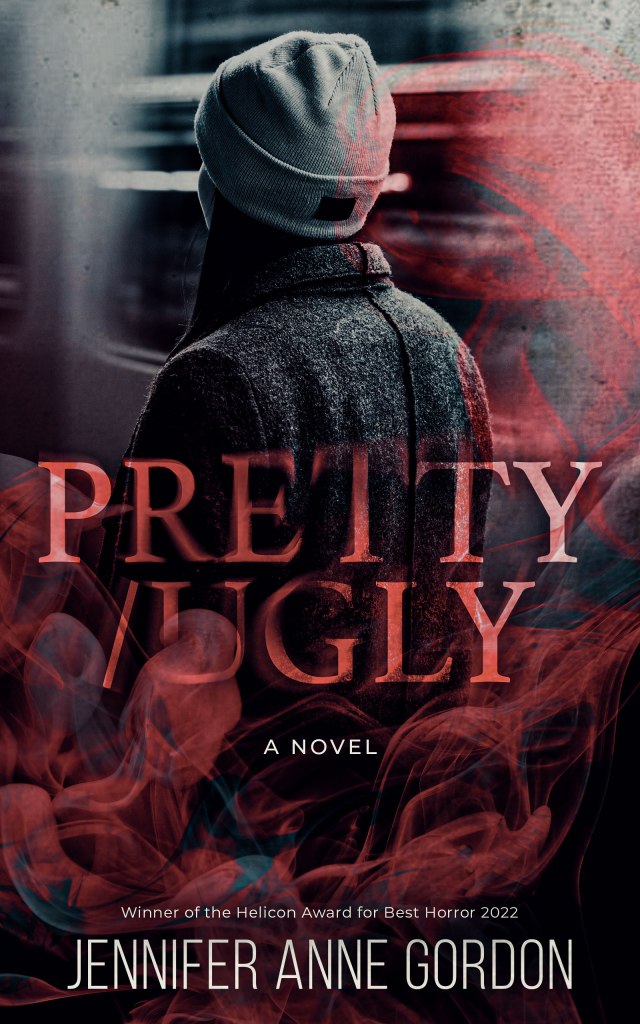
the Helicon Award for Best Horror for 2022, and the Kindle Book Award for Best Novel of the Year (Reader’s Choice). Her collection The Japanese Box: And Other Stories was an instant
Amazon Bestseller and her story The Japanese Box won the Lit Nastie Award for 2024 for Best Short Story.
Her personal essays have been featured on Horror Tree, Nerd Daily, Ladies of Horror Fiction, Writers After Dark, and Quail Bell Magazine, and are featured in Such a Loss, and Letting Grief
Speak: Writing Portals for Life After Loss. Jennifer is the creator and co-host of the popular comedic literary podcast Vox Vomitus, as well as a co-host of House of Mystery on NBC Radio.
For benevolent stalking please visit: http://www.JenniferAnneGordon.com
What was your first published work?
I love this question, because I would love to mention the “cookbook” my kindergarten class published. My recipe was a grilled cheese sandwich and a can of baked beans. (I did not come from a family of chefs), I believe I even included the line “mmmmmm beans” as part of it…But that’s not really published, nor is my third-grade poem about wanting to have a kitten…
During my adult years I did have several poems published in literary journals, as well as some arts and entertainment pieces published in several area newspapers…but what I really feel is my first published work is my debut novel that came out in 2020 a couple weeks before covid lockdown.
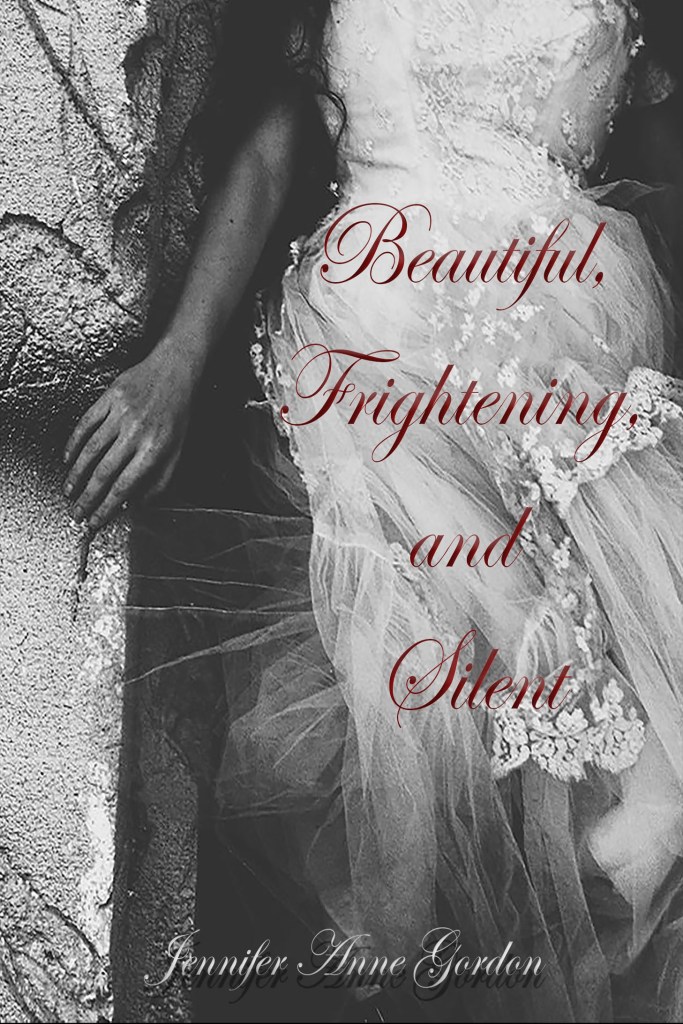
That novel was a literary grief horror novel called Beautiful, Frightening, and Silent. It is a novel that took 30 years to write. It started in my head as a stage play, then a graphic novel, and then finally a novel. It went on to win several awards in the horror and literary community. It is currently unavailable, and I am hoping I will have exciting news about when it will be re- released soon. Like so much of what happens in publishing…I can’t really talk about much now, but crossing my fingers…I hope soon I can talk about this beautiful book of my heart again.
Is there a story inside that you have seeds of but can’t seem to connect that’s dying
to get out?I think this is actually my writing process. I work, in my head, on several projects at a time. The ones that stick…the ones that stories won’t take their claws out of me—those are the ones I focus on. That being said, I work for a long time “in my head” telling myself the story over and over again. I play it like a movie every night, every afternoon…I wait until I get stuck, and then try to
figure out the way out of it. It’s a slow process, but I realize that if I do my “imagination homework” then when I get to the writing process it is very quick. That being said, I am dangerously close to ending the imagination portion of a project—and I think by the time this issue of NightTide comes out—I will be a few weeks into active writing in a project that I have been wanting to write for close to two years. I am superstitious, and my agent would kill me if I gave too many details…but I like to think of this project as Eat Pray Love meets The Exorcist. And my main character is named Beth…and trust me, she is dying to get out.
How do you handle a rejected story?
Is saying “I’m dead inside” acceptable? I am joking, or half joking. My feelings on rejection have changed over the years. I was once a
professional theatre actor, so I am no stranger to rejection. Rejection for work I have written…that is a different sting. My first few big rejections after being “on sub” really hurt…especially the ones when it was a dream editor and publisher, and it gets pretty far into the process before that last final no. I think that hurts for everyone.
That being said, I also write creative nonfiction and memoirs and have recently started submitting to literary journals. There is a lot of rejection there, and again…it’s different because it’s nonfiction and it’s about my life. Does that feel different than a rejection for a novel…. yes. Does it feel better or worse. I don’t know. I’m dead inside. I joke. You have to take every rejection for what it is, BUT, if you keep getting rejected for the same reasons, take that to heart. (looking at you “Her style seems too quirky for such dark
themes.”)
What does literary success look like to you?
At the end of the day, you need to still love to write, you need to still want to tell stories. All the rejection or success in the world cannot change that. If you don’t love it, it’s not a real success story.
Do you read your book reviews? How do you deal with bad or good ones?
The first time I read a two-star review of my novel Beautiful, Frightening, and Silent I sobbed. I messaged my close writer friends. I sobbed some more. I drank honey whiskey. I drank more honey whiskey. I was profoundly confused how someone could read my book about very damaged people going through grief and not find them as amazing as I did. I got the advice to look up my favorite books, and then click on their one-star reviews and read them. Many of the one-star reviews were mentioning the things I loved the most. Reviews. Personal taste. This is all subjective. When I first started, I was obsessed with my reviews…
But that was four years ago, and now I will read a review if it is sent to me, and I read editorial reviews, and I read feedback from beta readers or authors in writing groups. I no longer seek out reviews to read. My publicist will send me some good reviews. I love that. I
don’t live in a bubble, but I also know in my heart that Good Reads reviews are not meant for me. They are for other readers, and we cannot control them. Also there have been many cases of “review bombing” and “review bullying”. Reviews are not for us as writers.



What is the most difficult part of your artistic process?
For me, it’s trusting myself to know when the story is ready to come out of my “imagination process” and I am ready to really start, because once I start, I need to finish. Every project that I have DNF’d or has taken a long time and been a struggle is always because I did not put the emotional work into it before I started.
As in most times, the truth is stranger than fiction, what has been the hardest scene or chapter you’ve had to write, if you were channeling personal experience?
While I channel personal experience a lot when I am writing, the hardest thing to write (and to send out into the world) was my collection “The Japanese Box and Other Stories”. The title story in that collection started in an advanced grief writing workshop, and other parts of it were explored in a memoir class. The heart of that story “The Japanese Box” is in my childhood and teen years. It was, at its original start, almost too honest. I got to the point, for me, where fictionalizing it—making it horror was so much easier than sitting with my emotions.
What inspired your latest work?
Hard question…I write a lot of short work that is not out there in the world…I also have a novel that I wrote that is currently “out on sub”. The novel was inspired by the years I was taking care of my elderly mother who has dementia and severe mental illness, combined with the couple years I was working hand in hand with social workers in political advocacy. My last published work was my collection “The Japanese Box and Other Stories” and the heart of that story is always me, and the family relationship that shaped my life. Mother with mental illness, a father with PTSD who died young, etc. Not every piece in Japanese Box is based on my
life, but that story is.
If you could tell your younger writing self anything, what would it be?
I get asked this in almost every interview—my answer is always the same. Don’t listen to the voice in your head that keeps telling you that you can’t do it, or that you are not ready (I need to listen to this advice now, lol.)
What is the best advice you’ve gotten from a fellow writer?
Look, not gonna lie. I have gotten amazing advice from people. The writing community is incredible, but when I got to this question…I blanked out. What advice have I gotten…what advice is the best—what means the most…
I cheated.
I panic messaged one of my best friends, Josh Malerman- NYT Bestseller of Birdbox, my message to him was frantic…out of every conversation we have had, can you remember any advice you gave me…can you give me advice now??? I should say that Josh and I talk a lot, we have somehow become friends (bonding through anxiety and horror…?) So, to ask Josh now for “advice” many years into a friendship…he delivered. In response to my panic ask…. he responded with…
“Once you discover how extensive rewrites are, it no longer matters how “good” or “bad” the rough draft is. This is the most liberating reality a writer can accept: because once the pressure or standards (always self-imposed) are removed, you are free to write whatever you want in any way you want to write it, however the spirit moves you. And which would you rather build on? A draft composed of “failure” and “success”… or a stack of pages like a box of spirit, a box you know contains both your imagination and heart unchained?”
Amazing!
What is your go-to comfort horror/Sci-Fi book?
I guess I will just list the books I have read (horror/sci fi) multiple times, and the number of times I read or listened to the work.
- Ghost Story – Peter Straub (read with my eyeballs twice)
- Haunting of Hill House – Shirley Jackson (read with my eyeballs three times)
- We Have Always Lived in the Castle (read with my eyeballs and then read out loud to my
- partner.)
- It Stephen King (read twice and third on audio)
- On Writing – Stephen King (once reading, and twice on audio)
- Salem’s Lot & The Stand, Carrie (read both and then in audio)
- Books I read, and then did the audio… (these will be my future classics)
- Mary- Nat Cassidy
- Ghost Easters – Clay McLeoud Chapman
- Looking Glass Sound – Catriona Ward
- Incidents Around the House – Josh Malerman
If you were to genre-hop, which genres would you most like to try writing?
I would love to write a cozy mystery. I would be terrible at that…I love them, I would love to be
good at them. I do have an idea…but it probably isn’t as cozy. I guess my other genre, besides horror, would be “women’s fiction with a side order of crime”
Check out Jennifer’s podcast here!

 NightTide Magazine
Leave a comment