by Brodie Hubbard

Horror is heresy by nature. Most horror films can be understood as the ultimate battle between good and evil, but religious and folk horror typically subvert Christian values and iconography rather than celebrate them. Supernatural horror, for instance, places the unholy front and center in series like Sam Raimi’s The Evil Dead—where Bruce Campbell as Ash combats demonically possessed zombies unleashed from a cursed Sumerian text—and Clive Barker’s Hellraiser, which features Doug Bradley as the amoral antihero Pinhead, summoned from Hell by the occult artifact known as The Lament Configuration.
In our favorite slasher franchises, the very existence of nightmare stalkers, undead campground monsters, and relentless mutilators contradicts all that is holy; if there is a God, He has forsaken the likes of Sally Hardesty (Marilyn Burns) and Laurie Strode (Jamie Lee Curtis… or Scout Taylor-Compton, if you prefer).
Of course, more grounded, meta films like the Wes Craven Scream series make little, if any, reference to the metaphysical in their dialogue, let alone in their premise or plot. However, even writer-director Scott Glosserman’s Behind the Mask: The Rise of Leslie Vernon (2006)—which offers practical explanations for how seemingly invincible killers appear to rise from the dead (courtesy of Nathan Baesel as the title character)—acknowledges a broader cosmic perspective. Leslie’s mentor Eugene (played by the late Scott Wilson), who embodies early slasher prototypes like Billy from Bob Clark’s original Black Christmas (1974), asserts that iconic horror villains are a necessary evil, serving to balance and enhance the good in the world.

This eternal conflict, which serves as fodder for cinematic entertainment, is central to the Christian concept of spiritual warfare, rooted in Catholic and Evangelical interpretations of Ephesians 6:12: “For our struggle is not against flesh and blood, but against the rulers, against the authorities, against the powers of this dark world and against the spiritual forces of evil in the
heavenly realms.” This idea has been further developed through treatises from early twentieth- century Pentecostal revivals. Each generation has produced doomsday prophets declaring that the end is near, and across various Christian denominations, spiritual warfare is waged through prayer, exorcism, and other means. Inevitably, even the most campy horror sequels evoke this eschatological struggle, reflecting the larger fight for the fate of humanity between divine and demonic forces.
As early as Tobe Hooper’s Texas Chainsaw Massacre Part 2 (1986), Dennis Hopper’s Lefty declares himself “the Lord of the Harvest” (Matthew 9:38) in his quest for vengeance against the Sawyer family (Bill Johnson, Bill Moseley, and Jim Siedow). By the time Return of the Texas Chainsaw Massacre (also known as Texas Chainsaw Massacre: The Next Generation, helmed by the original’s co-creator Kim Henkel) rolled around in 1995, Leatherface (played here by Robert Jacks) and his family (including Matthew McConaughey in a very early acting role) are portrayed as tools of the Illuminati, seeking transcendence through pushing the limits of fear in their victims. Secret societies and cults claiming a stake in the confrontation between good and evil creep into these franchises just as much as the church.
Putting aside writer-director Tommy Lee Wallace’s non-Myers Halloween III: Season of the Witch (1982) and its child-murdering Celtic pagans in the Silver Shamrock Novelties corporation, the Halloween franchise launched by maestro John Carpenter managed to reach its sixth installment before director Joe Chappelle’s Halloween: The Curse of Michael Myers (1995) explicitly introduced a cult as the source of Michael’s purpose and powers. While Michael (played here by the late stuntman George P. Wilbur, in a return to the role after director Dwight H. Little’s Halloween 4: The Return of Michael Myers in 1988) was always described as the personification of evil, this sequel reveals that he is controlled by a Druid sect organized around an ancient rune. (Somehow, Paul Rudd, looking the same here as he does now 30 years later, outwits the sect in his take on Tommy Doyle.) None of the reboots or requels that followed continued this thread, though the Blumhouse Halloween trilogy (2018-2022) headed by director David Gordon Green retained a vague concept of evil as an infection that could be transmitted to others. (Early drafts of Halloween Ends toyed with bringing back Silver Shamrock.) Rob Zombie touched upon some Book of Revelation imagery with the white horse in his Halloween 2 (2009), though it served more as a psychological symbol. (Zombie’s fully formed take on religious horror wouldn’t rear its head until 2012’s The Lords of Salem, which is more inspired by Dario Argento than Pope Leo XIII.)
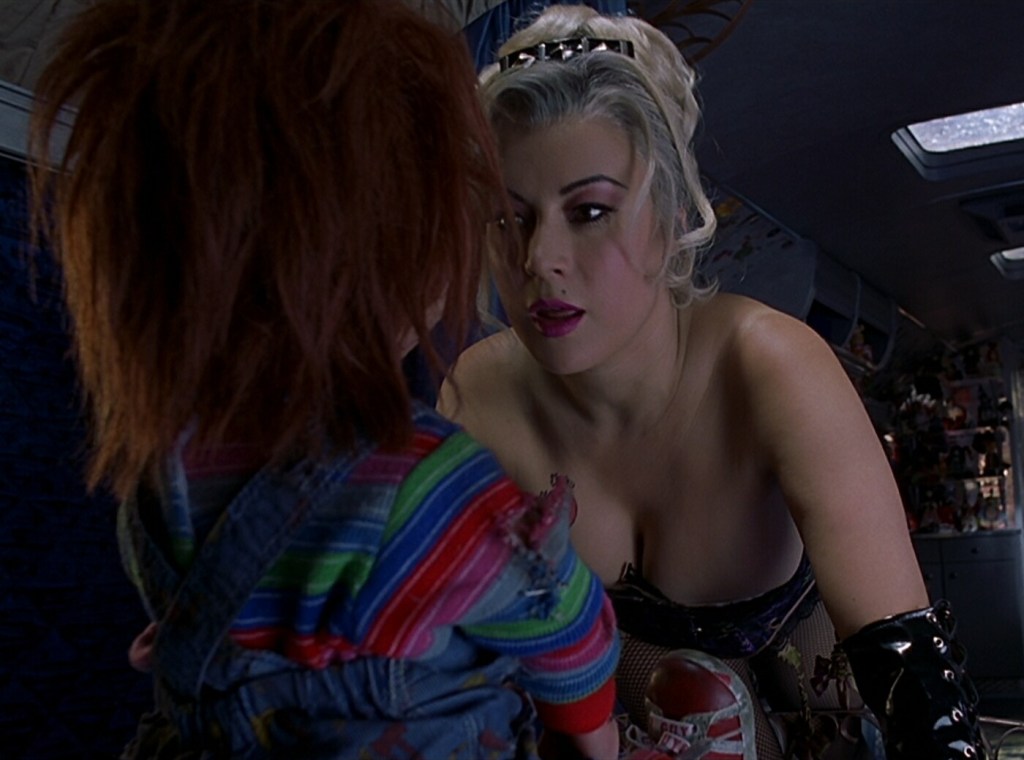
Don Mancini’s Child’s Play (1988) launched a franchise that spans seven films (not counting the 2019 reimagining) and a three-season television show (2021-2024), with the original utilizing voodoo right from the outset. Soul transference is crucial throughout the series, as Chucky (Brad Dourif) and Tiffany (Jennifer Tilly) possess dolls and attempt to take over other bodies, though the rules and structure of this enterprise are inconsistent. Near the end of Chucky season three, the titular character and fragments of his soul are scattered across an otherworldly realm, while a mortal and imprisoned Tiffany on death row is told that her lethal injection will send her to burn in Hell.
The lone entry of the Friday the 13th series that weaves occult themes into Jason Voorhees’s story also involves soul transference. Jason as an undead, unstoppable killer began with director Steve Miner’s Friday the 13th Part 2 in 1982 (a role shared in the film by Warrington Gillette as unmasked Jason and Steve Daskewisz channeling Charles B. Pierce’s The Town That Dreaded Sundown with a burlap sack over his head) or perhaps with the drowned zombie boy hallucination at the end of the 1980 original (Ari Lehman, as made up by special effects legend Tom Savini). Nevertheless, it was director Adam Marcus’s Jason Goes to Hell: The Final Friday (1993) that transformed Jason (played here by the definitive Voorhees actor, Kane Hodder) into a demon, possessing the bodies of his victims to keep moving and seek out a blood relation to be reborn in. This odd-one-out entry in the franchise includes the Necronomicon and Kandarian Dagger from the Evil Dead series, grafting a mythos onto Jason previously unseen in the Friday the 13th films. The title’s prophecy is fulfilled when Jason is defeated, and a razor-clawed glove (also manned by Hodder) reaches from the earth to drag Jason’s hockey mask to Hell, with a familiar cackle reminiscent of Robert Englund. (This would all be ignored to send Voorhees to outer space in director Jim Isaac’s Jason X.)
The glove, obviously, belongs to Freddy Krueger of the A Nightmare on Elm Street series, which only remained secular for the first two entries. As early as director Chuck Russell’s A Nightmare on Elm Street Part 3: Dream Warriors (1987), the effort against Freddy included ghost nun moms (in this film, played by Nan Martin) and holy water. Freddy is defeated in a church at the end of director Renny Harlin’s A Nightmare on Elm Street Part 4: The Dream Master (1988), and his origin as the product of the rape of Sister Amanda Krueger (played here by Beatrice Boepple) is revisited in director Stephen Hopkins’s A Nightmare on Elm Street Part 5: The Dream Child (1989). Director Rachel Talalay’s Freddy’s Dead: The Final Nightmare (1991) explains that a dying, mortal Freddy made a deal with the Devil via dream demons to become immortal. Wes Craven’s New Nightmare (1994) was more interested in Freddy as a myth than as a Judeo-Christian menace, though it still acknowledged him as an entity personifying evil. (2003’s Freddy Vs. Jason, directed by Ronny Yu, barely touches upon both horror heavyweights beginning the film in Hell, and the subsequent reboots concentrate on origin stories rather than religious motifs.)

With the decline of late twentieth-century slasher icons, apocalyptic themes have tended to stay in the purview of strictly religious horror, as seen in films like director James Wan’s The Conjuring (2013), so-called “elevated” horror like writer-director Robert Eggers’ The Witch (2015) and writer-director Ari Aster’s Hereditary (2018), or continuations of The Exorcist and The Omen franchises. But writer-director Damien Leone has been credited with reviving the classic eighties-style horror icon through Art the Clown (played by David Howard Thornton) in his Terrifier series. Art’s roots in short films like The Ninth Circle (2008) immediately introduce Satan into the narrative—not only through referencing Algheri’s The Divine Comedy but also as a literal character to whom Art (played in the shorts by retired actor Mike Giannelli) delivers his victims.
According to Leone, the three feature films take place in their own “standalone universe,” and the first film, Terrifier (2016), leaned more towards grindhouse than supernatural until the last minutes when the presumed dead clown rises from his morgue table. However, Terrifier 2 (2022) hinted at a war between angels and demons with the introduction of final girl Sienna (played by Lauren LaVera), while the latest installment, Terrifier 3 (2023), makes the religious undertones overt with direct mentions of demonology, symbolism such as crucifixion and the crown of thorns, and framing Sienna as God’s chosen warrior to defeat the evil that controls Art the Clown and his occasional accomplices. Terrifier 3 echoes Return to Texas Chainsaw Massacre’s escalation of fear and violence as a spiritual tool, and without spoiling the finale of this box office blockbuster, it strongly suggests a descent into Dante’s Inferno is imminent in the franchise.
As long as horror tells stories about humanity’s deepest fears—our dread over what happens to our bodies and souls—questions of Heaven and Hell will always be implied or inferred. Dr. Frankenstein’s creature, as written by Mary Shelley, lamented that while “Satan has his companions, fellow-devils,” he existed “solitary and detested.” In the slasher genre, Death rides a pale horse, and Hell follows with him—sometimes, wielding a chainsaw.
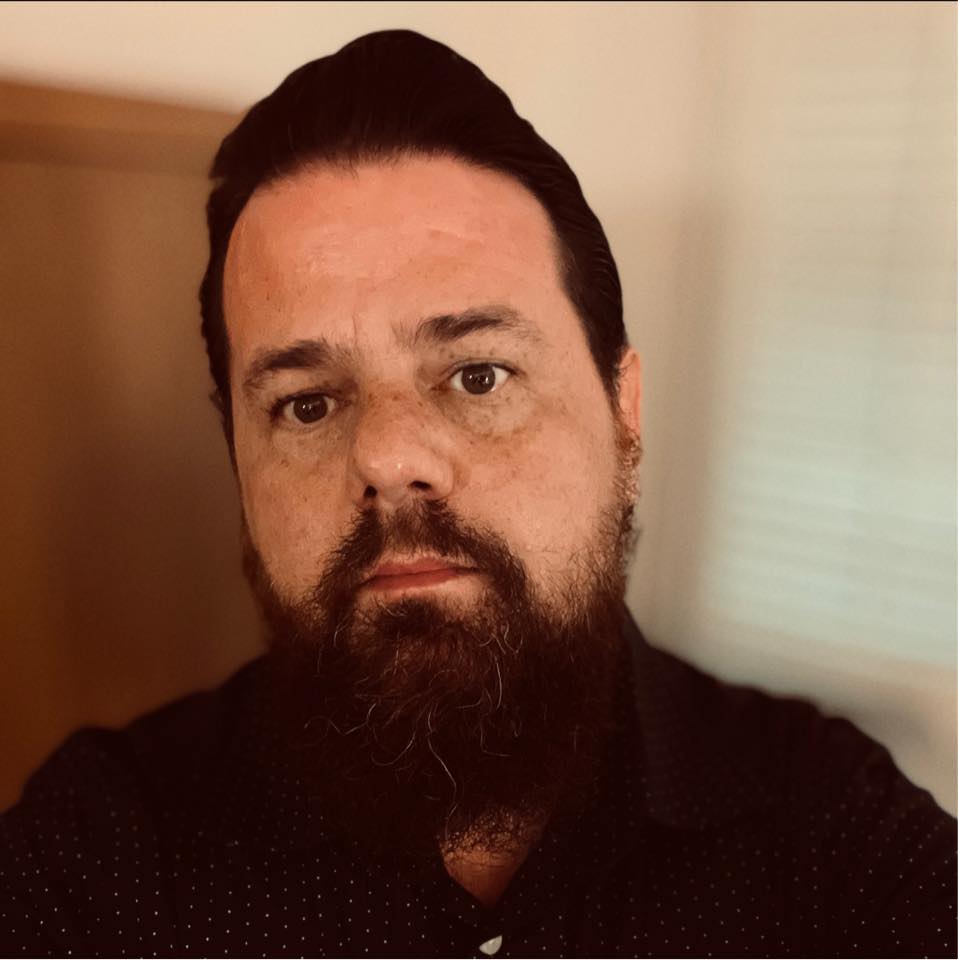
Brodie Hubbard (he/him) is a writer from Arizona. With an MFA in Creative Writing from Antioch University, his work has appeared in Cultural Daily, Drunk Monkeys, HOOT Review, and Meow Meow Pow Pow, as well as in The Book of Korinethians, a Pink Plastic Press anthology inspired by the films of Harmony Korine, featuring his essay “Devil Worshipping Sonofabitch.” He also contributes horror reviews, interviews, and commentaries for the Morbidly Beautiful network on Video of the Damned. You can connect with him on social media at @brodiehubbard and find out more about his work at brodiehubbard.com.
 NightTide Magazine
Leave a comment