by Charlotte Armstrong
When sci-fi horror tries to imagine the truly alien, it reveals uncomfortable truths about how our society views disability.
Across decades of alien horror, unfamiliar bodies are unsettling, alternative senses are weaponised, and different ways of processing reality are coded as threats to humanity itself. While these narratives might not intend to comment on disability, they inadvertently reveal society’s uncomfortable relationship with bodies, minds, and senses that deviate from expected human “norms”. Put plainly, disability is used as shorthand for monstrosity.
But often, these films also elevate physical, sensory, and neurological differences by showcasing their extraordinary power and sophistication. Throughout this subgenre, the very traits depicted as alien or monstrous often exceed human limitations. This tension plays out across many of the genre’s most iconic works, revealing our cultural fears while exposing just how limited our assumptions about “normal” human capabilities can be.

PREDATORY PERCEPTION
When the Xenomorph stalks through the Nostromo’s ventilation system in Alien, it navigates with perfect precision despite its apparent lack of eyes. Like many aliens to follow, it embodies a common horror trope: the monster whose heightened alternative senses compensate for something “missing” or “broken”. Unlike other genre conventions that depict seemingly compensatory abilities as mystical or inspirational, Alien frames non-visual senses – like echolocation and chemical detection – as predatory advantages. As the ship’s Science Officer Ash observes, “Its structural perfection is matched only by its hostility”.
This representation is deeply ambivalent in its implications. While the Xenomorph’s chemical sensing makes it a superior hunter in many situations, the film never allows these abilities to exist as neutral adaptations. Instead, they become weapons, marking their possessor as inherently threatening. This pattern repeats across decades of sci-fi horror, from the Predator’s thermal vision to the echolocating creatures of Pitch Black (2000). Even when portrayed as impressive, alternative sensory abilities remain markers of monstrosity rather than simply natural variations in ability. The message becomes clear: to sense the world differently is to be dangerous, to be other, to be alien.
Recent films like A Quiet Place (2018) and Bird Box (2018) flip this dynamic: presenting scenarios where survival depends on humans restricting or denying their own senses by staying silent or blindfolding themselves. But these narratives still frame sensory differences through fear, presenting worlds where diverse sensory experiences breed deadly conflicts rather than opportunities for coexistence. In some ways, these films mirror real-world situations where d/Deaf or visually impaired people must navigate environments designed exclusively for typical sensory perception, transforming this daily reality into an apocalyptic threat. The only solution becomes adaptation or extinction – there’s no room for exploring how multiple sensory perspectives could flourish together.
THE HORROR OF NOT FITTING IN
Alien horror ventures into unsettling territory when it depicts beings whose bodies are familiar, but whose behaviour is just wrong enough to trigger instinctive discomfort. In Signs (2002), the aliens approximate human form closely enough to make their differences deeply unsettling. They walk upright but move wrong, have recognisable limbs but use them strangely – creating horror by violating expected patterns of human movement and behaviour.
The horror of alien invasion often stems from beings who occupy spaces not designed for them – moving through ventilation systems, appearing in domestic spaces, and infiltrating human structures. This echoes the real-world barriers disabled people face in spaces that haven’t been built with them in mind. Think about how our everyday world is designed: most buildings assume everyone can use stairs, most restaurants assume everyone can read standard menus, and most workplaces assume everyone can handle bright lights and loud noises. Now imagine trying to navigate that world when your body or mind works differently. Yet, by showing how different bodies can successfully inhabit these spaces, these films suggest our built environment could adapt to embrace multiple ways of being. The genre thus contains seeds of critique against normalised design assumptions that exclude diverse bodies and movements.
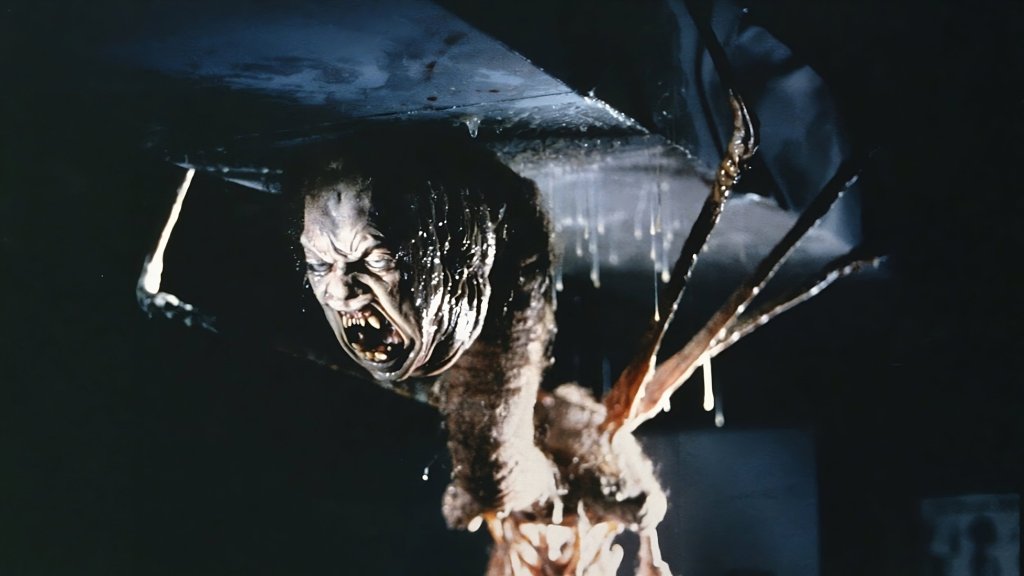
In The Thing (1982), we are presented with an organism that doesn’t just move differently but undergoes constant transformation and assimilation, absorbing the entire spectrum of human experience – from muscle memory to personal history. Horror stems not from the titular creature’s ability to mimic humans, but from the moments where that mimicry fails. These moments of failed mimicry parallel the real-world discomfort often felt when someone’s behaviour doesn’t match neurotypical or non-disabled expectations.
This resonates with what’s known as “autistic masking” – an exhausting practice where autistic people consciously copy and perform typical social behaviours to fit in. Think of it like having to constantly follow an intricate script for every social interaction, from maintaining ‘correct’ eye contact to using expected facial expressions and gestures. Just as The Thing’s mimicry breaks down in moments of stress or confrontation, for autistic people, the carefully constructed social mask can slip when overwhelmed, tired, or caught off-guard. The social backlash to these moments of unmasking plays out like the film’s horror sequences, revealing how rigid society’s expectations of ‘normal’ behaviour can be, and how quickly unease sets in when those expectations aren’t met.
SENSORY TRANSFORMATION
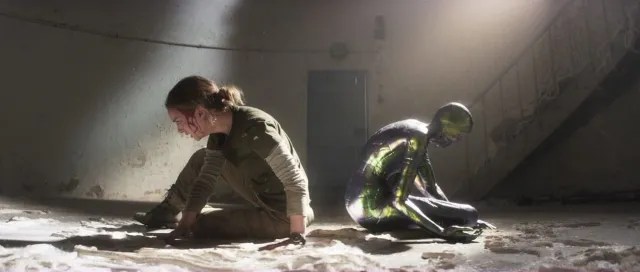
If The Thing shows us the horror of failed conformity to human norms, Under The Skin (2013) and Annihilation (2018) dismantle the very notion of “normal” perception altogether. Under the Skin presents an alien perspective that transforms mundane reality into something profoundly strange. Through the alien’s eyes, familiar Scottish streets become uncanny hunting grounds, everyday human interactions become bizarre rituals, and the landscape itself seems to pulse with otherworldly awareness. The film blends documentary-style realism with surreal elements – real Glasgow residents unknowingly interact with Johansson’s alien, their authentic reactions captured as she navigates their world with an outsider’s gaze. This mixing of real and surreal creates a destabilising effect that mirrors how many neurodivergent people experience everyday social environments.
Annihilation takes this transformation of perception even further. Its “Shimmer” emerges as one of cinema’s most vivid representations of neurodivergent sensory experiences. The way colours blend into sounds, sensory boundaries dissolve, and familiar patterns break down aligns with many autistic people’s accounts of their sensory realities. When the characters confront their inability to process this transformed environment, they encounter a version of what many neurodivergent people navigate daily. Recognising that their way of experiencing reality is just one perspective among many, what first appears as a frightening deviation reveals itself as something else entirely – an evolution toward new ways of being and perceiving. As Dr. Ventress comes to understand, this transformation defies simple categorisation as destruction or corruption – “It’s not destroying,” she realises, “it’s making something new”.
WHEN HUMAN PERCEPTION FAILS
While films like The Thing and Annihilation suggest radically different ways of experiencing reality, cosmic horror suggests our entire framework for experiencing existence might be fundamentally limited. The terror comes not from encountering beings whose movement and perception defy our norms, but from realising that humanity itself is profoundly restricted.
In Event Horizon (1997), human sensory systems prove useless in comprehending what lies in the “Other Place” – a dimension where conventional perception becomes meaningless. Dr. Weir’s warning that “where we’re going, we won’t need eyes to see” proves grimly prophetic when the crew encounters evidence of what happened in this other dimension. When they watch the recordings back, their sensory organs work perfectly fine – they can see the blood on the walls and hear the screams. But these conventional human senses prove inadequate for truly comprehending the horrors of the “Other Place”.
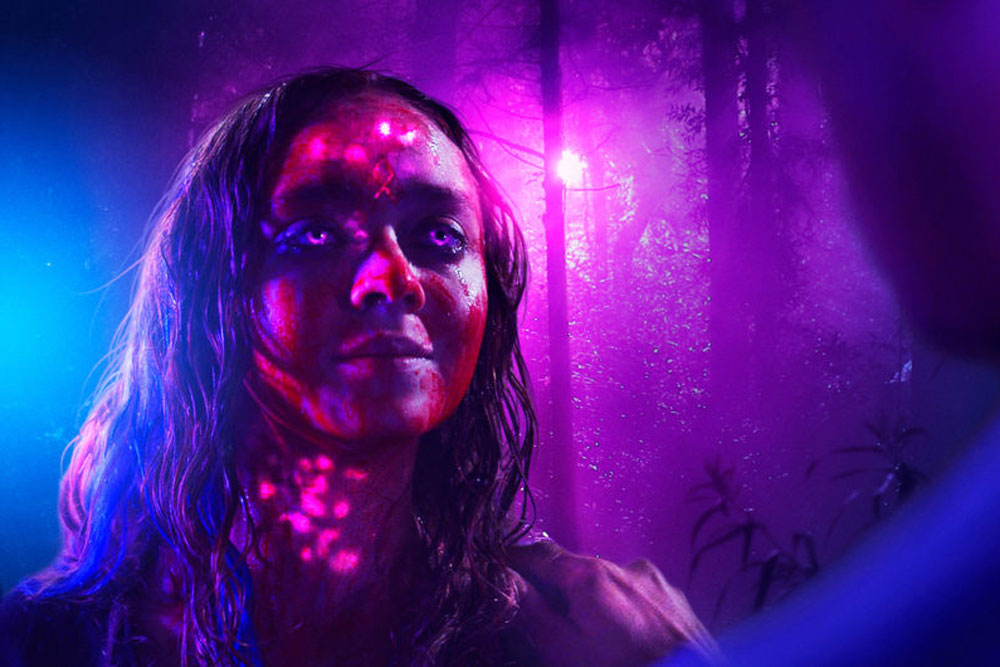
Similarly, The Color Out of Space (2019) presents a colour that fundamentally cannot be processed by human sensory organs or understood by human consciousness. Arriving by a meteorite, the colour infects and transforms everything it touches – warping plant life, distorting time and space, and gradually corrupting both the land and the minds of those exposed to it. Nearly a century after Lovecraft first imagined it, his description still resonates: “a frightful messenger from unformed realms of infinity beyond all Nature as we know it; from realms whose mere existence stuns the brain and numbs us”. That this concept – of something so alien it defies our most basic tools for understanding reality – remains deeply unsettling across generations speaks to universal anxieties about the limitations of human perception.
These films reveal how human perception and rationality are merely fragile constructs hiding incomprehensible cosmic truths. In doing so, they force their characters (and audiences) to grapple with the idea that all ways of experiencing reality are partial and limited. This realisation leads to something profound – if everyone’s way of perceiving the world is inherently limited, then no one way of experiencing reality can claim to be “right” or “normal” one. When cosmic horror shows us that even typical human senses and minds can’t fully grasp reality, it suggests that different ways of perceiving and processing the world aren’t deficits – they’re just different tools for understanding an infinitely complex universe. Rather than seeing some ways of experiencing reality as “normal” and others as “broken”, these stories hint at a world where all forms of perception have value
This cosmic perspective parallels an important evolution in disability discourse – from viewing physical, sensory, and neurological differences as problems to be fixed to questioning why society validates only some manifestations of humanity. When cosmic horror reveals the inadequacy of all human consciousness, it inadvertently argues for a more inclusive understanding of how we might navigate and interpret reality.
BEYOND THE METAPHOR
In coding physical, sensory, and neurological differences as alien, sci-fi horror exposes how deeply our culture privileges the “norm”. But at their most profound, these films demonstrate that there is no normal way of experiencing the world at all. These stories therefore hold radical potential to disrupt traditional views of disability as something “broken” to be fixed or cured rather than a valid form of human diversity. Instead, they show us powerful alternatives to non-disabled and neurotypical ways of being.
Yet, this potential remains largely unrealised, constrained by an industry where disabled and neurodivergent perspectives are rarely centred in storytelling. As the genre evolves, involving creators with lived experiences of neurodivergence, disability, and sensory differences will transform these metaphorical representations into more authentic and nuanced explorations of difference. Perhaps this is sci-fi horror’s most valuable contribution: not just revealing our fears, but showing us how those fears might be transformed into understanding.

 NightTide Magazine
Leave a comment