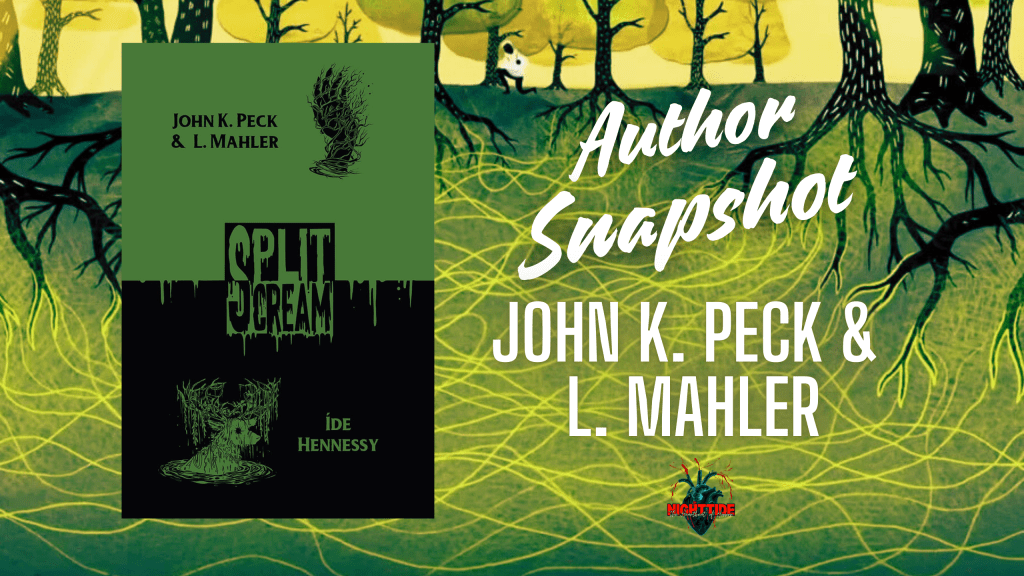
NightTide sits down with the authors of Evergreen for Split Scream Vol. 7 by Tenebrous Press.
“Twin Peaks + Longlegs + The Ruins. If you like two or more of those, you’ll probably dig it.”

John K. Peck is a Berlin-based writer and musician. His writing has appeared in a diverse range of journals including Interzone, Pyre, voidspace, Cosmic Horror Monthly, Cold Signal, McSweeney’s, Glasgow Review of Books, and Lost in Cult’s The Horror: Mansion. He is also the editor of Degraded Orbit, a website dedicated to unusual architecture, abandoned places, and underground writing and art.
Website: https://www.johnkpeck.com, Bluesky: https://bsky.app/profile/johnkpeck.bsky.social, Instagram: https://instagram.com/degradedorbit
L. Mahler is a designer and doctoral researcher specializing in cellulose-based origami structures and living design systems. Her academic writing has been published in various journals and conference proceedings, and her design works were recently featured at Dutch Design Week and Naturkundemuseum Bayern. She splits her time between Helsinki and Berlin, where her free hours are spent visiting the sauna and foraging for bast fibers.
Evergreen
Wrapping up the loose ends of her mother’s death, Deirdre makes a startling discovery: a tree growing in the closet of her childhood home, and a bizarre collection of knick-knacks buried in its soil. She soon learns that her mother had a hand in her hometown’s long history of odd disappearances and misfortune, and that this ominous tree is her legacy.
Nurturing the tree’s soil with filched mementos, Deirdre learns that she can control the vast system of roots thriving beneath the town to a terrifying degree, and she soon finds herself fighting her darkest desires to wreak terrible vengeance on the town that wronged her.
What was your first published work?
John Peck: My first published story was a slipstream cassette-futurist piece that appeared in Interzone in 2020, in one of the final issues edited by Andy Cox. I still love the story, but looking at it now it’s fairly downbeat and drags a bit, so I’m sure it was a hard sell for a first-time author. I’ll forever be grateful to Andy for taking a chance on it.
L. Mahler: My publication history is almost entirely academic, so this is actually my first real published fiction piece. As an undergrad, I studied writing and printmaking, and back then everybody had a little lit mag they sewed together in their downtime. We’d all print each other’s work, but I’m not sure that counts as officially publishing.
Is there a story inside that you have seeds of but can’t seem to connect that’s dying to get out?
J: Not just a story, but a whole world, a sort of “second world” that is both part of our world and not, at once stranger and more mundane. It’s got elements of crumbling post-Soviet Central Asia, as well as the wilds of rural Northern California. The closest equivalents would be the worlds of Nabokov’s Ada or perhaps Half-Life 2, the second half of which takes place in a dreamlike dystopian world that also resembles the Mendocino Coast.
L: There are a lot of things I come across in academic work that I tuck away for later. My field is design but also interdisciplinary, so the list is pretty eclectic: things like fractal symmetry, living materials, spacetime, and organism ecologies. I don’t think all those can fit in the same story, though maybe we’ll see.
How do you handle a rejected story?
J: Smile, shake it off, and submit two more. Eventually, the number of stories you have on sub will approach the infinite and it will be statistically impossible for them all to be rejected. Follow me for more useful writing tips!
What does literary success look like to you?
J: To me, success is sustainability. Rather than fame or fortune, my goal is to build a body of work within a community I can support and be supported by. That’s not to say the economic aspect can be ignored, though I don’t necessarily think that writers need to make their livings primarily by writing. I have great respect for those who do, but I also believe there can be benefits to keeping one’s day job and letting the writing remain separate.
L: This is a tough one to answer, but maybe I can broaden it a bit. Writerly success to me means looking both to the past and ahead: building on what has been done, while also pushing forward (or at least trying to) in innovative ways. This means that writing is also a process of constantly learning and growing, which is vital.
Do you read your book reviews? How do you deal with bad or good ones?
J: I’ve been in bands much longer than I’ve been a published writer, so I’ve developed a thick skin about reviews and generally avoid seeking them out. Good reviews are of course a pleasure, particularly if it feels like the reviewer truly engaged with the book. For bad reviews I use the corollary of the above: if they gave it a go but it wasn’t for them, fair enough; if they didn’t engage or generally just hate on the genre, fuck ’em.
L: Can I let you know in a few months?
What is the most difficult part of your artistic process?
J: My biggest challenge in writing is distraction. I’m easily distracted by not only the usual suspects like social media, but even by ideas for other stories. If I’m truly stuck on a story, I’ll outline, write, edit, and submit an entire other story to avoid working on it. I’ve developed a somewhat masochistic engine of self-motivation where I’ll force myself to focus and get work done by making a task I really don’t want to work on the only alternative. The worst task doesn’t get done, but in the meantime I’ve written two stories and cleaned half the house.
L: I tend to obsess about language to an absurd degree. While I have no trouble making notes or discussing what I want to say, when it comes to words on the page they have to be perfect. And actually, co-writing Evergreen with John helped a lot in this regard. The mechanics of collaboration didn’t allow for hours spent on a single sentence, and that is a very good thing.
As in most times, the truth is stranger than fiction, what has been the hardest scene or chapter you’ve had to write, if you were channeling personal experience?
J: Horror is the genre I’ve felt most at home in, though I came to it relatively late in life. I recently finished a novella that’s about not just phobias, but each person’s uniquely worst phobia made real, and of course each one I chose rang true in some way for me. I found it both difficult and also liberating to write through my own worst fears, and while it’s not necessarily curative, it can at least be cathartic in a way.
L: I would propose that writing fiction is more difficult than writing academically, so (for me, anyway) fiction is much stranger than the truth! Stranger because at any given moment, anything can happen. It’s a level of authorly responsibility that I occasionally find terrifying.
What inspired your latest work?
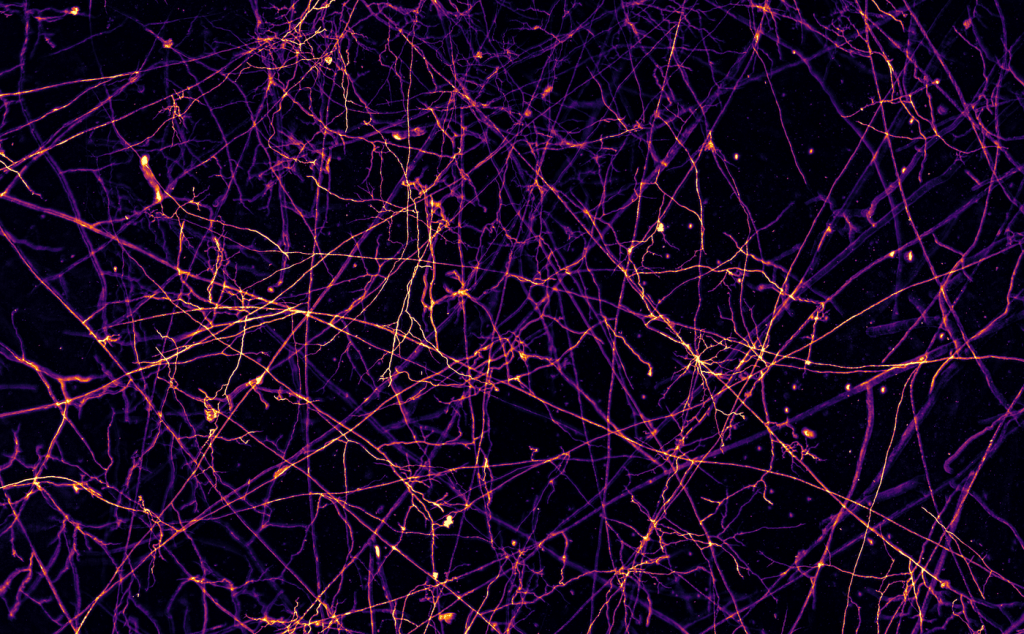
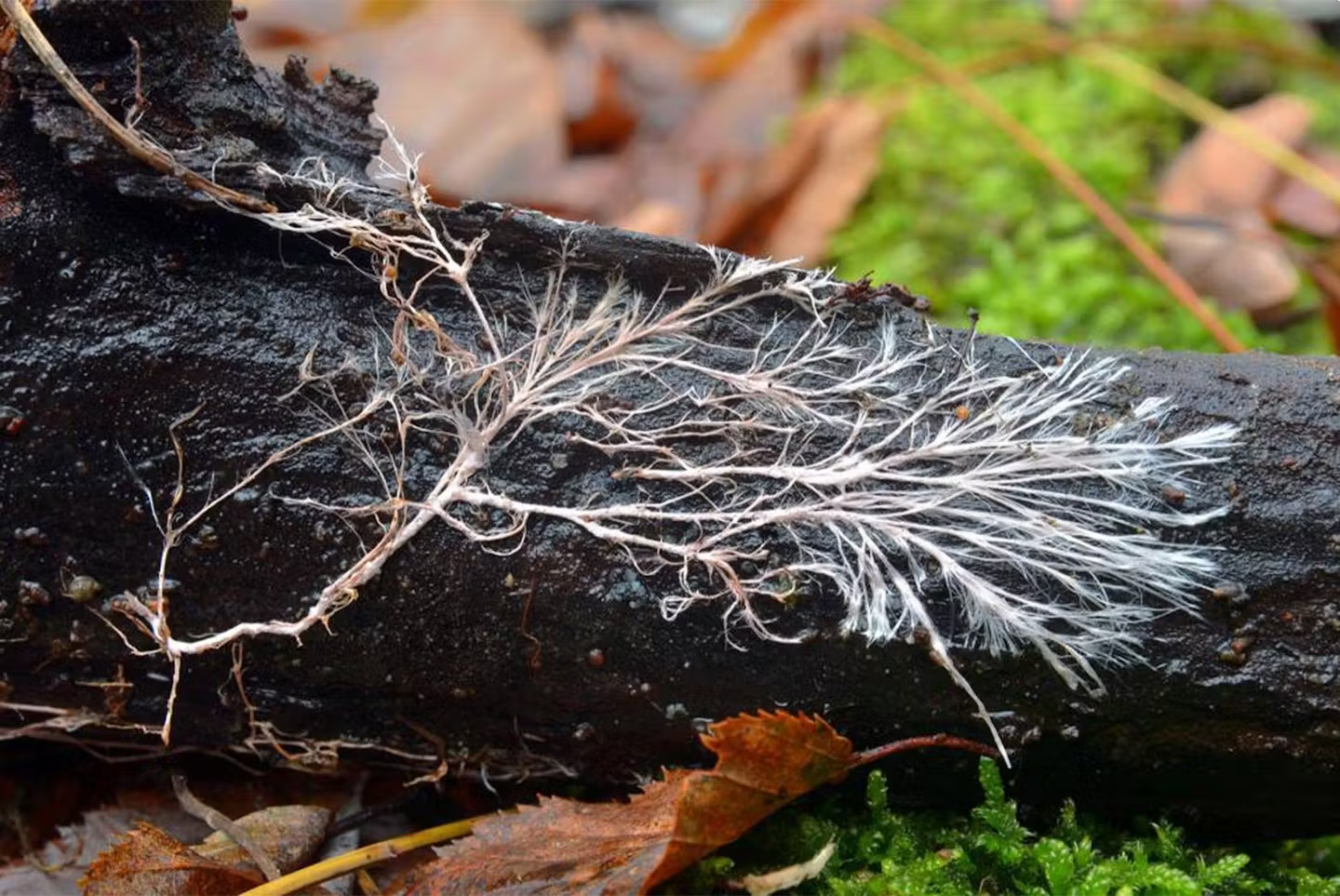
L: The story idea came from a laboratory residency I did in the Netherlands, where I was part of a team working with mycelium to grow three-dimensional tessellated structures. Long days in the lab got me thinking about the capabilities of fungal networks, which was the germ around which the story grew. The structure followed the concept pretty quickly. John and I both grew up in northern California, so we had a strong shared vision of the isolated forest town and its inhabitants. From there we each wrote specific sections, then edited and revised each other’s work.
If you could tell your younger writing self anything, what would it be?
J: You will have endless ideas and be overwhelmed by them, so take them one at a time and write it out to the end. You’ll write far more beginnings than endings, but it’s the work you do after the initial idea that makes you a writer.
L: Be confident in developing your own voice. Take risks, but make them educated risks.
Best advice you’ve ever gotten from a fellow writer?
J: Not so much advice as just a really honest statement, from a writer who I’ll let remain anonymous: “I feel least like a writer when I’m writing.” On its face it sounds negative, but I think it’s a refreshingly honest statement from someone who, at least in my mind, had “made it”: that they (and by extension I) didn’t need to feel inspired or confident when writing, they just had to sit down and do it. When that feeling is there it’s great, but the point is to write through the times when it isn’t.
L: A close mentor of mine always said that reading is the best thing a writer can do (next to writing, of course).
What is your go-to comfort horror/Sci-Fi book?
J: I have a shelf of mass-market sci-fi classics I always grab from when I need a palate cleanser between heavier fare – some Asimov, Poul Anderson, Jack Vance. Not that they aren’t great and often heavy hitters themselves, but I find mass-market paperbacks somehow comforting; the book equivalent of a quick, easy favorite meal. Something about the smaller format, cheaper paper, and semi-disposability of them makes them lower-stakes than a pristine new hardcover. When I worked at a bookstore I managed to rescue the occasional mass-market paperback that had its cover torn off, lowering the stakes even further. I guess the culinary equivalent at that point would be dumpster diving.
L: When I was a little kid, I used to devour Stephen King novels. This might sound bizarre, but as I got older I found a similar joy in reading Gogol, Kharms, and other surrealists. Though they aren’t strictly horror, they combine truly horrific elements with a relentless mundanity that I find fascinating. I still love curling up with Dead Souls on a cold winter night.
If you were to genre-hop, which genres would you most like to try writing?
J: Since character development is (at least for me) one of the hardest yet most important parts of writing, I find creating new characters especially draining – like each one takes a little piece of your soul to bring it to life. I’d love to write a series of connected stories with a recurring protagonist, and go “hard genre”: solving paranormal mysteries, hunting art thieves, something like that. They’d be published as mass-market paperbacks only so booksellers could fish them out of dumpsters when they wanted a fun read.
L: Rather than hop, I think I would hyper-specialize. I knew someone who wrote only “restoration horror”, which she defined as supernatural happenings that take place exclusively in old houses during renovation. So perhaps I would only write forest horror from a mycelial perspective…
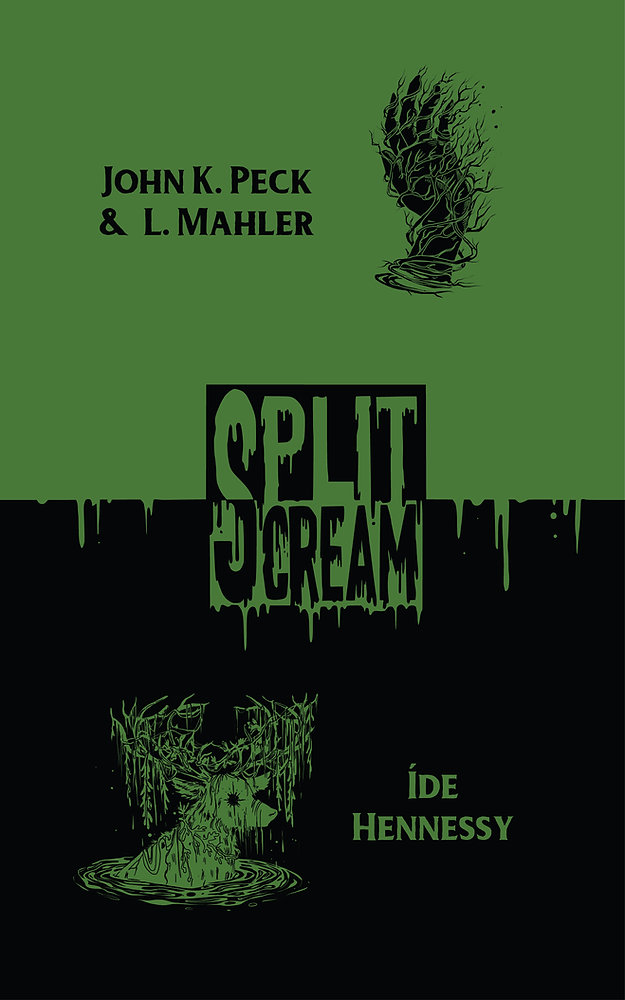
Split Scream Vol. 7 can be pre-ordered here!
Stay tuned as we chat with Ide Hennesey for Part 2 of Split Scream Madness!!
![[REVIEW] SPLIT SCREAM VOLUME 7: OFF THE MAP • DIS/MEMBER Avatar](https://www.dis-member.com/wp-content/uploads/2025/01/1-e1736119758457.png?w=48)
 NightTide Magazine
Leave a comment