
By Caroline Miller
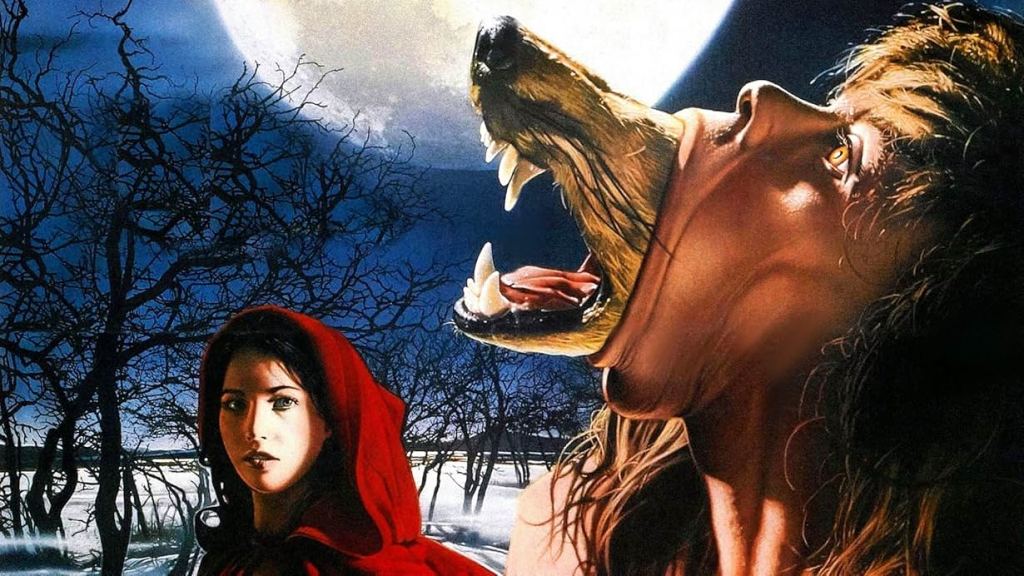
For a lot of us, our introduction to horror is very early. We’re barely old enough to walk, but our parents are telling us stories of little children getting baked into pies by a witch, or living cookies getting chased by hungry mouths, or poor orphans being forced to toil by their evil stepmothers. The fairy tales we know and love started out as cautionary tales, but later on developed new meanings to more modern audiences. Neil Jordan’s 1984 film, The Company of Wolves, brings some of those origins back in more ways than one, and what results is a shockingly gothic tale.
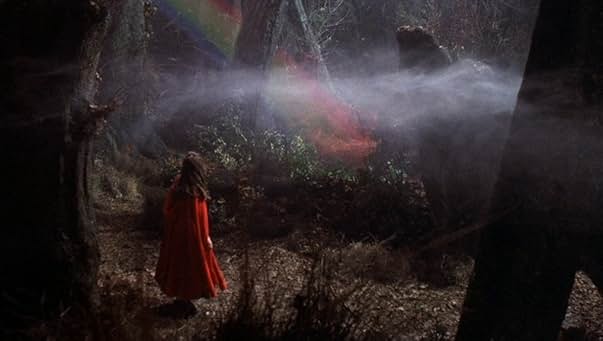
The Company of Wolves first came to be from a short story of the same name, initially featured in “The Bloody Chamber” short story collection by Angela Carter. Carter initially adapted the story into radio, and then co-wrote the film script with Jordan. The film follows a young girl, Rosaleen (Sarah Patterson), who dreams of herself in a living fairytale world. After the death of her sister, she stays with her grandmother (Angela Lansbury), who knits her a red shawl and warns her about the dangers of the world.
“Never stray from the path, never eat a windfall apple, and never trust a man whose eyebrows meet.”
As you can probably guess, this is gearing up to be a retelling of Little Red Riding Hood. We all know that famous story, I’m sure. Little Red Riding Hood sets off to her grandma’s house, runs into the wolf, foolishly tells him of where she’s going before they part ways. The wolf uses this information to trick the poor girl and devour her and her granny. The initial story ends there, though modern interpretations add in a wood cutter who kills the wolf and frees poor Red and Granny from the wolf’s stomach. This is to ease the dark narrative for young audiences, but the message still holds its ground. Beware of what you share with strangers, for there are wolves hiding everywhere.
“Little Red Riding Hood” has been told and retold with darker, more adult themes. But how does one make the tale specifically gothic, and how did Carter and Jordan pull it off?
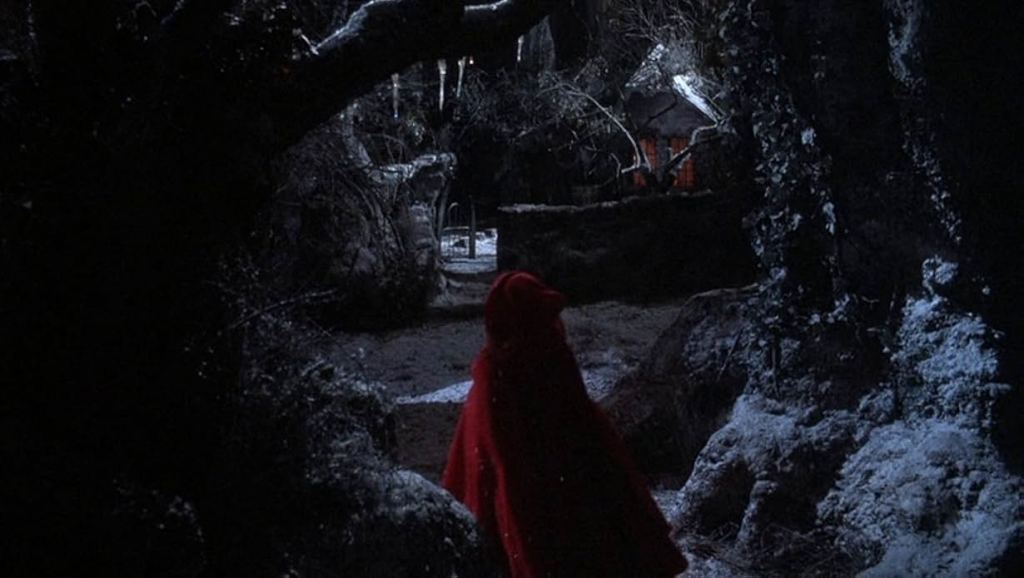
“Gothic” is a very layered label. Initially conceived to describe a type of architecture, which became the backdrop of various notable stories. Those old structures represented days long past, even in those initial stories that set the foundation of the genre. This leads to themes of grief of the past, and the decay of the present, being popular settings of gothic fiction.
The Company of Wolves has a gothic setting right from the beginning. The dreaming Rosaleen sleeps in a house that has certainly seen better days. She is surrounded by toys that become increasingly sinister and rotten as the film progresses. Her dream starts with her sister, who is attacked by those very toys, now large and filthy. After the toys slow her down, she is cornered and killed by the wolves.
The village Rosaleen inhabits in her dreams is presented as tiny, with a very small community. Surrounding that village is a thick, dreary, and cold forest that comes to life with wolf cries during the night. The nostalgia and comfort of childhood and fairytales clash with the tense threat of the wilds, the dread of mortality. Perhaps once upon a time, maybe in the spring, this village was bright and happy and full of life. But it is now fall, and later winter, and the world is in mourning in more ways than one.
But there is more to a gothic tale than its setting alone. A common feature of these stories is the threat of paranormal forces, which certainly come into play here. You see things like a living fur stole and eggs that hatch, crying stone children. Neither of these is questioned when the characters interact with them. However, wolves running around in disguise are apparently a new discovery for the village.
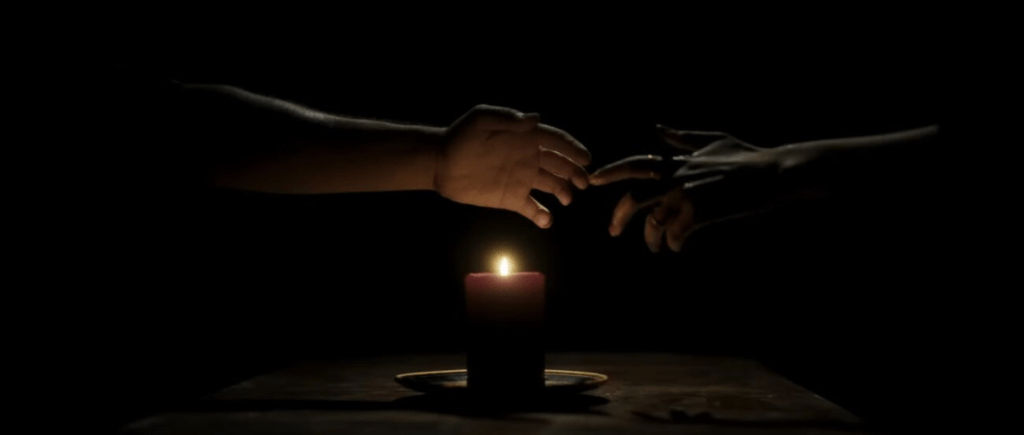
Rosaleen’s father joins the local men to hunt the killer wolf that has been killing cattle. When he returns home from the hunt, he’s shaken and weary. The father shows them a human hand wrapped in a cloth, swearing that what they caught was a wolf, but it turned into a man once they killed it. Rosaleen’s reactions to this news are especially noteworthy. She asks her father if he recognized the wolf in its man form, she asks if it was a wolf or man, and she attempts to touch it. Her mother manages to pull her back just in time, but this doesn’t stop her from studying it from after her father throws it into the fire.
Rosaleen’s actions in this scene are a prime example of The Company of Wolves at its most gothic. Out of all the elements that can put a story under this label, the setting, the tone, the paranormal, it is the way that the darkness is embraced that ultimately makes it so. None of the characters look the darkness head on quite like Rosaleen, and it is she who makes this film as gothic as it is.
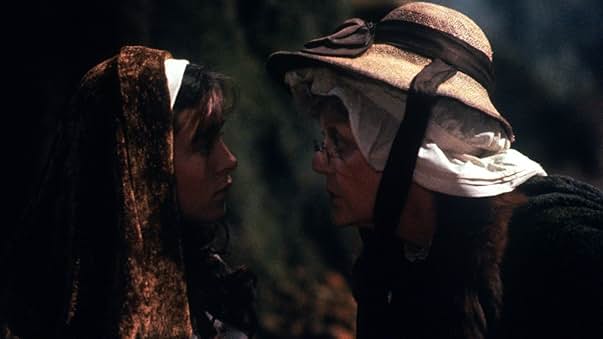
Unlike the original Red Riding Hood, Rosaleen is no naïve little girl, and her perspective of the world differs greatly from that of her elders. We see this throughout the film, starting from the way she coldly watches her sister’s coffin getting covered with dirt. When Granny tells the first story to Rosaleen, which ends with a woman being hit by her husband, her initial reaction is that she would never let a man strike her. Rosaleen continues to grow even bolder, and braver, despite her village growing ever cautious of wolves. She is unbothered by spiders, flirts back with a young boy (Shane Johnstone) who was previously scared away by Granny, ventures up a tree to make a new discovery, and eventually even takes up the mantle of storyteller.
Granny tells Rosaleen stories of men turning into animals to gobble up women, or getting consumed by the forest after making a deal with the devil. In comparison, Rosaleen’s stories portray not only the woods, but the wolves, in a more positive light. The first story she tells is about a woman who curses an upper-class party, it ends with her rocking her baby to sleep with the wolves serenading her. This story is of a lighter tone, vastly different from the second (and final) tale of the film. But that story is told when Rosaleen is put to the ultimate test.
The final act of the film is where it fully embraces the Little Red Riding Hood retelling. Rosaleen heads off to visit Granny, but comes across a strange huntsman (Micha Bergese) dressed in regal clothing. The man clearly is up to no good, but Rosaleen is all by herself in the woods, unable to get help without risk. Unlike her sister, who at the beginning of the film fled and was consumed, Rosaleen instead matches the energy of the stranger.
I must give a lot of credit to Sarah Patterson, who gives a stellar performance with Rosaleen all through to the finale. Rosaleen is visibly uncomfortable with the situation, she knows fully of the danger she’s in. But instead of giving in to her fear and running, she remains calm, answers back to the stranger in conversation, and thus stays alive. She even gets brave at times, flirting back with the stranger, challenging him and his capabilities. This is what sets things in motion for the Red Riding Hood plotline, the stranger challenges Rosaleen to a race back to Granny’s house, and you can imagine how things go from there.
When Rosaleen finally makes it to Granny’s cottage, she continues to stand her ground against the wolf, even when she sees evidence of Granny’s demise. Eventually, Rosaleen gets the upper hand and sees the wolf in his most primal form. But rather than running and screaming from the horrors in front of her, she weeps.
“I’m sorry,” she says with tears in her eyes. “I didn’t know a wolf could cry.”
Rosaleen tells her final story to the wolf to comfort him. The story follows a she-wolf, who gets injured, then finds solace with a priest. Like her previous story, Rosaleen does not show the wolves in a villainous light. The she-wolf is in now way sinister, but is instead “just a girl, who strayed from the path in the forest, and remembered what she’d found there.” With the visuals of a white flower turning red, it’s clear what we’re meant to interpret here. The she-wolf is a survivor, through sexual assault, or an attack, and now walks the world forever judged by her community.

This story gives us the full window into Rosaleen’s journey, and how she cements The Company of Wolves as a gothic tale. Throughout the film, all she’s seen, witnessed, and experienced, Rosaleen never loses control of herself and her view of the world. Even if the other members of the village raise up their weapons against the wolves, she never once doubts that they are living creatures that breathe and think and love. Even if the woods hold terrifying creatures, she doesn’t hesitate to run off the path, climb trees, and view the moon. When there are wolves prowling about outside, Rosaleen tells stories of wolves to care for children. Even when she is face-to-face with a creature she has been taught to fear, she sits next to it, cries for it, and comforts it.
A big, defining trait of Gothic storytelling is finding the beauty in that darkness. A dilapidated church, overgrown with weeds and unkept graves, can still have butterflies and a sleeping fawn from time to time. You could say the same with a forest full of wolves, still living creatures that run and play when they get the chance. Rosaleen, unlike the other members of her village, has the ability to see that. She sees a wolf, one who had just committed a murder even, and still manages to see a creature that can cry like any human being. She sits with it, pets it, and tells it a story of a beast just like it finding the love and support every creature wants.
This, of course, leads to the film’s ending, where Rosaleen fully crosses over into that dark world. Forever changed, she can never be seen under the same light to her family and friends. It’s not a happy ending, unfortunately. There is no scene where Rosaleen stands up against this fairytale societal system. Instead, like the she-wolf, she goes into the forest that she loves. The Company of Wolves is a film under the disguise of a cautionary fairy tale. But when that disguise is pulled away, you see a story of a girl exploring the world around her. That world she lives in is very polarized, reclusive, hidden away in a dark and cramped forest. She sees the beauty in the decayed, the reviled, and the feared. Rather than run from it, she embraces it, and eventually becomes one with it. A true Gothic fairytale.



 NightTide Magazine
Leave a comment