By Cullen Wade

Asbury Park, New Jersey, topped both Thrillist and Newsweek’s recent lists of the best U.S. beach towns. Asbury Park also had a 2022 poverty rate of nearly 20%—over 8% higher than the national one. Year-round residents of seaside towns do not always share in the tourists’ carefree opulence. Anyone who has been oceanside in the winter knows about the windswept loneliness of an off-season beach. It’s a splendid example of the eerie as defined by Mark Fisher—the absence of something that should be present, but enhanced because it underscores inequities of commerce. What’s even more eerie and distressing, then, is an empty beach in the summertime. The absence echoes louder—the tourists haven’t just left for the season, they’ve gone forever, and taken the promise of pleasure with them. It’s a hollowness that reverberates across two micro-budget nightmare logic horror films, made a dozen years apart, that feature solitary women in unfamiliar places, menaced by vaguely inhuman hordes, uncaring locals, and men who won’t take no for an answer.
In 1962’s Carnival of Souls, protagonist, Mary, travels to Salt Lake City for a job as a church organist. Passing a defunct tourist attraction, she becomes captivated by a decaying pavilion on the dried-up lake. Haunted by visions of a pale-faced man and periodic disconnection from reality, she ends up returning to the pavilion to confront whatever seems to be drawing her there.
1974’s Messiah of Evil follows a young woman named Arletty to the coastal California town of Point Dume in search of her reclusive artist father. Instead of dad, she finds insular townsfolk fond of raw meat, who whisper about the coming of a dark stranger and an impending “blood moon.” Increasingly strange happenings culminate in a beachside chase and a trauma that lands Arletty in a psychiatric hospital.
Apparently, Messiah of Evil’s makers, Willard Huyck and Gloria Katz, claim not to have seen Carnival of Souls before making their film. Perhaps it’s surprising, then, how many details the films share. Both seem preoccupied with all things automotive, haunted by the ubiquity of commercial art, wary of bodies of water, and skeptical about the allure of the American West. All these details aggregate into pointed audits of just what was sacrificed at the American midcentury cathedral of progress.
Both films open with death by the water. Carnival’s Mary is in a car with two other women when the driver is goaded into a drag race by a group of young men. The men deliberately crowd the women off a bridge, killing them in a plunge into the river below. Messiah of Evil’s opening shows a man fleeing an unseen pursuer down a residential street. A young girl offers him refuge in her swimming pool patio but slits his throat once he lets his guard down. Both opening scenes hit the same notes: leisure activities—afternoon drives and swimming pools—gone wrong; violence by seemingly normal neighbors; watery graves.


Within a few minutes, both protagonists are alone in cars en route to destinations in the American West. Messiah’s Arletty stops at a gas station, where she encounters a strange, tall man with a truck that appears to be full of corpses. After Arletty leaves, an assailant murders the gas station attendant, and his bloodied body is hoisted on the mechanic’s lift. Carnival of Souls has its own gas station scene late in the film, also involving a mechanic’s lift. Mary refuses to leave her car while it’s being worked on, and while on the lift, she dreams of being pursued through town by the pale man and his ghouls.
The sleek, streamlined midcentury American gas station is emblematic of the era’s techno-optimism. “Lots of them featured superfluous central towers ringed with those strange radiator flanges that were a signature motif of the style,” William Gibson writes in “The Gernsback Continuum,” “as though they might generate potent bursts of raw technological enthusiasm. Pop artist Ed Ruscha made a name for himself painting the gas stations of the American West in a bold, minimalist style evocative of commercial art. Messiah of Evil acknowledges its debt to pop art with the interior of Arletty’s painter dad’s house, which he has covered with murals that echo Ruscha’s style—all sharp diagonals and well-dressed men right out of magazine ads. The largest mural suggests an empty beachside boardwalk.

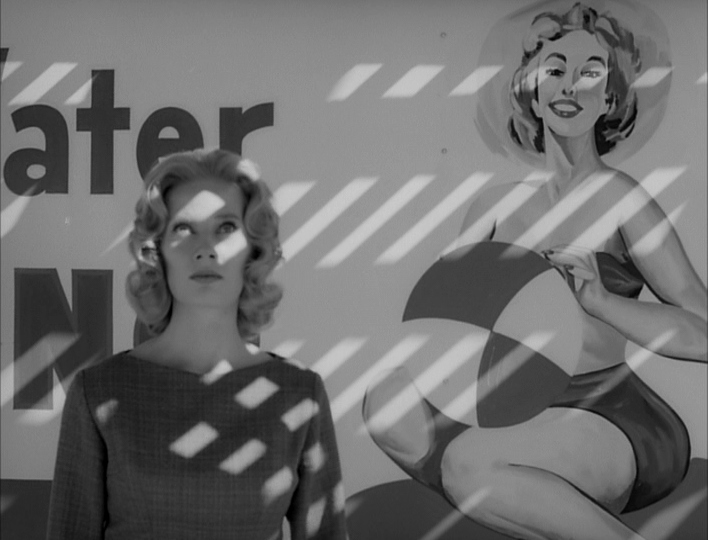
Carnival of Souls is also interested in commercial art intruding on private moments. In the garage scene, a radio show advertisement hangs nearby, and as the car rises on the lift, the broadcaster’s portrait draws level with Mary’s head, his illustrated eyes gazing through the windshield. In another key scene, while exploring the abandoned pavilion, Mary pauses beside an ad for the swimming facilities. Framed next to a smiling painted woman in a two-piece swimsuit, Mary, with her heavy tweed dress and haunted eyes, is juxtaposed with the idealized bathing beauty, holding a beach ball and staring into a future that never arrived.
The Saltair Pavilion was built in 1893 by the Mormon church. By the nineteenth century, lounging and socializing at “watering places” was well-established as a pastime for the wealthy, but the middle class did not get in on the act until the spread of railroads and the custom of paid vacation time made recreational outdoor swimming accessible and popular. Saltair was built atop stilts sunk beneath the Great Salt Lake and floated above the water like a fantasy Arabian palace or a reverse oasis. It boasted the world’s largest dance floor, and enjoyed a reputation as the “Coney Island of the West.” The whole thing burned down in 1925 and was rebuilt in the same spot. While they were at it, they should have chosen a new location further offshore, because the lake waters receded, leaving the pavilion crouching on thousands of insect legs above a barren salt flat. The untenable position of being a lake resort without a lake forced Saltair to shutter in the late 1950s. There it waited, rotting, for Carnival of Souls director Herk Harvey to glimpse it on a twilight drive and be struck by inspiration.
“If the cities of the world were destroyed tomorrow,” narrates Arletty’s father in Messiah of Evil, “they would all be rebuilt to look like Point Dume.” Unlike Saltair, Point Dume is not a real place, and according to locals in the film, it’s neither an artist colony nor a tourist town. So what is it? To put it simply, it’s America. As the story goes, a hundred years ago, a preacher descended from the mountains, saying he had traveled with the Donner Party. He was spreading a “new religion,” and walked into the sea with a promise to return in a century, “to a world tired and disillusioned.”
By mentioning the Donner Party, Messiah of Evil evokes the perils of American westward expansion. The automotive imagery in both films tells the same tale: the personal vehicle still carries the glamor of the freedom it was supposed to afford post-industrial America. But as Mary and Arletty both find out, once you reach your destination, you might not like what you find. The alluring images of advertising—the radio man, the happy consumers, the beach bunny—are lies.
The second time we see the tall trucker from Messiah of Evil’s gas station, the people in his truck seem motionless but alive, pale-faced and staring skyward, and the man says they are coming from an oceanside ritual called “the waiting.” They are waiting, of course, for the dark stranger to return from the sea. The world is now “tired and disillusioned” enough to welcome the coming of a charismatic sadist with a promise of transformation. He might lead them into carnage, but at least they’ll be going somewhere.
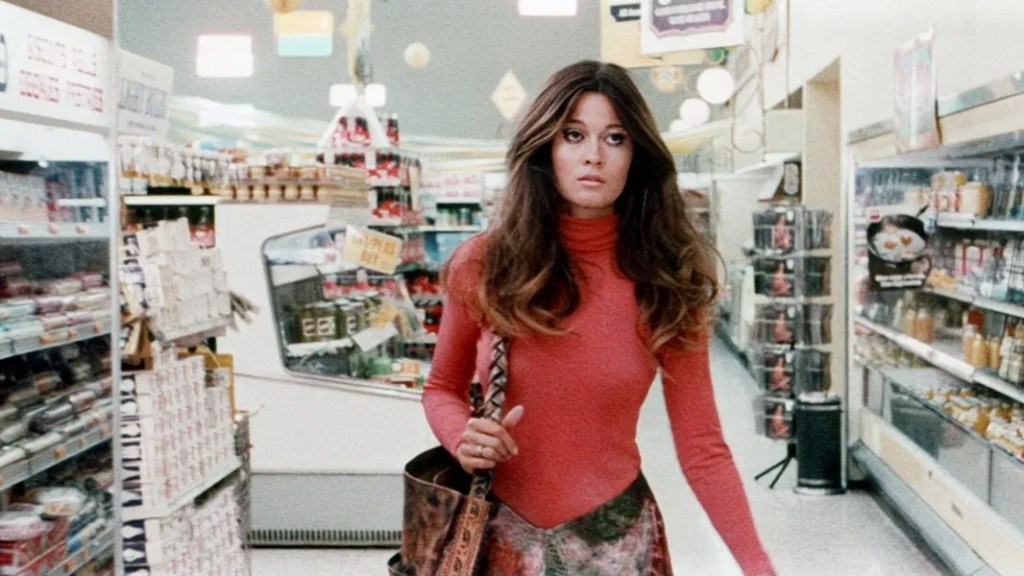
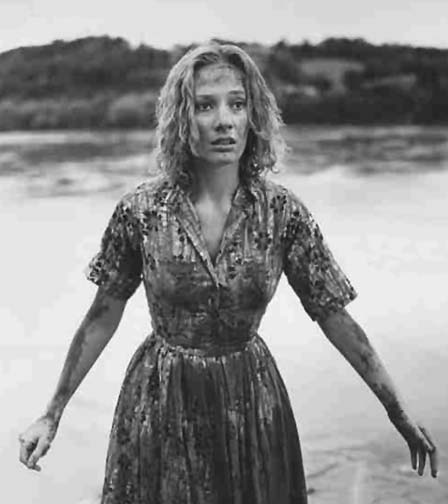
Arletty and Mary are both tired and disillusioned, too, and with good reason. They have been traumatized by callous male behavior—flippantly homicidal drivers, abandoning fathers—and surrounded by men determined to neuter their agency. Both films exist in worlds bled of their trust by repeated failings of the American promise. The teasing boys will try to run you off the road, your friendly neighbor just wants to get in your pants, the townsfolk are not what they seem, and that innocent girl by the pool might just slash you with a razor.
In Messiah of Evil’s climax, the zombified locals chase Arletty up the empty beach. In Carnival of Souls, the ghouls pursue Mary through the abandoned pavilion’s grounds. Both women’s stories end in the darkness underneath pylons—Arletty beneath a fishing pier, and Mary under Saltair itself. When is a beach no longer a beach? When the water or the goodwill dries up, what takes its place, in the blackness beneath the sun-washed structure, is death.



 NightTide Magazine
Leave a comment