
By Mo Moshaty

NightTide has always been built with intention, but it’s also been built slowly, carefully, and very honestly. This magazine didn’t come from a business plan or a rush to scale. It came from conversations, from frustration, from love of horror, and from wanting to make space where space wasn’t being made.
As the site has grown, something really clear started to happen: the writers who kept showing up, who kept getting what NightTide was about, who kept writing with care and thought and heart, were already shaping the magazine. It just felt right to name that.
So this isn’t a pivot or a rebrand or anything dramatic.
It’s just us growing up a little.
NightTide is still 100% woman of color-led. That hasn’t changed, and it isn’t changing. What has changed is that I’m no longer pretending I can or should do everything alone. Don’t get me wrong, I’m still the only muchacha handling pitches, so thank you in advance for your patience!
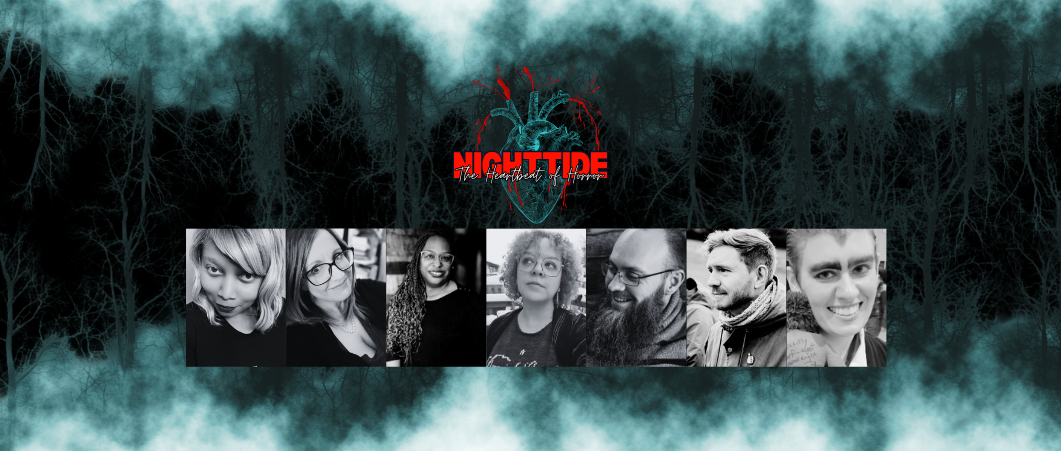
The people you’ve been reading, returning to, and trusting are now officially part of the structure that helps guide where we go next.
And honestly? That feels really good.
Why a Staff, and Why Now?
Sustainability.
I wanted NightTide to be a place where writers weren’t just dropping in and disappearing, but could return to ideas, build on conversations, and feel like they were part of something ongoing. I also wanted to be transparent about labor, roles, and expectations, especially in a genre space that too often runs on unpaid or invisible work, NightTide included…again, one muchacha with one job and no sponsors.
This staff structure is about:
- Consistency
- Care
- Trust
- And doing the best we can with the resources we actually have
The people below were already doing this work. Now we’re just saying it out loud.
The NightTide Crew
Sharai Bohannon – Head Writer

I’ve known Sharai for many years, and her voice has been part of my horror world for just as long. Long before her NightTide titles entered the picture, she was already someone I trusted to see the genre clearly, to name what was happening inside it, and to say the things that needed saying without apology.
Sharai is the podcaster behind Blerdy Massacre and A Nightmare on Fierce Street. She’s someone who understands horror as a living conversation; one shaped by culture, history, power, and the people who are constantly being pushed to the margins of it. She doesn’t write from the sidelines. She writes from inside the genre, with full knowledge of its contradictions, its failures, and its potential.
What sets Sharai apart is how deeply she understands what horror can hold. She doesn’t dilute her thinking or soften her voice. She brings conviction and an unshakeable sense of purpose to her work, and she carries NightTide’s mission naturally because it already aligns with how she moves through the world.
As Head Writer, Sharai helps anchor the magazine’s voice because she already embodies it. There was never a question about who this role belonged to.
Read Sharai’s work: SHE NEVER DIED: The Most Promising Movie We Don’t Talk About Enough, FAMILY, SNAKES, AND MOTHER OF FLIES: AN INTERVIEW WITH FILMMAKER TOBY POSER
Cullen Wade – Morbid Minds & Sinister Screen

Cullen is a writer who follows ideas all the way down. His work at NightTide has explored disability and eugenics in horror, the policing of women’s interior lives, the strange logic of slasher violence, and the unsettling emotional geometry of horror spaces.
What connects all of it is his interest in how horror thinks. Cullen doesn’t write to flatten films into arguments or hot takes. He writes to understand what they’re doing beneath the surface, how power, fear, and control move through the genre, and why that matters.
He works from NightTide’s mission instinctively. His allyship is deliberate, his criticism knows when to push and when to listen, and his writing consistently enters conversations with purpose. He’s also the author of Splasher Flicks and the Secret Life of Horror Ghouls, which reflects the same curiosity and attention he brings to his work here.
Read Cullen’s work: IRONIC INSANITY AND UNFAMILIAR GEOMETRICS IN TOBE HOOPER’S “APARTMENT TRILOGY.”, CARNIVAL OF SOULS, MESSIAH OF EVIL, AND THE NIGHTMARE OF AN EMPTY BEACH
R. J. Joseph – Morbid Minds

Rhonda Jackson (RJ) Joseph is exactly the kind of writer Morbid Minds was created to hold.
She’s an award-winning, Shirley Jackson and Stoker Award–nominated writer, speaker, and editor whose work examines race, gender, and class in horror and popular culture with focus and precision. Rhonda doesn’t enter conversations casually. She knows the frameworks she’s working within, understands the histories behind them, and writes with a clear sense of responsibility to the subject matter.
Her NightTide essay, “Adapting the Master’s Tools to Dismantle the Master’s House,” is a strong example of her approach to criticism. It’s deliberate, specific, and deeply engaged with the cultural work horror is doing, especially when it comes to power and representation. Her writing fits naturally within Morbid Minds because it’s exactly the kind of academic-leaning, theory-forward work the section was designed to make space for.
Beyond NightTide, Rhonda teaches at The Speculative Fiction Academy, co-hosts the Genre Blackademic podcast, and has been working editorially with Raw Dog Screaming Press on their novella line Selected Papers from the Consortium for the Study of Anomalous Phenomena. Her presence in Morbid Minds strengthens the section through depth, context, and intellectual seriousness.
Read Rhonda’s work: ADAPTING THE MASTER’S TOOLS TO DISMANTLE THE MASTER’S HOUSE
Elizabeth Broadbent – Stranger Than Fiction

Elizabeth Broadbent brings an exacting, thoughtful voice to Stranger Than Fiction, rooted in her long engagement with literature, history, and storytelling as lived experience. Her work moves beyond surface tropes and into the emotional and cultural logics that make horror meaningful, not just frightening.
She’s the author of Blood Cypress, Ink Vine, and Ninety-Eight Sabers, with Ink Vine and Other Swamp Stories on the way in early 2026. Her nonfiction and criticism have appeared in outlets such as The Washington Post, Time, Insider, ADDitude Magazine, and Nightmare Magazine, and she’s been featured on BBC World News and NPR’s All Things Considered.
At NightTide, Elizabeth’s writing, including essays like So Much Blood in This Earth: Generational Trauma in Southern Gothic — demonstrates how horror can articulate the narratives that shape both culture and self. Her work reads how stories continue to operate, how they intersect with place and memory, and how writers engage those forces without reducing them to caricature, and does so with intentional allyship; attentive to who has been excluded from these narratives and how horror can be used to make those absences visible.
Elizabeth approaches Stranger Than Fiction with a clear command of subject and context, and her curiosity consistently brings depth and precision to the authors and texts she explores.
Read Elizabeth’s work: SO MUCH BLOOD IN THIS EARTH: GENERATIONAL TRAUMA IN SOUTHERN GOTHIC
Emma Cole – Morbid Minds & Sinister Screen

Emma Cole writes about horror with an attentiveness that feels genuinely caring. Her work takes time with films, moods, and emotional undercurrents, especially where fear intersects with intimacy, desire, and connection.
She’s an editor at MIRA Books and the author of Love Never Dies: Romance in Horror Movies (2026), and her writing reflects a deep interest in how horror and romance speak to one another across both film and literature. Rather than treating those genres as opposites, Emma understands how closely they’re intertwined, and how much they rely on vulnerability, tension, and feeling.
At NightTide, Emma’s work moves easily between Morbid Minds and Sinister Screen. Her essays pay close attention to atmosphere and psychology, often lingering in the moments where meaning gathers. She brings warmth to her criticism without losing insight, and her writing always feels grounded in genuine engagement with the work on screen.
Emma’s presence adds an important emotional texture to NightTide, and we’re really glad to have her voice as part of where the magazine is headed.
Read Emma’s work: TRANSFORMATION AND MOTHERHOOD IN ROSEMARY’S BABY AND THE OMEN, ROMANCE AND DETACHMENT IN DAVID CRONENBERG’S EARLY WORK
Paul Wooldridge – Sinister Screen

Paul Wooldridge brings a genuine love of horror to Sinister Screen, the kind that comes from long engagement rather than surface fandom. His writing pays attention to how films work, their rhythms, their imagery, the moments that stay with you, and why they stay with us decades later.
A Black Country–based writer, printmaker, and podcast host, Paul is also one half of The Yammityville Horror Pod, where he digs into the best horror available on streaming with curiosity and enthusiasm. That same energy carries through his writing for NightTide. Whether he’s exploring the power of a great opening scene, revisiting Day of the Dead on its 40th anniversary, or thinking through how horror behaves in daylight, his work is inviting, thoughtful, and rooted in real affection for the genre.
Paul also brings a maker’s eye to his criticism. His background as a printmaker sharpens his approach to visual language, texture, and composition, and gives his writing a tactile, grounded quality that feels distinctly his.
Paul’s voice adds momentum and accessibility to Sinister Screen, drawing readers in and keeping them there.
Read Paul’s work: DAY OF THE DEAD (1985) 40TH ANNIVERSARY: THE POWER OF POPULIST GORE CINEMA, SUNSHINE HORROR: BRINGING HORROR INTO THE LIGHT OF DAY
Ray Walton – Resident Curator, Dark Days with Ray Walton

Ray Walton curates Dark Days with a really strong sense of taste and intention. The series comes from how Ray actually watches horror, dark cinema, and thrillers: paying attention to mood, emotional pressure, and the kinds of films that get under your skin without needing to shout about it.
Dark Days is about films that sit with discomfort, isolation, and interior experience. Ray’s writing doesn’t overexplain or flatten the work into themes. It trusts the films, trusts the audience, and lets the tension do what it’s meant to do. That approach has made Dark Days one of the most distinctive things NightTide does.
Ray is a neurodivergent film writer and curator, and their lived experience shapes how they think about horror and why it resonates. Their work understands horror as something people use to process feelings and internal states, not just something to rate or rank.
Ray brings a perspective to NightTide that’s thoughtful without being precious or being stiff, and Dark Days reflects that every step of the way.
Explore Dark Days with Ray Walton: DARK DAYS WITH RAY WALTON NIGHT 14: THE MUMMY (1959), DARK DAYS WITH RAY WALTON NIGHT 2: THE SERVANT (1963)
Where This Leaves Us
I built NightTide from the ground up. On my couch in 2023, and in my head in 2022.
I put the call out. I emailed people directly. I reached into my own community and asked writers I trusted to come build something with me. From the start, I knew what I didn’t want this magazine to be. I didn’t want a constant news churn. I didn’t want to be racing to cover every horror headline or feeling pressure to be first, loudest, or most clickable. Plenty of outlets already do that well. You don’t need that from me.
What I wanted was a place where people could slow down. A place where writers could return to ideas, think deeply, and treat horror as more than content. I wanted NightTide to be a home for academic thinking, analytical writing, and long-form engagement with horror as a social mirror, without sensationalism, without trend-chasing, without needing to be “on the pulse” every second.
That vision is what shaped Morbid Minds, Sinister Screen, Stranger Than Fiction, Dark Days, and everything else NightTide has become. And it’s what’s allowed the magazine to grow into something that feels steady, thoughtful, and intentional.
I couldn’t have done this without the contributors. Their work is the magazine. Always has been. But this moment, this staff structure, this next step, feels like NightTide moving into a new tier. One where it’s clearly a home for thought leaders. A home for horror celebration, horror criticism, and horror identity. A place where writers aren’t just passing through, but helping shape the conversations we’re known for. Please note: we’re still open to those interested in working with us; that doesn’t change.
I’m incredibly proud of what NightTide has grown into, and I’m excited about where it’s going with this team. We’ll also be welcoming a second wave of staff later this summer, so stay tuned.
Thank you for reading.
Thank you for trusting this space.
And welcome home. 🖤


Mo Moshaty is an acclaimed horror writer, lecturer, and producer whose work combines visceral storytelling with the psychological insight of her Cognitive Behavioral Therapy background. She has lectured internationally, including as a keynote speaker at Nightmares from Monkeypaw: A Jordan Peele Symposium (Prairie View A&M), No Return: A Yellowjackets Symposium (Horror Studies BAFSS Sig), The Whole Damn Swarm: Celebrating 30 Years of Candyman (University of California), and with the Centre for the History of the Gothic (University of Sheffield). Mo has also presented at the BFI, Miskatonic Institute of Horror Studies, and Final Girls Berlin Film Festival’s Brain Binge on women’s trauma in horror cinema, Cine-Excess on The Creepy Kid Horror Subgenre and Mother/Daughter Trauma in Horror, and Romancing the Gothic on Cosmic Horror’s Havoc on The Body Electric Her short film, 13 Minutes of Horror: Sci-Fi Horror, won the 2022 Rondo Hatton Classic Horror Award for Best Short Film. As a core producer with Nyx Horror Collective, Mo co-created the 13 Minutes of Horror Film Fest and partnered with Shudder in 2021 and 2022, while also establishing a Stowe Story Labs fellowship supporting women creatives over 40+ in horror. A member of the Black Women in Horror Class of 2023 and featured in 160 Black Women in Horror, Mo’s short fiction appears in A Quaint and Curious Volume of Gothic Tales (Brigid’s Gate Press) and 206 Word Stories (Bag O’ Bones Press). Her debut novella, Love the Sinner, was released July 5, 2024, with Clairviolence: Tales of Tarot and Torment released in October 2025. The first of her five-volume non-fiction series, The Annex of the Obscure: The Afterlife, will be released in 2027 from Tenebrous Press. As the Editor-in-Chief of NightTide Magazine and founder of Mourning Manor Media, Mo champions marginalized voices in horror. Under her leadership, NightTide plans to launch a film festival in 2028, furthering her mission to reshape the genre through inclusivity and representation.

Leave a Reply