
By Dawn Major

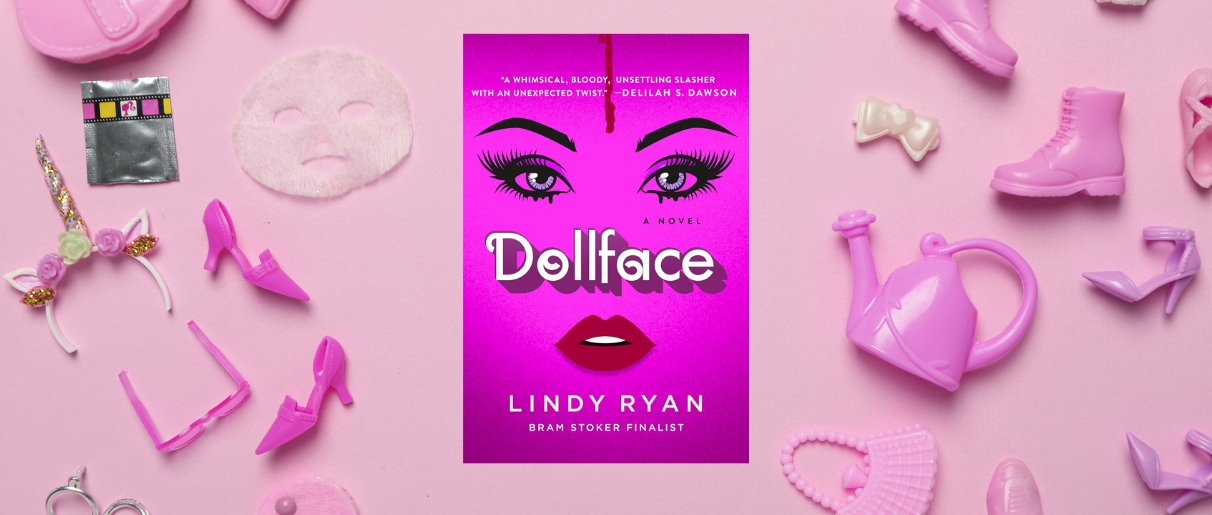
Dollface: A Novel by Lindy Ryan
Horror author Jill has just moved to suburban New Jersey, hoping to fit in with the new PTA moms and maybe not weird everyone out with her Final Girl coffee mug. You know. Make some real friends.
But then a plastic face-masked serial killer begins slashing their way through town, one overly made-up mom at a time. The police are incredulous. The moms are indignant. And Jill is slowly wrapped into a killer’s murderous spree, until she might just be the last woman standing.
Lindy Ryan’s Dollface may not resemble John Cheever’s suburbia, but like Cheever, Ryan explores the darker side of America’s suburban landscapes. How many times have you heard “we never locked our doors” or “this type of thing doesn’t happen in our town”? Subdivisions create a false sense of safety as Ryan’s quirky protagonist and horror writer, Jill Marshall, soon discovers. Behind white picket fences and perfectly manicured lawns, Jill’s neighbors mask deep-seated insecurities. With a doll-faced maniac hacking through Jill’s new neighborhood of Brunswick, New Jersey, the town’s cookie-cutter facade starts to crumble.
Donning a vintage Ben Cooper doll face mask, someone is set on mutilating Brunswick’s glam squad. This is body horror at its best, and the mask serves a dual purpose. It disguises the deranged person behind it while also functioning as a grotesque symbol of beauty, a response to the societal pressures placed on women to achieve unrealistic ideals. Ryan uses the mask to explore another central theme in the novel: containment. With everyone trying to keep up appearances, suburbia begins to look less like a refuge and more like a carefully decorated prison.
Those pressures weigh heavily on Jill, surrounded by women who seemingly have everything under control. She is wracked with guilt for not being everything for everyone. Somehow, her new PTA gal pals manage full-time jobs, maintain Martha Stewart-esque homes, participate in every school function, and remain flawless even after hot yoga. Ryan captures the exhausting expectations placed on women with a light touch rather than a heavy-handed critique. Jill, reminiscent of Rachel Harrison’s heroines, is sharp-tongued and observant, and her quick-witted internal commentary about her new social circle often provides some of the novel’s funniest moments.
The strain of suburban life quickly bleeds into Jill’s creative life as well. Her cursor sits idle as she battles writer’s block and doubts her ability to follow up on the success of her debut novel. Imposter syndrome begins slashing away at her confidence, even as a real killer slashes through Brunswick. Between unpacking a cross-country move, helping her eight-year-old son Tanner adjust to a new school, and navigating the social politics of the PTA, Jill begins to feel as though she’s losing control of the story she once thought she could write.
To make matters worse, the arrival of Jill’s younger sister, Kitty, complicates things. Since the death of their mother, Jill has taken on the role of caretaker, and Kitty’s constant need for validation adds another layer of stress. As a social influencer, Kitty thrives on attention, but Jill struggles to keep up with her sister’s demands while managing her own unravelling life. Between Kitty blowing up her phone day and night, an overbearing neighbor who refuses to respect boundaries, a demanding literary agent, and a killer dismembering her friends, Jill’s carefully balanced world begins to fracture.
Ryan also touches on the theme of otherness. Jill carries the weight of childhood trauma, and that experience leaves her feeling separate from the seemingly perfect lives around her. Her messy hair buns and the Chucky T-shirts make her feel out of place among Brunswick’s polished social set. Yet as the story unfolds, Jill begins to realize that the women she initially dismissed may be living far more fragile lives than their immaculate homes suggest.
Allusions to classic horror novels and films, such as Jill’s dog being named Lugosi, add another layer of genre awareness. As Jill’s life spirals further out of control, her new home begins to resemble something closer to the Overlook Hotel from Stephen King’s The Shining. A writer suffering from writer’s block. Check. A family slowly driving her mad. Check. A growing sense of paranoia. Check. Something eventually has to give.
And it does. At the PTA’s Halloween Boogie Bash, the proverbial boiler room finally explodes. Masks come off, secrets unravel, and the ugly truths hiding behind Brunswick’s pristine surface are revealed. Ryan’s Dollface ultimately proves that beneath suburbia’s carefully curated perfection lies something far messier and far more dangerous.
Ryan’s Dollface is a bloody good time.

Dawn Major’s debut novel, The Bystanders, was named Finalist for the 2024 Georgia Author of the Year for Best First Novel. Major serves on the board at Broadleaf Writers Association, is a member of the Atlanta chapter of Horror Writers Association, an Associate Editor at Southern Literary Review, and a Coeditor at WELL READ Magazine where she writes a monthly column called “TripLit with D. Major.” Major lives in Atlanta, GA. For publications and more: http://www.dawnmajor.com



Leave a Reply