
By Victoria Hood

The New Boy (2025) ⭐️⭐️⭐️
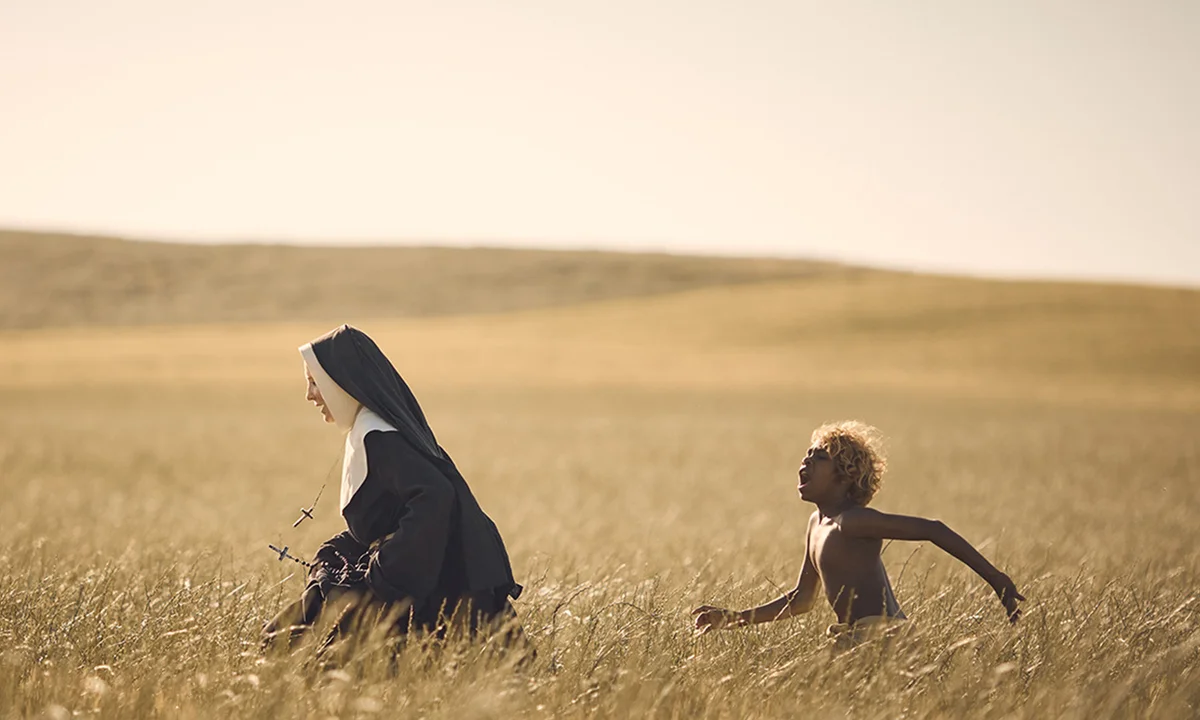
In 1940s Australia, when a 9-year-old Aboriginal boy arrives in the dead of night at a remote monastery run by a renegade nun, his presence disturbs a delicately balanced world.
Genre: Sci-Fi Fantasy/Drama
Written and Directed by Warwick Thornton
Starring: Cate Blanchett, Aswan Reid, Deborah Mailman, Wayne Blair
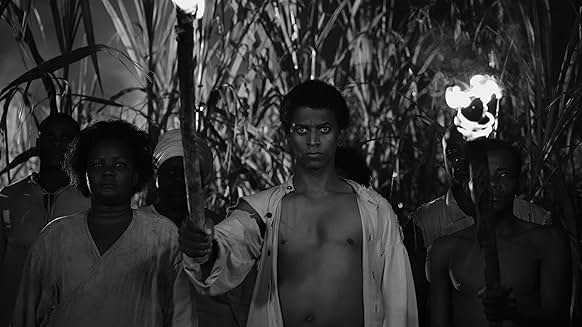
The New Boy gives a fresh face to the old truths of our lives: Christianity and racism are still palpable facets of our lives, regardless of where we may live. We open to New Boy (Aswan Reid) fighting, and seemingly killing, an older man while the man’s horse bends its neck to meet him. After this scene, New Boy is captured and brought to a boarding school run by nuns. The Father, who is meant to run the school, is nowhere to be found.
Once we are brought into this boarding school, we follow New Boy as he assimilates into the community he was given to. We observe winding, treacherous labor, though New Boy seems to find his way out of the harshest portions through a silent questioning of the world in which he’s found himself. These scenes move quickly, pushing us through the desert landscape into new forms of heat, exhaustion, and boredom that these boys are continuously forced into, valuing labor over education. War is continuously discussed and drawn back to, though we never see the war that is referenced by the adults. Rather, we are centered around the war of freedoms the children find themselves in—moments of whimsy juxtaposed with long days of labor. The boys who have been in the school the longest know the correct words, the correct actions, the proper way to serve the God the nuns follow. New Boy, however, wanders between what is expected of him and what he wants. Though New Boy is not defiant to rules, he is uneducated in the correct way of behaving; we see New Boy attempt to take jam for him morning meal, but after Sister Mum (Deborah Mailman) informs New Boy that George (Wayne Blair) would not like that, he leaves the jam be.
The tensions between Aboriginal spirituality and Christianity are perpetuated by Sister Eileen (Cate Blanchett), who struggles to understand the power that New Boy holds. New Boy is a healer, a caregiver, a boy who is motivated by curiosity. Sister Eileen finds intrigue and use in New Boy’s powers, but the struggle between faith and healing fuels Sister Eileen’s drinking and guilt. The performances by Blanchett and Reid are the glue that holds this film together. Long shots of desert landscape and manual labor create a mute sense of boredom and longing that is flipped into palpable emotion, resistance, and honesty when Sister Eileen and New Boy appear on screen. Their performances are tangible, evolving, and bring life to the barren landscape of the desert. I found myself yearning for more and more of their presence on the screen as I drifted into the background of the desert, forced to sit with the silence of labor.

Sweeping landscape shots, focused views of labor, and day-in-the-life shots of the young boys take up most of the film’s runtime with echoing silence and a wonderful score by Nick Cave and Warren Ellis. Though likely used as a way to place us into the mundanity of this world, I found myself disengaging from the continuous labor of watching to ponder the purpose of the collected short scenes. This labor is interrupted by the unnatural light power New Boy holds, which feels opposed to the atmosphere of the film. The light power acts as a representation of Aboriginal spirituality, but visually reflects more modern advancements in technology, which makes it feel visually out of place against the desert landscape in which we are placed.
The ending of this film asks us to reflect on the use of Christianity as a tool of force and control. In modern America, this ending feels both expected and completely honest and true. What role does Christianity play in the lives of those with other spiritual beliefs? In lesser hands, the figure of the silent, mystical child might veer into the “Magical Indigenous” trope, but director Warwick Thornton skillfully subverts this by giving the boy interiority, agency, and a spiritual gravity that challenges, rather than serves, the white characters. Though this film reflects on Australia’s history of “breeding out blackness” and its relationship to Aboriginal spirituality, it can also be seen as a reflection of the domineering history of Christianity and puritanical beliefs that flood American culture. The release of this film coincides with the ascension of the first American Pope, who has rejected our sitting President’s attempts to broaden the reach of Christofascism in America. Though The New Boy left my mind wandering in between scenes, the performances by Blanchett and Reid provide thoughtful critiques on the continuous ways Christianity and racism fuel not only our media, but also our worldly beliefs. The New Boy can be a helpful tool in reconsidering one’s relationship with faith and equity for those willing to put forth the labor of doing so.


Victoria (Tori) Hood holds an MA in English Literature with a concentration in Creative Writing from the University of Maine where she continues to work as lecturer and mentor. Tori also teaches and tutors at Husson University. She is the winner of FC2’s 2021 Ronald Sukenick Innovative Fiction Prize, for her collection of short stories My Haunted Home released by FC2. Victoria’s poetry chapbook Death and Darlings was published in 2022 by Bottlecap Press; her hybrid chapbook Entries of Boredom and Fear was published in 2023 by Bottlecap Press. Her book of poetry, I Am My Mother’s Disappointments, released on Mother’s Day from Girl Noise Press (2024). Victoria is currently working with Girl Noise Press on her next collection of short stories, Destroy Me, Desecrate My Bones, which is set to release February 2026. Her work has been published in Split/Lip Magazine, Tiny Spoon, Interpret Magazine, pioneertown, Querenica Press, The Hooghly Review, Bitchin’ Kitsch, ergot., Cult Magazine, and other various places. Tori now reads for Querenica Press year round and Split/Lip Press for the flash fiction/short story reading period. You can find her on instagram @toriiellen and Bluesky @toriiellen.bsky.social. Overall, she hopes to discomfort, humor and charm.
Leave a Reply