
By Mo Moshaty

The home remembers everything we try to forget.
Even when we redecorate, repaint, or reframe, it still hums with the frequency of what was once said within its walls. The Others (2001) and The Night House (2020) understand this with surgical precision. These are not haunted house films in the traditional sense; they are studies of memory as architecture, of grief so dense it calcifies into its structure.
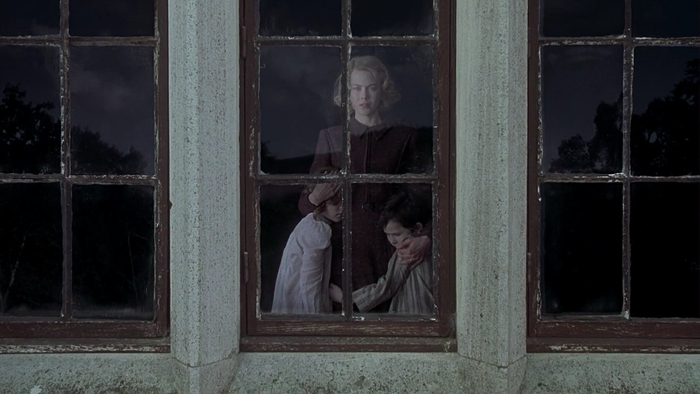
In both stories, a woman wanders her own home as though trespassing. Grace (Nicole Kidman) in The Others closes curtains against an imagined light that threatens to expose her denial. Beth (Rebecca Hall) in The Night House flings them open, desperate to see something she cannot name. Two halves of the same haunting: one hiding from the truth, one chasing it.
Haunted houses are always autobiographies. They don’t invent ghosts but record them. Every locked door is a boundary we’ve drawn around pain. Every hallway is an elongated memory, stretching until it loops back on itself. Both films whisper the same warning that the living and the dead share more than walls.
Grace’s Fortress of Denial
The Others opens on Grace, gasping awake as if startled by her own existence. From the first frame, we sense a woman who has built her faith like a fortress, and like all fortresses, it doubles as a tomb. The film unfolds and perpetual half-light; curtains are drawn tight for the “children’s condition”, but the true affliction is Grace’s grief, not their photosensitivity.
The darkness is her coping mechanism. She controls light the way she controls memory. Meticulously, fearfully, with devotion bordering on madness. The servants return to the house like a chorus of reminders. Every whisper unsettles the illusion of order. The Others is not about possession, it’s about repression. The horror doesn’t break in; it seeps through the cracks in Grace’s composure and sometimes knocks at the front door.
When the final revelation arrives that Grace and her children are the ghosts, it feels less like a twist than an inevitability. The film has been preparing us for this confession all along. Denial, after all, is kind a kind of haunting. Grace is sin is not violence, its forgetting. She smothers her guilt beneath ritual, religion, and domestic duty.
Houses in gothic fiction often represent the psyche. Grace’s home is pure idolatry; devotion turned into delusion. When she screams, ‘This house is ours!’ she’s not protecting property, she’s guarding her narrative. In the house, patient as stone, lets her believe it…for a little while.

Beth’s Mirror House
If The Others is repression’s cathedral, The Night House is its demolition site.
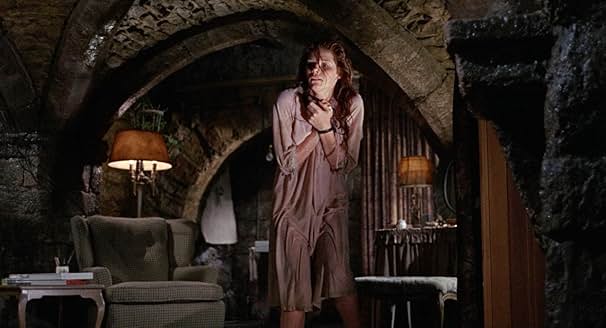
Where Grace hides from the truth, Beth hunts it. After her husband’s suicide, she wanders their lakeside home in a grief so raw it manifests spatially. The house bends, doubles, misaligns – architectural grief rendered literal doorways leave nowhere. Reflections move without her. Shadows mimic rooms that shouldn’t exist.
Beth isn’t haunted by a ghost, but by negative space, a mirrored version of her home where her dead husband’s secret life takes form. David Bruckner’s film turns absence into design. It’s a clever evolution of the Gothic: Where the Victorians had creaking attics, Beth has blueprints and floor plans. The uncanny emerges not from decay, but from symmetry too perfect to trust.
Her haunting is psychological but also architectural, the way trauma remakes the environment to accommodate itself. Every creak, every shift of light becomes evidence. Beth treats her house like a crime scene and herself as both detective and victim. If Grace was trapped in faith, Beth is trapped in logic. She dissects grief the way a coroner dissects a body, looking for meaning in the remains. But horror thrives where meaning fails.
When the final image comes, Beth on the dock, staring into the reflection that nearly swallowed her, it isn’t triumph, it’s surrender. And it’s now navigating within this parameter to the end of her own life. She sees the shape of her loss and knows that she will never unsee it, escape it, or outrun it.

Memory As Blueprint
Both films turn the house into more than a backdrop. It’s grief’s architecture, a physical manifestation of denial and remembrance.
In The Others, space contracts. Rooms feel smaller, tighter, more airless as Grace’s delusion consumes her. The home’s strict order mimics her need to control it. In The Night House, space expands. The home becomes a labyrinth of unanswered questions, the geometry of mourning. One woman is suffocated by stillness, the other swallowed by echo.
These are films about what happens when women are told to move on but cannot, when closure is impossible and the body builds a house for grief to live in. There’s something so profoundly feminine about this kind of haunting. Both Grace and Beth perform emotional labor even in death and despair, tending to their houses, maintaining their spaces, keeping up appearances while internally collapsing. Their homes are museums curated by guilt.
In the Gothic tradition, the haunted house often mirrors patriarchy’s power: grand, decaying and impossible to leave. But The Others and The Night House shift the focus here. The horror isn’t the house itself, it’s what it remembers for us.
When Grace finally realizes she and her children are dead, She doesn’t scream. She breathes. The house finally exhales with her. In The Night House, when Beth steps away from the abyss, literally and metaphorically, she too begins to breathe again. But the house still stands, patient and echoing. Neither film offers freedom. Instead, they offer awareness and the recognition that forgetting is a fantasy. Horror’s gift, perverse as it sounds, is honesty.
Every wall, every shadow, every silence is an archive. The home remembers everything we try to forget, and that’s why it haunts us. Because grief, like architecture, is built to last.


Mo Moshaty is an acclaimed horror writer, lecturer, and producer whose work combines visceral storytelling with the psychological insight of her Cognitive Behavioral Therapy background. She has lectured internationally, including as a keynote speaker at Nightmares from Monkeypaw: A Jordan Peele Symposium (Prairie View A&M), No Return: A Yellowjackets Symposium (Horror Studies BAFSS Sig), The Whole Damn Swarm: Celebrating 30 Years of Candyman (University of California), and with the Centre for the History of the Gothic (University of Sheffield). Mo has also presented at the BFI, Miskatonic Institute of Horror Studies, and Final Girls Berlin Film Festival’s Brain Binge on women’s trauma in horror cinema, Cine-Excess on The Creepy Kid Horror Subgenre and Mother/Daughter Trauma in Horror, and Romancing the Gothic on Cosmic Horror’s Havoc on The Body Electric Her short film, 13 Minutes of Horror: Sci-Fi Horror, won the 2022 Rondo Hatton Classic Horror Award for Best Short Film. As a core producer with Nyx Horror Collective, Mo co-created the 13 Minutes of Horror Film Fest and partnered with Shudder in 2021 and 2022, while also establishing a Stowe Story Labs fellowship supporting women creatives over 40+ in horror. A member of the Black Women in Horror Class of 2023 and featured in 160 Black Women in Horror, Mo’s short fiction appears in A Quaint and Curious Volume of Gothic Tales (Brigid’s Gate Press) and 206 Word Stories (Bag O’ Bones Press). Her debut novella, Love the Sinner, was released July 5, 2024, with Clairviolence: Tales of Tarot and Torment released in October 2025. The first of her five-volume non-fiction series, The Annex of the Obscure: The Afterlife, will be released in 2027 from Tenebrous Press. As the Editor-in-Chief of NightTide Magazine and founder of Mourning Manor Media, Mo champions marginalized voices in horror. Under her leadership, NightTide plans to launch a film festival in 2028, furthering her mission to reshape the genre through inclusivity and representation.

Leave a Reply