
By Mo Moshaty
There’s a reason that horror always sends us downstairs.
Basements aren’t transitional spaces. They’re storage or containment. They’re warehouses to keep what we don’t want to display. The lighting sucks, the air is heavier, most times, it reeks. The ceilings are way lower than anyone needs them to be.
You don’t decorate a basement the way you would decorate a living room. You sort of tolerate it; make it work. And you descend into it only when you have to.
And don’t get me started on man caves, because that’s not what I’m talking about.
In horror, the descent is never accidental. The basement is where captivity happens, where secrets are sealed, where violence is systematized. It isn’t just a darker room. It’s the architectural admission that something has been pushed below the level of daily life. What can’t be integrated into daily life gets buried, what can’t be explained gets locked away, and what can’t be acknowledged is kept out of sight but never really fully gone. And when characters head downstairs, we already know what they’re about to find: not just danger, but something that the house has been hiding on purpose.
The Collector (1965)

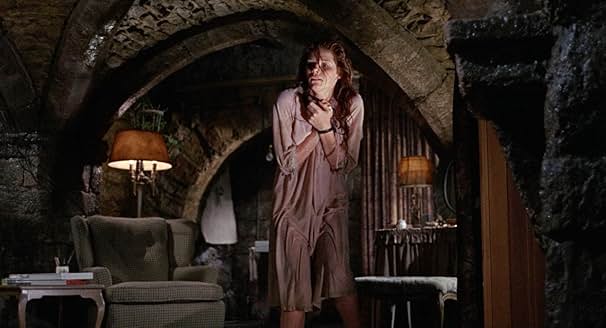
Long before horror perfected the secret basement reveal, the collector understood that the real nightmare is in chaos. But preparation? Freddie Clegg (Terence Stamp) doesn’t rage. He renovates. He wins money, buys a country house, and quietly outfits the cellar like someone preparing a guest room for a very reluctant visitor. The lighting is considered, the furniture is deliberate, and there’s even an attempt at some sort of comfort. It’s horrifying in the way a tidy Excel spreadsheet can be horrifying. Everything is accounted for.
The basement in The Collector isn’t damp and wild, but curated. Freddie doesn’t see himself as a monster, just a careful, patient, devoted guy. The cellar becomes his preservation space, not unlike the butterfly cases he keeps upstairs. The only difference is that this new specimen, named Miranda (Samantha Eggar), is still breathing. That totally ups the creep factor here, because the house remains respectable above ground. Tea can be poured, curtains can be drawn, and the garden can bloom beautifully. But downstairs? Someone is imprisoned, and the violence doesn’t spill out into the living room, but it’s neatly stored below it, compartmentalized and managed.
The basement becomes Freddie’s moral filing cabinet. What can’t coexist with polite society gets archived under the floorboards, and the genius of this space allows him to believe he’s still very much civilized.
The People Under the Stairs (1991)

From personal archive to a percolating ecosystem, Wes Craven doesn’t hide what’s going on below ground. He gives us a fortress, a house that gleams from the outside and operates like a prison underneath. The basement is completely engineered and exists to keep certain bodies contained and certain stories buried.
The Robesons (Everett McGill & Wendy Robie) are landlords: controlled, meticulous, and devoted to order. Their upstairs is polished suburban propriety: rules about noise, discipline, and cleanliness. Downstairs is confinement, hunger, and mutilation. The contrast isn’t subtle because it isn’t meant to be. Craven draws a straight line between property ownership and possession: of space, of bodies, and of power.
Children are kept below. Punishment happens below. Class resentment festers below. The home’s pristine facade depends on what’s happening underneath it. This isn’t one disturbed individual rationalizing captivity. This is a system built to preserve dominance, and the center of this ecosystem is Fool (Brandon Quinton Adams).
Fool isn’t just some child protagonist wandering into a basement. He’s the only character who understands, instinctively, that the house is lying. Unlike the Robesons, who treat hierarchy as natural law, and unlike the trapped children who’ve been forced into silence, Fool moves through the structure with suspicion. He listens, he adapts, and he refuses to accept the rules of the house as inevitable. In a film about containment, Fool is the true driving mobility.
He is a Black child navigating a property system that was never designed for him. The Robeson’s wealth depends on extracting from his community. Their power is secured by ownership and eviction. Fool enters the house not as an equal or a guest, but as someone who already understands what it means to live under structural pressure. The basement simply confirms what he already knows. Respectability can conceal violence. And that’s what makes him so important: he doesn’t internalize the house’s logic. He doesn’t treat upstairs as superior or downstairs as forbidden knowledge. He treats the entire structure like a terrain. While the Robesons rely on walls and locked doors fool relies on agility and improvisation. He survives by not obeying the architecture but by navigating around it.
The children under the stairs are casualties of a hierarchy that protects property over people. When the lower level finally erupts into the upper one, when the house literally cracks open its final exposure, the system can’t sustain itself once what’s been buried refuses to stay that way. Craven understood something crucial: basements aren’t just storage, they’re strategy. And in The People Under The Stairs, the strategy fails the moment someone refuses to stay at their assigned level.
Parasite (2019)

The Park house is immaculate. Glass, stone, open space. It’s designed to look effortless, as if comfort simply exists there without strain. There’s a bunker underneath it.
Not an abandoned room. Not a crusty, dusty corner for your discarded boxes and seasonal decor. Not a horror cliche. But a sealed, functional space built for crisis and repurposed into concealment. Someone lives there quietly and is dependent on what happens upstairs to stay alive. But there isn’t just one person surviving through concealment.
The Kim family (Song Kang-ho, Jang Hye-jin, Choi Woo-shik, Park So-dam) also moves through the house invisibly. They slip into roles: Tutor, Driver, Housekeeper, inserting themselves into the structure that excludes them. They don’t break into the basement; they enter through the front door. They work. They perform competently. They learn the rhythms of the family above them and survive by becoming indispensable.
What makes Parasite so sharp is that the violence isn’t confined to one hidden body underground; it’s layered. The Kims live semi-subterranean lives in their own home, below street level, flooding first when the rain comes. The Parks (Lee Sun-kyun, Cho Yeo-jeong, Jung Ji-so, Jung Hyeon-jun) live above the family, insulated from consequence; every level depends on the one beneath it. When the bunker is revealed, the horror isn’t simply that someone has been hiding there, but that the system has had room for it. That a house can operate smoothly while containing a person out of sight. That a wealthy family can move through a space without noticing the labor and desperation required to maintain it.
The garden party violence doesn’t erupt out of nowhere; it rises through the house’s layers. The humiliation of smell, the recoil of disgust, the reminder that proximity does not equal equality. The moment someone below becomes visible, the illusion fractures. Parasite was pivotal to class horror because it showed that the basement isn’t a single secret; it’s a structure of reliance. The lower level sustains the upper, and the upper pretends that it floats.
The stabbing is shocking, yes, but it’s the only moment where the hierarchy becomes impossible to ignore. The house doesn’t collapse because a monster appears, but because the levels can no longer stay separate.
Martyrs (2008)

The basement in Martyrs didn’t begin underground. It begins in a slaughterhouse.
Lucie (Mylène Jampanoï) is found feral, injured, and silent. She carries the signs of prolonged captivity but no narrative the authorities can use. No names, no clarity, just a body that has survived something systemic. The film refuses to give us catharsis on the outset. Instead, it just gives us residue.
Lucie grows up with Anna (Morjana Alaoui). She’s haunted not by a ghost, but by the memories that refuse to resolve. The rasping woman who attacks her isn’t supernatural. She’s a psychic wound: a reminder that someone else was left behind. Fifteen years later, Lucie doesn’t descend into a basement; she invades a breakfast table.
The murder of the Belfond family is abrupt, brutal, and destabilizing. A shotgun at close range. Children killed. No theatrical villain monologue, just pure conviction. And Lucie believes she has found the people who kidnapped her. She believes this is justice and believes that killing them will end the hauntings…but it doesn’t.
Violence above ground doesn’t resolve what happened below ground, and Lucie’s trauma isn’t satisfied by revenge because the system that carried it and created it still exists within her. Her hallucinated attacker returns. The guilt of leaving another woman behind claws at her. Her body becomes a battleground. The cutting, the collapse, the suicide; trauma doesn’t dissipate but turns inward. The real basement arrives after Lucie is gone.
Anna discovers it behind a cabinet, a staircase, a hidden complex. Photographs of suffering line the walls, like research documentation. A woman chained, a blindfold riveted to her skull. This isn’t one family hiding a crime; it’s a complete network.
The woman known as Mademoiselle (Catherine Bégin) explains it plainly. They’re not interested in victims; they’re interested in martyrs. Young women are selected because their bodies apparently endure suffering better than most. Pain isn’t random but administered methodically. Beatings, starvation, isolation, flaying.
The violence in martyrs isn’t eroticized; it’s procedural and impulsive. The female body becomes experimental material in pursuit of some sort of transcendence. Suffering is framed as spiritual access; the idea that a woman’s pain reveals something higher wasn’t invented here, but the film simply pushes it to its logical extreme.
Anna is beaten until she no longer resists, not because she’s weak, but because her endurance is part of the experiment. Her body is stripped of everything but sensation. When she is finally flayed and hung under lights, it isn’t presented as a show. It’s presented as data collection. The wealthy observers who arrive at the house gather an expectation. They want knowledge, they want proof of the afterlife, and the basement is their laboratory. When Anna whispers what she’s seen to Mademoiselle, the film refuses to tell us. We don’t get the revelation. We get a gunshot, and Mademoiselle chooses death rather than disclosure. The people upstairs are left waiting as the doubt remains intact.
The basement in Martyrs is the final form of what we’ve been tracing all along. It’s what happens when containment becomes doctrine, when there’s no respectable upstairs left to protect, only witnesses.
Basements in horror aren’t just convenient places to stash a body. They’re management systems. They hold what the upstairs can’t accommodate. Shame. Class disparity, racial hierarchy. Obsession. Institutional cruelty. Sometimes survival itself, sometimes guilt, sometimes an entire second life running quietly beneath the first.
The lower level allows separation and creates distance between who someone believes they are and what they are willing to tolerate. A house can remain orderly while something starves below it. A family can eat breakfast while someone is chained underground. A wealthy home can glow with glass and sunlight, while dependency hums beneath the floorboards. An organization can speak of transcendence while women are methodically broken in secret rooms.
Basements make compartmentalization possible. That’s why it keeps returning in horror. It often offers containment without resolution. It lets characters revisit what they’ve buried. It lets them maintain an upstairs life that feels copacetic while something rots out of sight. It allows cruelty to become an infrastructure.
And when someone finally does go downstairs, when the cabinet is moved, when the locked door opens, when the staircase keeps descending further than expected, we begin to understand that the lower level was never an accident. Someone just needed a place to put what they didn’t want upstairs.


Mo Moshaty is an acclaimed horror writer, lecturer, and producer whose work combines visceral storytelling with the psychological insight of her Cognitive Behavioral Therapy background. She has lectured internationally, including as a keynote speaker at Nightmares from Monkeypaw: A Jordan Peele Symposium (Prairie View A&M), No Return: A Yellowjackets Symposium (Horror Studies BAFSS Sig), The Whole Damn Swarm: Celebrating 30 Years of Candyman (University of California), and with the Centre for the History of the Gothic (University of Sheffield). Mo has also presented at the BFI, Miskatonic Institute of Horror Studies, and Final Girls Berlin Film Festival’s Brain Binge on women’s trauma in horror cinema, Cine-Excess on The Creepy Kid Horror Subgenre and Mother/Daughter Trauma in Horror, and Romancing the Gothic on Cosmic Horror’s Havoc on The Body Electric Her short film, 13 Minutes of Horror: Sci-Fi Horror, won the 2022 Rondo Hatton Classic Horror Award for Best Short Film. As a core producer with Nyx Horror Collective, Mo co-created the 13 Minutes of Horror Film Fest and partnered with Shudder in 2021 and 2022, while also establishing a Stowe Story Labs fellowship supporting women creatives over 40+ in horror. A member of the Black Women in Horror Class of 2023 and featured in 160 Black Women in Horror, Mo’s short fiction appears in A Quaint and Curious Volume of Gothic Tales (Brigid’s Gate Press) and 206 Word Stories (Bag O’ Bones Press). Her debut novella, Love the Sinner, was released July 5, 2024, with Clairviolence: Tales of Tarot and Torment released in October 2025. The first of her five-volume non-fiction series, The Annex of the Obscure: The Afterlife, will be released in 2027 from Tenebrous Press. As the Editor-in-Chief of NightTide Magazine and founder of Mourning Manor Media, Mo champions marginalized voices in horror. Under her leadership, NightTide plans to launch a film festival in 2028, furthering her mission to reshape the genre through inclusivity and representation.


Leave a Reply