
By Vivi Estaris

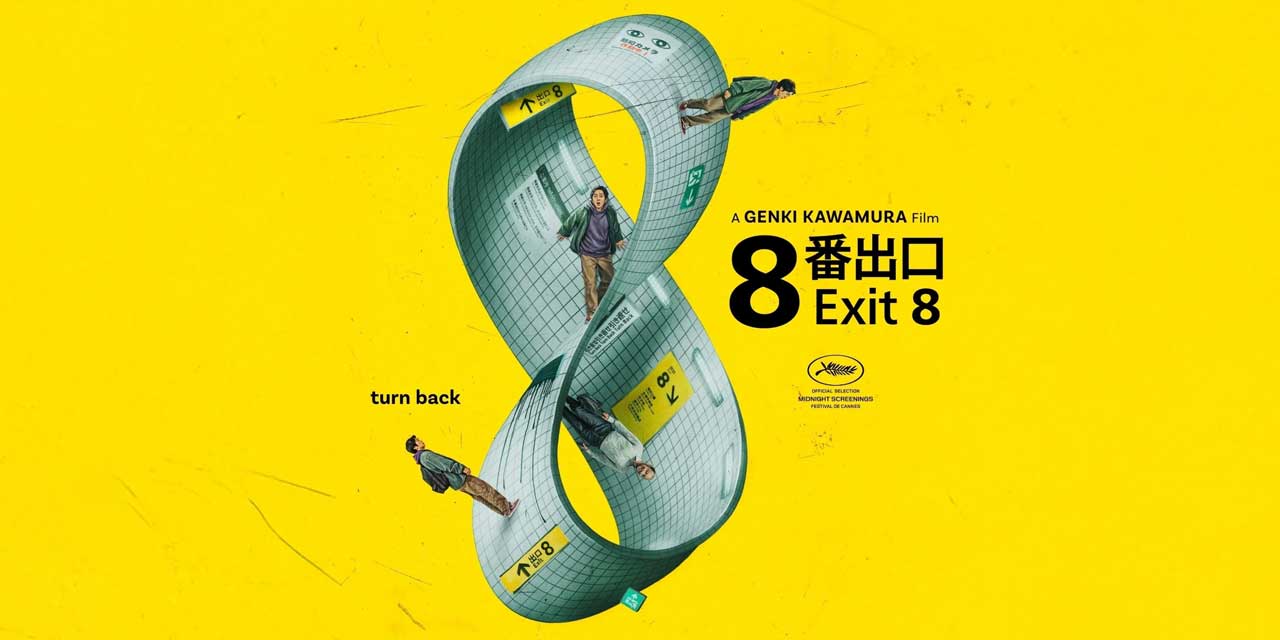
Following its premiere at the 2025 Cannes Film Festival and its theatrical release in Japan, Exit 8 was met with critical success. This might not sound like a remarkable statement on its face until you consider this genre of adaptations as a whole. To say that film adaptations of video games are hit-or-miss would be too generous. Exit 8 is a proverbial diamond in the rough.
Since the dawn of video game adaptations in the early ‘90s, this category of film has been notorious for churning out mediocre, uninspired films. Following Exit 8’s North American release, however, the movie has become the highest-rated video game adaptation of all time, according to Rotten Tomatoes, currently sitting pretty at a 93% score. The difference between Exit 8 and its peers is dramatic to say the least, making the movie an anomaly in and of itself.
So, how did this happen? What kind of movie magic fate made Exit 8 into such a critical success?
Exit 8 is a convergence of all the right elements at the exact right time. It arrives at a point where movie adaptations of video games have continued to stagnate while the indie game market has continued to flourish. Exit 8 uses its source material as a foundation for atmosphere and external conflict. Simultaneously, it takes advantage of the game’s scarcities in narrative substance to craft an original story that feels fitting and intrinsic to the liminal world in which it lives.
An overwhelming majority of movies based on video games are adapted from major franchises, such as Super Mario Bros., Sonic the Hedgehog, and Street Fighter, the latter of which is due for its newest adaptation later this year. This makes sense—landmark franchises such as these have more installments, more material to draw from, and a guaranteed fanbase. While video game adaptations are bereft of true critical breakthroughs, box office numbers for recognizable titles are consistent. But adaptations are still perceived and assumed to be underwhelming by fans who are familiar with the source material.
Meanwhile, in the video game industry, the landscape has been steadily changing for over a decade. Are those major franchises seizing the attention of high-budget Hollywood studios? They aren’t the only players on the field anymore. Some of the most popular video game releases since the 2010s have been produced by independent developers: Minecraft, Undertale, Stardew Valley, and Among Us were all indie releases before becoming some of the most sensational video games of all time.
And it’s no wonder that players have come around to independent releases. Key studios and companies in the video game industry have adapted to a profit-first mentality, laying off employees en masse, adopting obnoxious purchase structures for their products, and trying to temper players’ expectations about return in value. In the midst of all this disappointment in studios and publishers once hailed as the forefathers of the industry as we know it, supporting independent developers has slowly but surely become the alternative to spending exorbitant amounts of money on games that aren’t pushing the envelope.
SETTING THE STAGE
Indie games’ rise in popularity is especially interesting in the horror genre. In 2010, a new video game hit the scene just in time for the boom of “let’s play” channels on YouTube. Independent game studio Frictional Games released Amnesia: The Dark Descent, a dismal and haunting horror game that broke away from the pack by taking away the player’s ability to fight back. Unlike the most well-known horror games before it, like Silent Hill and Resident Evil, Amnesia’s first-person perspective experience cranked up the immersion and gave the players only three options while confronting the terror: run, hide, or die. Soon, other indie games would follow this formula—upping the ante and paring down the player’s control—and similarly benefit from the hype generated by various YouTube personalities.
The stage is primed for something drastically new to hit the scene, both in the world of filmmaking and the world of video games.


Amnesia: The Dark Descent (2010) Frictional Games
To understand how The Exit 8 became a viral, runaway success, it’s important to examine the eclectic ways in which horror video games have continued to evolve. The success of Amnesia: The Dark Descent keyed other developers into something unique about horror game design: when you cull agency and the ability to fight back, these experiences become truly horrifying.
For example, the runaway train of mascot horror success known as Five Nights at Freddy’s imposed restrictions upon its players, which masterfully heightened the nerve-wracking nature of the game. In the original Five Nights at Freddy’s, the player cannot move. They can control their security camera feed, the lights outside of their booth, and the doors, which can ward off the animatronic monsters. It’s a game of resource conservation and fast reactions—you cannot fight back against the monsters, but you can be quick enough on the draw to impede them.
The Exit 8 is simply one of the latest dominoes to fall in this resource-removal evolution of horror gameplay.
In fact, The Exit 8 is not the first of its kind. It was inspired by a somewhat recent movement in indie horror games that began several years ago with the I’m on Observation Duty series. The Observation Duty games, similar to Five Nights at Freddy’s, provide the players with surveillance footage, a reporting system, and not much else. Players must cycle through footage, waiting and looking for “anomalies,” indications that something or someone has tampered with the environment. Anomalies must be reported as soon as possible, lest they overwhelm the player and end the game. Some anomalies are small and innocuous: an extra object sitting on a table, or an advertisement proclaiming “pasta” where it used to say “pizza”. Other anomalies can be as dramatic and jarring as a giant, entropic void in the middle of the map or, heaven forbid, !!! HUGE MAN !!!. And while this spot-the-difference format may have started as far back as 2013 with the empathy game Papers, Please, I’m on Observation is one of the first to be credited with denying its players a template for reference, forcing them to memorize the maps and, consequently, doubt their own memory.
At the time of writing this, there are eight official installments of I’m on Observation Duty, and an even greater number of other indie anomaly games that follow the same formula. Other notable titles include Captured, Dollmare, and The Cabin Factory. The most successful anomaly game to date, however, is, of course, The Exit 8.
It’s easy enough to explain the concept behind The Exit 8: the player loops the same train station corridor, only continuing to the end when they do not notice any anomalies, and turning back when they do.
There are two things The Exit 8 player can do in terms of gameplay: move and move faster. There is no story, nothing that explains the existence of this train station corridor. Players do not even know what kind of character they’re meant to be piloting. In spite of the lack of feedback and substantive storytelling, the game has been a resounding success. Staying engaged is easy, the anomalies are unsettling, and the environment is incredibly isolating and dreamlike.


The Exit 8 (2023) Kotake Create
The Exit 8 is also cashing in on another trend in online horror phenomena: liminal spaces. It must speak to the suburban upbringings of Millennial and Gen Z audiences that the most popular choice for haunted settings has become interior spaces where everything feels too sterile, too mundane to be safe, and inoffensive to a fault. The Exit 8 definitely captures this sense of unnerving minimalism, of being so familiar that it’s scary. The most famous example of liminal spaces as a platform for horror is the Backrooms Creepy Pasta, an Internet story that has been adapted into short films, games, and a major motion picture distributed by A24 coming out later this month. Like The Backrooms, The Exit 8 taps into the unnerving universality of certain modern spaces. While the train corridor in the game may be distinct to a certain region or station, its purpose is instantly recognizable to anyone who has used an underground train system.
The looping nature of the corridor also hearkens to the maddening structure of P.T., Hideo Kojima’s playable teaser for a since-canceled installment of the Silent Hill franchise. P.T.’s constantly refraining map was a landmark unto itself in horror video games, and its Lynchian nightmare layout is echoed in The Exit 8, where the endless monotony makes up half of the unease.
Additionally, The Exit 8’s anomalies have as much range as the ones found in I’m on Observation Duty. Most anomalies players will encounter are subtle and require an acute sense of scrutiny. The more innocent anomalies serve to intensify the obvious ones, such as the tidal wave that chases the player from one end of the corridor to the next and the pair of twins standing in The Shining-style in the middle of the map.

Exit 8, the film, first places the audience in the shoes of an initially unseen protagonist by using a first-person perspective camera angle, similar to the one in the game. This protagonist, The Lost Man, witnesses a mother being openly bullied on the train for her infant’s crying, and chooses not to intervene. After departing, he immediately voices his regret to his ex-girlfriend, who has called him to tell him he’s pregnant.
The viewer has already been introduced to a sense of internal conflict by the time the titular corridor reveals itself. This push-and-pull dilemma of wanting to break through a barrier of reluctance to become a better person anchors the audience in an ambient source of anxiety throughout the movie. Director Genki Kawamura thus uses the foundation of the game to dictate feelings of indecision, insecurity, and paralyzing hesitation. The Lost Man cannot decide if he can be a father, so he is plagued by images and sounds reminiscent of the crying infant from the train. He is also woefully alone for most of the movie. His frustration with himself and the purgatory that is Exit 8 manifests in a wide-angle shot of him breaking down in the middle of the corridor, isolated and utterly helpless.
The film also understands the hair-raising nature of liminal spaces. The familiarity of the setting indicates it should function as every other train corridor, and thus it is weaponized to betray both the Lost Man and the audience. After all, not everyone has been to the Amityville house or Dracula’s castle, but most audiences will understand the anxiety of being alone in the subway.
Kawamara reinforces these anxieties with clever camera work: long tracking shots to make the monotony of the space feel inescapable, a scope that closes in when the viewer yearns to inspect the characters’ surroundings, and angles dedicated to excruciating moments of dramatic irony. Every way the camera forces the viewer to look at the corridor makes it feel claustrophobic.
The Exit 8 is a game that prioritizes minimalism, and so the movie follows suit. Most horror stories collapse in on themselves when they over-explain their own lore, but the Exit 8 adaptation plays in the space without expanding beyond the reach of a standard 90-minute runtime. For example, the film examines The Walking Man and introduces the idea that someone can meet their doom should they not play by the rules of the space. The movie also proposes that Exit 8 exists beyond the bounds of both space and time, presenting inconsistencies in the chronicle of events. The liberties the film takes do not offer true answers so much as they craft new problems based on the existing material. After all, The Exit 8 does not offer any stakes to the player other than finishing the game. The film, on the other hand, expands only as much as it needs to tell the story.

Kawamura and co-writer Kentaro Hirase essentially recognized that The Exit 8’s limitations were their strongest assets. They were given a blank slate and, rather than try to unravel the nature of the beast, they used the existing horror to guide an original story that fit the gameplay. Evidently, being restricted to a single set enabled more collaboration amongst cast and crew. Leading actor Kazunari Nomiya was also credited as a script coordinator for the project, having some familiarity with the game. Nomiya was involved from day one, helping guide the script into a story that felt natural to the game’s environment. Is the story groundbreaking and extraordinary? Not necessarily. But anything too ambitious would be disingenuous to the source material. As is, the story fits snugly in the strengths put forward by the game.
WHAT LIES AHEAD
In January of this year, something truly remarkable happened: Iron Lung, an independent film adaptation of an independent horror game, made over 17 times its budget at the box office. The critical response was divisive. In fact, the movie’s financial success might be primarily attributed to the clout of the writer, director, and leading actor, Mark Fischbach, better known by his online handle, Markiplier. A long-time YouTube personality whose early success is partially owed to his own Let’s Play series of the aforementioned Amnesia: The Dark Descent, Markiplier has been growing his brand and fanbase for over a decade. But Iron Lung was his passion project, and it shows.
Regardless of Markiplier’s success, it’s worth noting that Iron Lung was based on another bare bones independent game where the player is extremely limited in choice and agency. Iron Lung and Exit 8 are both seizing the path less taken, a route paved by trail-blazing indie developers.
In terms of creative freedom, it’s to the benefit of the filmmaker to look towards independent video games for adaptation inspiration. Indie games are often not tied to major franchise restrictions, set characters, or hard stories. Indie games are the most malleable and the first to bend the rules, much like their neighbors in independent filmmaking. Kawamura and Markiplier have both proved that indie titles are brimming with originality and innovation.
This year has already offered proof that a good video game adaptation can be done if all the parts are moving in the same direction. It would be great to see more horror filmmakers take on similar projects, and it does seem like the interest is present. The developers of Phasmophobia recently announced that Blumhouse would be adapting their own independent project, a game that is still in early access! This will be one to look out for, as, similar to Exit 8 and Iron Lung, Phasmophobia does not offer much preexisting lore or characters to tie down a movie plot.
In any case, bold adaptations as well-executed as Exit 8 thrive best within horror, a genre primed for rewarding the most attentive and creative minds the industry has to offer.

Vivi Estaris (she/they) is a writer based in New Orleans. Their bylines include NightTide Magazine and The Noobist, and their fiction has appeared in Cosmic Horror Monthly. You can read more at viviofthevoid.com.


Leave a Reply