By Jill Vranken

A young woman stands, suitcase in hand, in the vast expanse of a near empty parking lot. Her name is Justine (Garance Marillier) and at this point we know three things about her: she is about to start education at the same veterinary college her older sister Alexia (Ella Rumpf) attends, said older sister is considered the rebellious black sheep of the family, and – most crucially of all – Justine is a lifelong, committed vegetarian.
If you know anything about Julia Ducournau’s 2016 debut feature Raw, you know that this won’t last. As her parents drive her to her new school, Justine – a quiet and studious young woman whose body feels taut with nerves – seems anxious about this new start, despite knowing her sister will also be there (even though Alexia has already broken her promise to meet her on arrival).
Justine and fellow students are drenched with animal blood. With their white lab coats (customary kit for the duration of the ritual) stiff and crimson crusted, Justine and her roommate, a young gay man named Adrien (Rabah Naït Oufella) queue up for the next part of the ritual. Justine is taken aback when she realizes she’s being forced to eat a raw rabbit kidney, refusing because of her vegetarianism. But when she asks Alexia (herself one of the seniors conducting the hazing) to back her up, her sister instead forces her to go against herself, and Justine ends up grimly swallowing down the tiny, chewy chunk of offal before running off and heaving. She shakes it off, trying to move on with her day.
But then she starts getting this itch…
In a 2017 interview with GQ, Ducournau commented on the growing number of femme filmmakers tackling cannibalism.
“With women choosing the topic of cannibalism in the same moment, I think it’s absolutely mind-blowing. I think the fact that women want to tear up the skin is very interesting. I do believe that the skin is the recipient of the outside look. When someone looks at you from the outside, they’re going to look at your skin. It’s your envelope. I do think that somehow, symbolically, women want to get rid of that skin that has been sexualized, glamorized, and seen as something that is completely not relatable for women. They want to tear up that skin to be completely raw.”
Growing up, I never saw myself fully reflected in the media I consumed. I was – still am for some – too much in body and brain. My autism, my ADHD, my chronic pain, my fat body, all twisted into things to hold against me. I was not a protagonist in anything apart from the fantasies I escaped to. I had to refocus and learn to seek fragments of myself, like looking into the shards of a broken mirror. The urge to symbolically “tear up the skin” rings true because mine was judged, found wanting, and found unworthy of assimilation with my peers. I felt hunger for belonging, for a chance to figure myself out, but no matter how hard I tried, no matter how hard I masked my full self, it was never going to be enough. It was like an itch I could never quite scratch.

Justine’s itch, which quickly escalates from somewhat benign to annoying, then to an angry, all-over red rash, starts peeling her skin, causing her to have to visit the nurse’s office. The nurse provides her with some cream and a bit of well-meaning advice. She asks Justine how she sees herself, and when she responds with “average”, the nurse tells her to “find a quiet corner and wait it out”, it being the seeming relentlessness of the hazing ritual and the symbolic initiation into her adulthood. In that statement, I see memories of wanting to do the same, wanting not to be perceived, but finding it impossible. I am hit with recollections of my first menstrual period, unable to deal with the heavy flow, bleeding to the amusement of the others in my class, and wanting to disappear into the floor until it stopped -the bleeding, or the bullying. I am hit with conflicting memories of wanting someone to see me, the real me, stims and tics, and special interests, and all. I am once again hit with the desperate feeling of not wanting to be so alone.
As much as she may want to try, Justine cannot find a quiet corner to wait it out in because an urge is growing within her. The once-devout vegetarian steals a hamburger patty from the cafeteria only to throw it away in embarrassment when Adrien catches her and offers to pay for it. Adrien takes Justine to a roadside gas station and buys her a sandwich with meat, which she devours with the zeal of someone coming up for air after being underwater. Later that night, Justine sneaks to their communal fridge and starts biting a raw chicken breast. After a grim encounter with an angry teacher, Justine runs to the bathroom to throw up and is terrified to discover she’s throwing up wads of her own hair.
Alexia, who has been trying to help Justine assimilate in her own strange way, decides to give her sister a bikini wax – something Justine is not keen o,n given that she’s fine with her body hair. Everything seems to be going fine, if painful, until a strip of wax gets stuck and Alexia decides to get out the scissors. A terrified Justine kicks her sister away, and in the process, Alexia accidentally cuts the top of one of her fingers off and faints from the blood. This is where Justine’s transformation completes itself. Unable to find ice to safely store the finger in until the paramedics get there, she sags down to the floor. Considers the finger. Considers just how much she aches to bite the flesh off it.
And then she does.
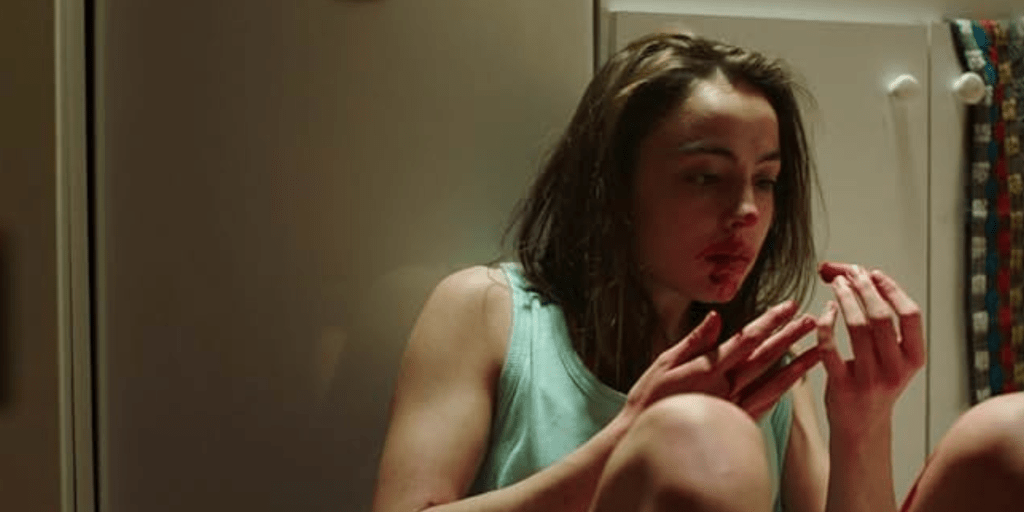
If we split the narrative into three component parts, with the first third of the film covering the hardships of coming of age, with the violent nature of sisterhood bleeding into the second part, this moment is where we get our first full hint of the part that ties both together. Alexia wakes up to the sight of her sister turning cannibal, and a tear streaks down her face. We don’t quite know why until the next morning, when Alexia takes Justine to a stretch of deserted road near the school and jumps in front of a car, making it veer off the road. It’s revealed that Alexia, too, has a cannibalistic nature and causes car crashes to eat either dead or dying victims, something which is hinted at earlier in the film. Alexia starts eating one of the passengers, so that Justine will “learn”, but Justine refuses and walks away, shaken.
Her hunger for human flesh, however, refuses to stop growing, and soon she’s lusting after her roommate and coming into her own sexuality while her true nature starts spiralling out of control.
The final part of the trifecta making up Raw is the idea of cannibalism as a generational curse. Here specifically, as revealed at the end of the film, it’s passed down the women in the family, with Justine and Alexia inheriting it from their mother. It’s a making literal of the horror of girlhood, the wanting so desperately to fit in, stand out, and just get by all at once. Through a neurodivergent lens, it hits extra hard because that horror is doubled as you try to do all of these things with the settings on what feels impossible. I remember my own desire, for food, for intimacy, for belonging, feeling not unlike Justine’s hunger for human flesh – insatiable, impossible, even more so because I did not have a familiar to guide me.
In the closing minutes of the film, after a horrific tragedy ends with Alexia in jail, Justine’s father (Laurent Lucas) assures Justine that it’s neither of the girls’ faults. With that, he explains that when he first met the girls’ mother, he couldn’t figure out why she didn’t want to be with him. The camera focuses on a scar on his top lip, the product, he says, of their first kiss, after which he understood. He unbuttons his shirt and reveals to Justine his chest, covered with scars and chunks missing, and gently tells his terrified daughter that she will find a way.
In horror is the closest I’ve ever come to finding the whole of me represented in ways I could not have imagined when I was a lonely teenager. And while I fear I may never be fully able to put into words just how held I feel by this genre, I can tell you this: Ducournau’s lens feels like a gentle hand reaching out, bloodied but friendly, offering a twisted assurance that I am not a monster and that I will find a way to exist how I am.

 NightTide Magazine
Leave a comment