
By Elijah Fischer
The 1972 photograph “The Terror of War” (also known as “Napalm Girl”) depicts Phan Thi Kim Phuc, a then 9-year-old girl in South Vietnam, fleeing from a napalm strike conducted by US-backed South Vietnamese forces against their own civilians after mistaking them for enemies. Phuc tore off her burning clothes and is depicted in the infamous photograph running naked down a smoke-framed road, surrounded by other crying children and loomed over by soldiers. Though the Pulitzer Prize-winning photo is regarded as one of the most important pictures of the 20th century, and is taught in schools around the globe as an example of anti-war iconography, the photo is hit with censorship to this day due to the nudity of Phuc.

In a guest essay for The New York Times, Phuc wrote, “I grew up detesting that photo. I thought to myself, ‘I am a little girl. I am naked. Why did he take that picture? Why didn’t my parents protect me? Why did he print that photo? Why was I the only kid naked while my brothers and cousins in the photo had their clothes on?’ I felt ugly and ashamed.” However, as she grew into an adult, Phuc began to understand the importance of the photo’s uncomfortable viscerality, particularly with school shootings making violence against children via military-grade weaponry an everyday occurrence. “I know what it is like to have your village bombed, your home devastated, to see family members die and bodies of innocent civilians lying in the street.” She wrote. “These are the horrors of war from Vietnam memorialized in countless photographs and newsreels. They are, in a different way, also the horrific images coming from school shootings. We may not see the bodies, as we do with foreign wars, but these attacks are the domestic equivalent of war. The thought of sharing the images of the carnage, especially of children, may seem unbearable — but we should confront them. It is easier to hide from the realities of war if we don’t see the consequences.”

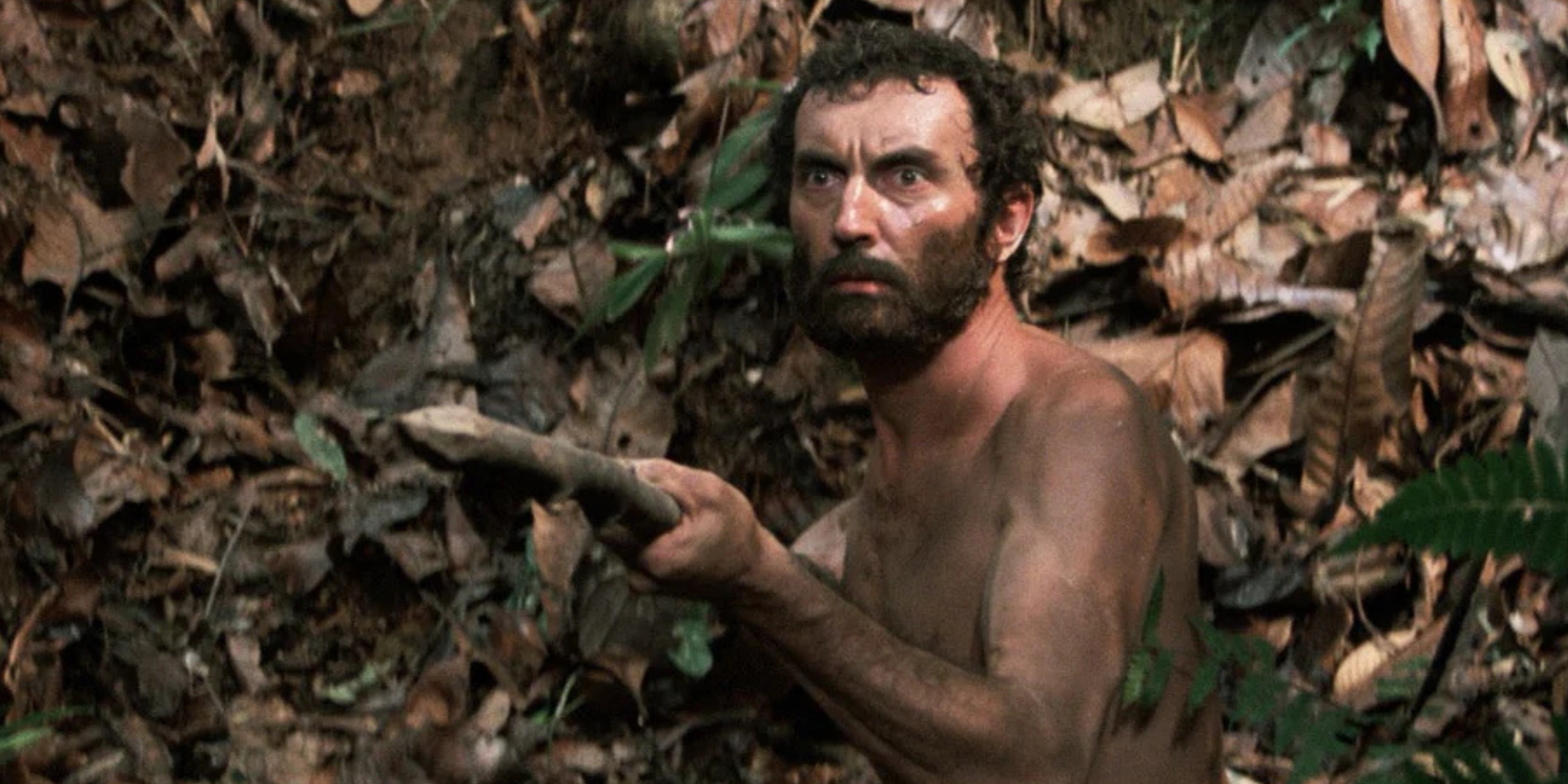
The cannibal subgenre is one inextricably linked to the horrors of Vietnam, particularly during the height of the mondo craze. But no mondo-era filmmaker’s work is as thematically connected to Vietnam as the work of Deodato, and no film of his is as strongly as Last Cannibal World (1977). Starring prolific Italian B-Actor Massimo Foschi, the film follows American oil prospector Robert Harper, who is stranded on an island in the Philippines while scouting for his next drilling location. After getting lost in the jungle, Robert is captured by a native tribe of cannibals, who capture him and strip him naked before torturing him until he falls unconscious. Robert spends days being held as a prisoner by the natives, during which he is urinated on, fed rotting meat, and sexually assaulted by a native woman named Pulan (Me Me Lai). When Robert discovers he’s being kept as bait for crocodile hunting, he plans his escape, during which he kidnaps and rapes Pulan, keeping her as his prisoner and using her as a guide through the jungle. By the time Robert escapes the island, he is the only member of the prospecting party left alive, Pulan has been killed and consumed by the tribe, and Robert has killed a tribesman and eaten his guts to prove himself to the tribe.
The presence of Vietnam is undeniable in Deodato’s cannibal works, but the connection finds itself most palpable here. Dreamlike shots of labyrinthian jungles, as beautiful as they are fatal, create a thick landscape throughout the film that makes you feel as swallowed as its protagonist. A score dominated by soft guitar and haunting theremin only heightens an alien feeling, as if we’ve wandered into somebody’s bad memories. The most damning evidence of Vietnam’s impact on Last Cannibal World is its use of nudity and sexuality. Sexual exploitation of Asian women, whether through outright rape such as the My Lai massacre or murkier instances such as the prevalence of “War Brides”, was one of the driving aspects of horror behind why Vietnam was such a vastly unpopular war. Last Cannibal World is full of naked bodies of both genders, but what makes it such an outlier amidst the mondo craze is that its most gratuitous nudity, objectification, and victimization come from none other than its white American male protagonist.

When Robert (played by Massimo Foschi) is first captured by the cannibal tribe, he is brought to their home within a cave. He is promptly tied splayed out to a rock, where the tribesmen then pull at and grope him before tearing off everything but his underwear. A native woman, Pulan, then comes forward and removes his underwear, pulling at his penis alongside the tribesmen. Robert is then tied to a pulley mechanism that lifts him in the air like a bird and drops him from a great height, repeating this until he passes out. Robert wakes up in captivity, still naked, and spends the rest of the movie almost entirely nude, save for leaves over his private parts. The scene in which Robert is stripped, as well as the scene where he is forcibly masturbated by Pulan, are unique in the cannibal subgenre through their outright victimization of a male.
We’ve seen white people put on the receiving end of the sexual violence committed against indigenous peoples in films such as the gangrape of Faye Daniels (Francesca Ciardi) at the end of Deodato’s own Cannibal Holocaust (1980), and we’ve even seen white men emasculated via the literal removal of their penis in films such as Cannibal Ferox (1981) and Slave of the Cannibal God (1978), but when white men receive violence that targets their gender in these movies they never appear fully naked except in Last Cannibal World, where the camera lingers across Foschi’s exposed body the same way it lingers on Mei Mei Lai’s in later scenes. Through his complete nudity and the camera’s lengthy depiction of it, the film explicitly disempowers Robert in a way that carries throughout the rest of the film. Even when he commits acts of “retributory” violence against the natives, such as the rape of Pulan or his fatal defeat and consumption of a tribesman in combat, Robert is never seen fully clothed again. In the end he may escape and return to “civilization”, but our last image of Robert is a dirty, bloodied, almost naked man fleeing Mindanao in a plane, reminiscent of the American choppers seen fleeing the Fall of Saigon.
Another way in which Last Cannibal World sticks out from its contemporaries and what would follow it in the cannibal subgenre is its depiction of cannibalism and tribal violence, another remnant of Vietnam’s greater cultural trauma. The tribe in Last Cannibal World is not mindlessly violent, such as the Ya̧nomamö in Cannibal Holocaust, but instead deeply strategic in a way that mirrors the Viet Cong. The tribe uses snake venom-tipped spears as weapons, a tactic also applied via urban legend to the Viet Cong. They have an intricate knowledge of the jungle that Robert and his companions repeatedly get turned around in, leading to him forcing Pulan to help him find his way back to the airstrip. Using this knowledge, the tribe fills the jungle with intricate traps, many of which almost kill Robert and take out the rest of his party. The echoes of Western military powers’ defeat in the jungles of Vietnam are felt as Robert is increasingly outmatched by those he deems “savages”.

The cannibalism depicted in the film is also not spontaneous, but deeply ritualistic and tied to emotional weight. The people eaten are cooked, and in most cases, shown are killed and consumed as part of a justice system within the tribe. However, the most notable consumption does not feel like a matter of justice, but rather a final reminder to Robert and all he represents that the jungle does not belong to him.
After Robert has raped Pulan (and, problematically, formed a sort of romantic relationship with her) and she has guided him back to the airstrip, the tribe kills Pulan just as Robert is about to escape with her. Robert watches as the tribe consumes Pulan, set to a soft and beautiful score in an ironic stylistic choice that Deodato would become known for later with Cannibal Holocaust. The ritual in which Pulan is prepared and consumed is almost depicted with a sense of beauty, similar to the sense of beauty the expansive jungle, with all its dangerous tribes and wildlife, is depicted with as Robert journeys through it. On a more obvious level, there is the Orientalist “beauty of the unknown”, but on a subconscious level, the beauty of Pulan’s consumption comes from robbing Robert of his “War Bride”. Throughout the film, Robert is only allowed victories that dehumanize him. To escape with Pulan would be a colonialist victory, one that the tribe doesn’t allow, contributing to the film’s throughline of disempowering the colonizer as punishment for his crimes.
Though impressive in its transgressiveness, Last Cannibal World is obviously a double-edged sword, playing into racist and misogynistic tropes as well as subverting them. Deodato seems incapable of making a statement on colonialism through mondo without falling victim to his own criticisms, as he did with his egregiously unethical behavior during the production of Cannibal Holocaust. However, the controversy has only contributed to a cultural legacy that has made the works of Deodato persist, while his contemporaries like Umberto Lenzi have been forgotten. In a 2015 interview with Tristan Thomas alongside Francesca Ciardi, Mei Mei Lai said that while “I don’t like watching my own films, certainly not the cannibal ones”, her outlook on her work in the mondo genre has somewhat changed with the distance of the decades. “I’m glad now that they were controversial. I wasn’t pleased at the time, but on reflection the more controversial they were, the better it was for me. But at the time it wasn’t so good.” The cannibal subgenre is one full of contradictions and hypocrisies, but its controversy and exploitation comes hand in hand with shining a light on colonialist legacy in the Global South and East through upsetting art. Mondo cinema may be uncomfortable to sit through, but it is ultimately a consequence of real life atrocity, and as “Napalm Girl” Phan Thi Kim Phuc wrote, “It is easier to hide from the realities of war if we don’t see the consequences.”


Elijah Fischer is a journalist and film critic based in Philadelphia, PA. For further comment or writings he can be found on Instagram (eli.fis03), Letterboxd (eliserhead), or contacted by email upon request.


Leave a Reply