By Ray Walton
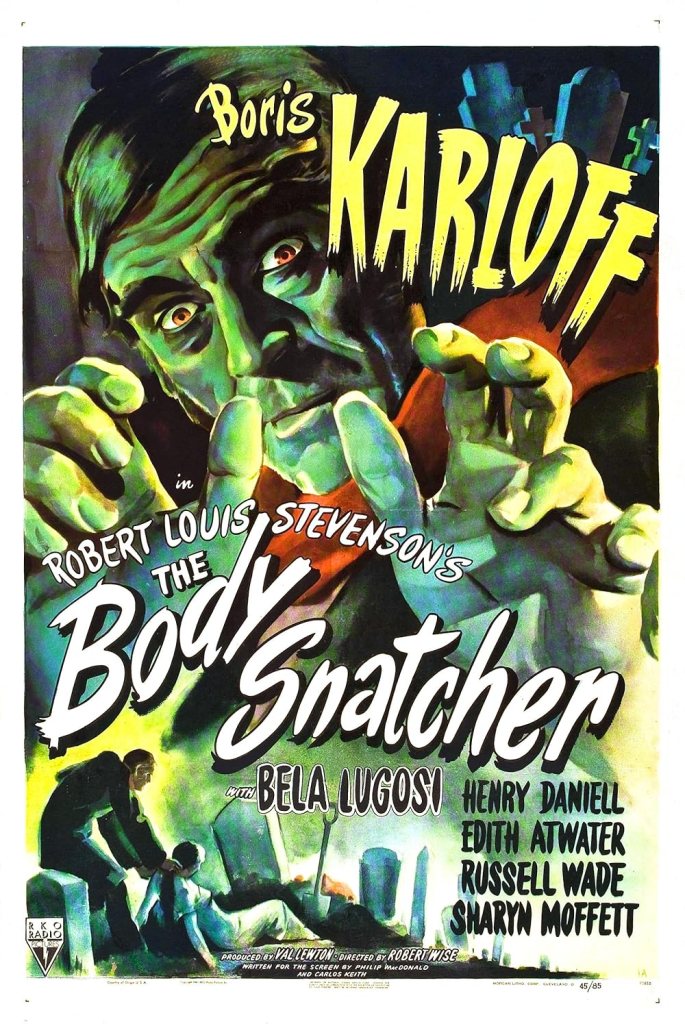
The Body Snatcher (1945) Director: Robert Wise ⭐️⭐️⭐.5
A ruthless doctor and his young prize student find themselves continually harassed by their murderous supplier of illegal cadavers.
Released in 1945, The Body Snatcher emerged at the close of World War II, a moment marked by deep unease around authority, scientific progress, and bodily autonomy. Directed by Robert Wise as part of Val Lewton’s cycle of atmospheric horror, the film adapts Robert Louis Stevenson’s tale of grave robbing and medical exploitation, a story rooted in real historical anxieties surrounding the Burke and Hare murders in 19th-century Edinburgh.
Rather than relying on spectacle, Wise employs restraint, shadow, and implication to generate dread. Violence often occurs offscreen, forcing the audience to sit with suggestion rather than action. The film’s horror is institutional rather than supernatural, shaped by systems that normalize exploitation in the name of advancement. In this way, The Body Snatcher reflects a broader cultural reckoning with who holds power over bodies, and at what cost.
I mainly associate Boris Karloff with Frankenstein’s monster, so it was refreshing to see him here without heavy makeup: speaking, negotiating, and fully inhabiting a character who is unsettling in a much quieter way. It’s easy to understand why Karloff became so closely linked to horror, but what stands out is how willingly he embraced the genre, even when the terror came from restraint rather than spectacle.
I didn’t love The Body Snatcher, but there is a great deal to appreciate. Director Robert Wise takes a less-is-more approach, partly due to the restrictions of the 1940s, but that limitation works in the film’s favor. The offscreen violence is often more effective than anything explicit; moments where sound abruptly cuts out, or a struggle suddenly ends, are surprisingly chilling.
Henry Daniell and Russell Wade give strong performances as Dr. MacFarlane and Donald Fettes, and over the film’s brief runtime, both characters are allowed complexity. Their arcs are shaped by compromise, ambition, and unease rather than clear moral lines. Bela Lugosi’s small role as Joseph adds texture, though it’s puzzling that he received such prominent billing, given the weight carried by Daniell and Wade.
What stayed with me most is how ordinary the horror feels. The Body Snatcher isn’t about monsters in the traditional sense, but about choices made quietly and justified easily. Karloff’s presence looms over the film not because he is supernatural, but because he is disturbingly practical. There’s a reason he remains an icon; even here, he commands attention.
Why tonight?
Because this is a film where horror lives in implication, and in the sound that suddenly stops.


 NightTide Magazine
Leave a comment