
By Mo Moshaty
You may have noticed that we’ve been focused on “the after” here at NightTide. The post-festivities blergh, the dead calm, the dark days. You may say we’re fixated on what the hell we all do now after making resolutions as our worlds fall apart…literally. I suppose it’s more of a “new year, new boo” with us. Haunted by trauma, survival, and here, survivor’s guilt. “After Horror” isn’t empty. Survival doesn’t clear the space. It reorganizes it. What remains isn’t so much a ghostly return, but a continued presence that must be lived alongside.
Horror has trained us to expect a kind of quiet after survival. The monster is gone, the threat has passed, and what remains, we’re told, is simply just absence. The house has emptied of danger. Our life is cleared of intrusion. In After Horror, the noise should stop.
But some films seem unconvinced by that idea. They don’t rush to fill the space with relief or any closure. They linger instead on what stays behind; not as a haunting in the traditional sense, but as a condition that is already settled in. These stories aren’t interested in what arrives after the danger; they’re interested in what never left. After Horror in these films, isn’t empty, but pretty fucking populated.
When you really think about it, survival doesn’t reset the environment; it just reorganizes it. The rooms are the same, but they feel different. The body moves forward, but it does so alongside memories, histories, and presences that refuse to be dismissed as past. What remains isn’t always hostile. Sometimes it’s intimate, sometimes it’s necessary, and sometimes it’s simply unavoidable.
Horror usually teaches us to watch for intrusion. The open closet door, the figure that appears, the sound that shouldn’t be there. But there’s another mode of horror that’s quieter and less patient that asks us a different question: What if the most unsettling thing isn’t what enters the space, but what continues to occupy it?
These films are not about being chased. They’re about living with proximity, and they treat aftermath as something that must be negotiated rather than escaped. Survival, here, doesn’t really clear the room; it only confirms who’s still in it. This kind of horror doesn’t build towards eradication or release or any type of catharsis. It just settles into coexistence. You’ve just got to deal with it. The threat doesn’t need to announce itself again. You’re pretty aware that it’s there, and it has already shaped the conditions of the living and those left behind. The work of the story isn’t to remove, but to show what it means to go on with it still present. After Horror is learning how to live in a space that no longer belongs to you alone.
Presence is usually a problem to be solved. Something appears where it shouldn’t, a boundary is crossed, and the story organizes itself around its removal. Find it, name it, kick it, get rid of it. But the films that operate in this quiet After Horror register seem less interested in arrival than in duration. Presence isn’t the threat; it’s the condition. It doesn’t always oppose the characters directly. It simply stays: shaping how space is used and how life continues.
What’s creepy isn’t that something isn’t there, it’s that it can’t be neatly confronted. There’s no clear antagonist, no ritual that promises resolution. That’s a kind of, maybe sort of, survival complication. If presence isn’t something to be defeated, then surviving doesn’t mean restoring the world to what it was before. Which brings us to houses, bodies, and histories that were never as empty as we thought.
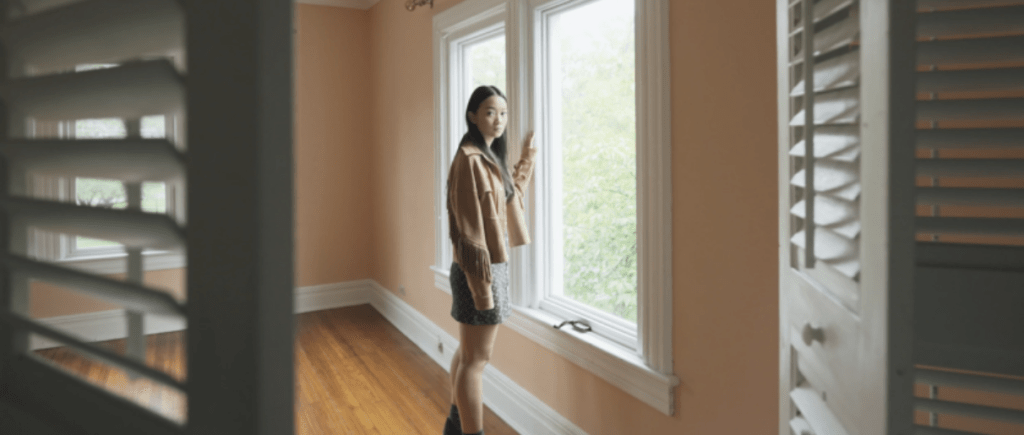
This House Was Never Empty – Presence (2024) dir. Steven Soderbergh
Presence begins by undoing one of horror’s most reliable assumptions: that a haunted house becomes haunted when something enters it. Here, the house is already occupado.
What makes Presence so effective is how little it insists on this fact. There’s no dramatic arrival, no escalation meant to convince us that the space has changed. Instead, it asks us to accept that the house has always been shared, and that what unsettles the characters isn’t discovery but duration. It’s been there as a constant, patient witness.
This shifts the emotional logic of the haunted house entirely. It’s a cohabitation, not a violation…messy. By using the entity’s POV, the presence drains the situation of over-performance. We’re not watching the house from the outside, waiting for some jump scare. We’re stuck inside, observing routines, conflicts, silences, dead space, and family fracture in real time.
What’s interesting is how quickly this normalizes unease. The longer the film stays with the family, the clearer it becomes that the house isn’t the problem. The presence isn’t intruding on a copasetic family life; it’s smack-dab in the middle of grief, rivalry, distance, and unresolved tension and showcasing just how long these cracks have been there. This is where it aligns so well with After Horror. The film itself isn’t troubled with the impact, but what happens when it’s already occurred, and life traipses unmerrily along anyway. It exists in trauma’s aftermath, occupying the same rooms as the living who are trying (in varying degrees) to move forward.
There’s a deep cruelty in how calm the film remains, leading folks to call it a dud or my fave, “not even scary”. But without that escalation, the audience is really denied the comfort of clear danger. Soderbergh didn’t promise you a rose garden of Poltergeisty proportions. The horror here emerges through accumulation. A glance that lingers, a movement of something you didn’t put there, a domestic dispute framed by an unseen listener. Presence understands that the aftermath rarely announces itself; it settles into habit, becomes part of the furniture. Just because you’ve survived doesn’t mean that furniture has moved, been refurbished, or upcycled.
Importantly, the film resists the fantasy of a clean exorcism, no reclamation of the home after its disturbance. Whatever resolution the story leans toward is provisional at best. Maybe mom is like, “well, I better focus on the kid I got left”, “maybe I’ll come clean about whatever the fuck I had on the line for my son’s benefit” …who knows, who cares even. The unease of Presence comes it’s refusal to grant any relief. The house remains unoccupied again, the characters altered. Nothing can be undone or opposed. Sit with that, kids, it says.
The film doesn’t use haunting as a metaphor for invasion, but more as a way of dealing with the aftermath. About how survival rearranges space and our best laid plans. About how some things don’t leave when the trauma passes.
The house was never empty.
The horror is learning how we live as if it were.
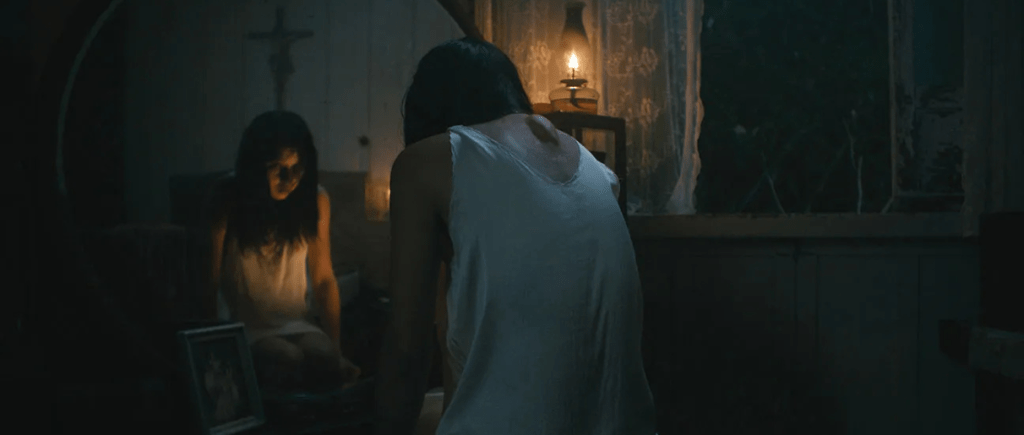
Love That Survives Too Much: In My Mother’s Skin (2023) dir. Kenneth Dagatan
If Presence shows aftermath as coexistence, In My Mother’s Skin shows it as entanglement. This is a film where survival arrives braided tightly with love, belief, and moral compromise, oh, and body horror.
The horror doesn’t replace care; it snakes its way through. What lingers is devotion stretched to the point where it begins to change shape.
Set in the Philippines during the final months of World War II, In My Mother’s Skin situates its horror inside a landscape where survival has already been stripped of moral clarity. Occupation, scarcity, and rumor have collapsed the distance between protection and all-out danger. When the family patriarch leaves, the absence doesn’t create a vacuum but exposes just how little the household has its shit together. What matters here isn’t the arrival of the flesh-eating fairy, BUT the conditions that make her presence digestible (get it?).
The film shows survival as a state where belief becomes functional. The family’s young daughter, Tala, turns to the fairy in an attempt to stabilize a world and environment that’s proven itself unreliable. The supernatural extends the logic of war and offers certainty in exchange for cost and continuity in exchange for compromise.
The violence has already recognized the family’s emotional and ethical terrain. They are rich, entitled, and removed – so of course, the less adapted to struggle, the more we turn toward quick fixes, even the bad choices. But here, we’re not choosing between right/wrong, good or bad, but between bad and worse. The fairy arrives because care has already been stretched thin by circumstances that refuse to let it remain gentle. Love has already been forced to change shape to survive. Love doesn’t disappear; it’s just altered by necessity. Protection becomes something that has to be bargained for, and for a child whose entire world has upheaved, it’s a hell of a lot to ask them to sit with.
There’s something here that echoes a familiar pattern in horror, one that shows up most clearly when children are involved. Like Let The Right One In, In My Mother’s Skin understands that children will move toward wherever care appears the most available, even when that care is conditional, dangerous, and predatory.
What matters isn’t whether the care is good, but whether it feels present.
In both films, the supernatural doesn’t lure children through cruelty or fascination. It offers attention, protection, and consistency in worlds where adults are absent, overwhelmed, or structurally unable to provide safety. The danger is outweighed by the promise of being looked after, of being seen, of being held steady when everything else is falling apart. It makes Tala’s choice understandable. She’s not drawn to the fairy because it’s monstrous, but because she seems like the most reliable person around. Even distorted care looks handsome.
In My Mother’s Skin shows survival instinct born of circumstance. When care is scarce, children will gravitate toward continuity, even if that continuity comes at a cost their little minds can’t measure. It was the wrong choice, but the only choice she had.
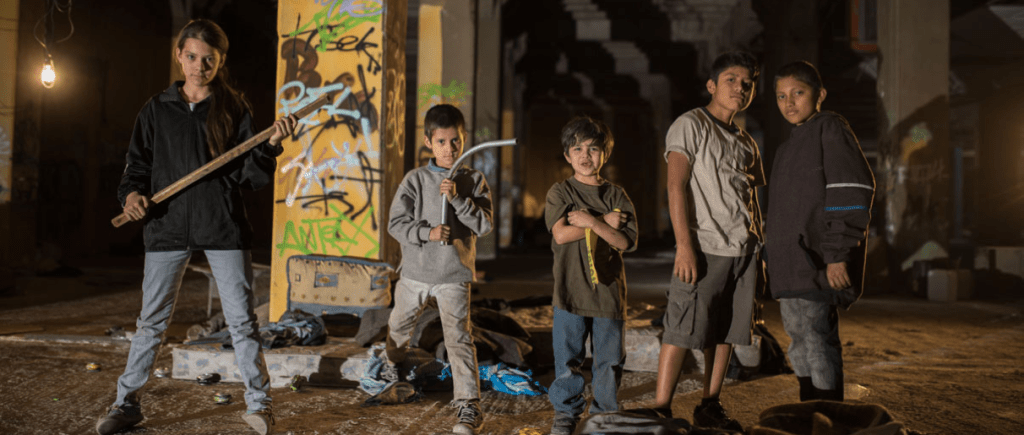
Walking Forward With Witnesses: Tigers Are Not Afraid (2017) dir. Issa López
Tigers Are Not Afraid gets that same gravitational pull toward care, but it asks the question of where that pull might lead.
If In My Mother’s Skin shows how distorted care can become when survival narrows the available choices, Tigers Are Not Afraid shifts the register without abandoning the logic. In this film, children are still moved toward what feels attentive and present…each other. The difference is that the care they find doesn’t ask to consume them in return.
The film’s ghosts are companions, not tempters.
The children don’t recoil from ghosts here; they accept them with the same wary pragmatism they bring to everything else. In a world shaped by cartel violence and abandonment, the supernatural doesn’t register as more frightening or more dangerous than the living…just another day at the office.
Care is shared, not clean.
The ghost that follows Estrella doesn’t pull her backward. It moves with her, acting as a witness rather than an obstacle. A reminder rather than a threat. The film makes a powerful adjustment here. Children still gravitate toward care, yes, but care here doesn’t masquerade as salvation. It doesn’t promise safety. It offers camaraderie. In the absence of assumed dead adults, targets on their back, and unstable structures, that company becomes a way of staying oriented in the world.
What sharpens the tenderness is the fact that every child in Estrella’s orbit has been orphaned by cartel violence. These are not abstract losses. They are sudden, brutal erasures that leave children with no language, no rituals, and no adults capable of helping them make sense of what’s happened. Asking a child to emotionally or cognitively reconcile that kind of loss is not just unreasonable. It’s cruel. The film never pretends otherwise.
In this context, the presence of the ghost feels less like a fantasy and more like a necessity. These children are carrying grief that has nowhere to go. The dead become a way of acknowledging what the living world refuses to hold long enough. The ghosts don’t solve anything. They don’t soften the reality of what’s been taken. They simply offer recognition in a landscape that demands children move on far too quickly.
What Tigers Are Not Afraid seems to understand is that when the scale of violence exceeds a child’s capacity to process it, imagination steps in where care should have been. The supernatural becomes a way of keeping loss visible, of refusing the impossible demand that children metabolize atrocities on their own…and quickly.
This is why Tigers Are Not Afraid belongs to After Horror. The film isn’t concerned with the moment of violence itself, but with what happens once that violence has already taken everything it can, leaving children to live inside the consequences without the tools to make sense of them. After Horror, here, isn’t about recovery or moving on. It’s about the immense emotional labor placed on children that can seem invisible to mature eyes, and the weight of their losses that were never meant to be theirs.
What these films share is a refusal to treat aftermath as absence. In each case, survival doesn’t clear the space or quiet the damage. It changes the terms of living. After Horror, here, isn’t the moment when danger ends, but the longer stretch of life that begins while its effects are still shaping everything.
Presence lingers in different firms across stories. Sometimes it settles into architecture, sometimes into intimacy, sometimes into companionship. What remains is not always hostile, but it’s never neutral. Memory, loss, and obligation stay close, reorganizing how people move through the world rather than announcing themselves as threats to be defeated.
This is especially true in films centered on children, where demand to “move on” becomes quietly brutal. After Horror, I’m defining here, is the impossible emotional labor placed on those least equipped to carry it. The supernatural piece doesn’t intrude so much as step into a vacancy left by systems that have already failed.
What makes this strain of horror so resonant is it’s uwillingness to tidy shit up. These films don’t reward survival with balance. They allow the dead to remain visible, the past to stay active, and care to persist in compromised forms. They accept that living after violence isn’t a matter of resolution, but proximity and negotiation.
After Horror, then, is not an ending at all.
It’s the condition under which life continues, shaped by what refuses to leave and what must be carried forward anyway.


 NightTide Magazine
Leave a comment