By Mo Moshaty
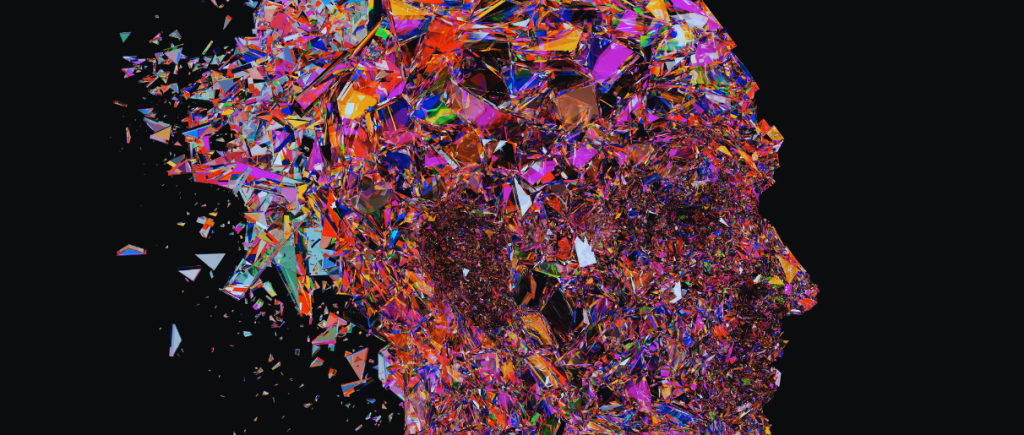
There’s a particular kind of restlessness that lives inside my work. It isn’t anxiety…exactly. Its ambition, but not the shiny kind that people like to applaud. It’s the feeling that everything matters at once.
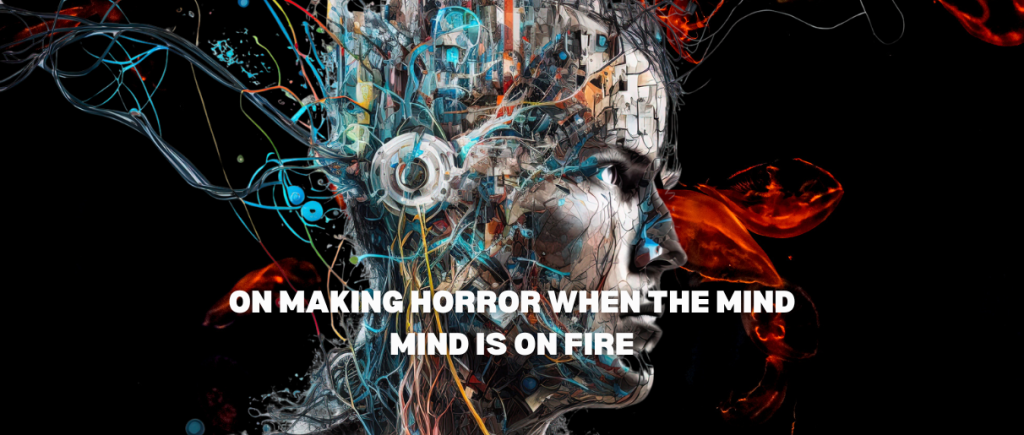
I write horror with a brain that refuses to queue through its thoughts. Ideas don’t drift in single file; they rush me like a zombie crowd breaking through a barricade. A lecture outline becomes twelve tangents. An essay meant to be lean starts to bloom outward, reaching for context, nuance, or anything that might keep it from being misunderstood. I worry I’m saying too much and in the same breath, not enough.
This is ADHD as a horror creative: the constant negotiation between urgency and exhaustion.
Executive dysfunction doesn’t look dramatic from the outside. It looks like staring at a screen filled with words I know how to arrange but can’t yet touch. It looks like knowing exactly what I want to say and needing three false starts before the sentence lets me through. It looks like loving my work deeply and still struggling to begin it.
There’s a myth that people like me are chaotic but carefree, that ideas come easily, and that creativity is a kind of endless adrenaline rush. The truth is much heavier. Every piece carries a low-level fear: Will this resonate, or did I lose the thread somewhere back there? Did I bury the lede too much under word vomit? Did my devotion to clarity become clutter?
And yet I keep choosing care. I want my work to hold people. I want it to feel researched, intentional, aware of where it sits in history, who it speaks for, and to be inclusive without flattening difference. I want to be precise without gatekeeping. I want to be expansive without erasing myself. I want to walk within my mission, not just cite it.
That desire, to do right by horror, by readers, by marginalized voices, by the genre that raised me, comes from the same place as my overwhelm. ADHD actually sharpens my ethics. It makes me notice everything. Patterns, absences, repetition, harm. It makes it hard to look away, but it also makes it hard to stop.
On the other side of that coin, wins don’t land cleanly for me. They slide off, half celebrated because my mind has already moved on to the next mountain. Another essay to finish, another platform to build, another person to uplift. Another gap I haven’t filled yet. Achievement becomes transitional, something I pass through on the way to responsibility. I don’t linger with praise because there’s always more to do and someone else who needs space, patience, light, and protection. This is the part people don’t always see: How types of care can become self-erasure if you don’t know how to pause for yourself.
ADHD gives me hunger, not greed, hunger. For connection and for impact. For doing horror well. It’s why I want to teach everything, curate everything, fix everything, and say yes too often. Horror is a house with many rooms, and I want to open all the doors at once, even if it costs me sleep, silence, and stillness. Sometimes I worry that my mind makes me too much: too wordy, too layered, too earnest, too aware of how fragile representation can be and how easily it fractures under careless analysis. I wonder if readers feel educated or overwhelmed.
But then I remember this: horror has always belonged to the excessive.
Horror is obsession, it’s rumination, and it’s returning to the same wound from different angles until it speaks back. Horror gets fixation. It understands minds that won’t let go. It runs on the engine of having too many thoughts and nowhere safe to put them. My ADHD doesn’t sit outside my horror work. It shapes its rhythm and its density and its insistence on context. As well as its refusal to simplify pain into something digestible or marketable. If I’m relentless, it’s because horror taught me that what we don’t examine will haunt us anyway.
I’m learning slowly to celebrate myself without guilt; to mark a milestone without immediately converting it into a to-do list, to trust that the work can breathe without my constant supervision, and to let a piece stand as finished, even if my brain is already whispering revisions.
I make horror with a mind that never fully rests, and I’m still learning how to rest inside of it. I’m still learning how to believe that what I’ve built matters, even when I’m already thinking about what comes next. If you’ve ever felt this way: overfull, under-celebrated, and burning with the next idea, I see you.
Some of us don’t create horror simply because we love the fear. We create it because our minds have always known how to survive it.

 NightTide Magazine
Leave a comment