

By Paul Wooldridge
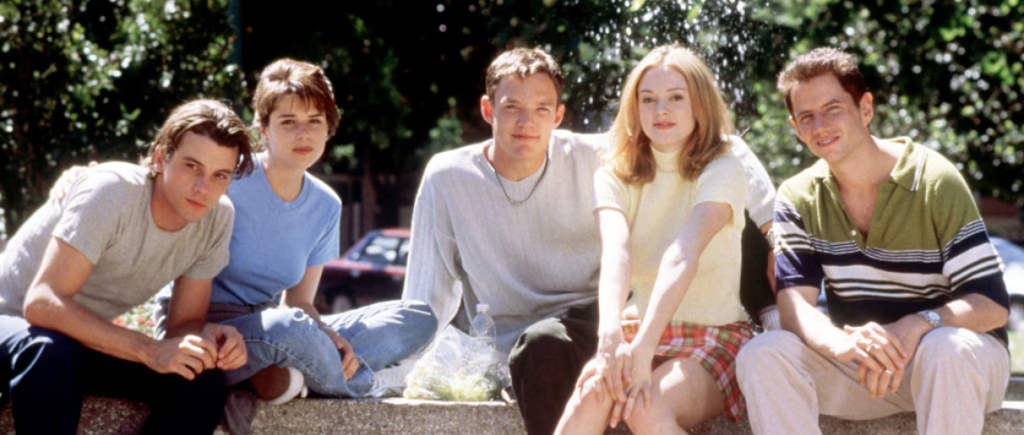
Thirty years after it first tore through cinemas, Scream is edging towards its seventh instalment. When Wes Craven revived the slasher in 1996, he did it with a meta grin that felt both accessible and properly entertaining. He’d already toyed with horror blurring into “real life” in New Nightmare (1994), but Scream made that trick mainstream, a box-office-friendly recalibration that turned genre rules into punchlines and weaponised self-awareness. Teaming up with writer Kevin Williamson, the pair rejuvenated the genre, revelling in self-awareness and redefining horror as a cinematic experience worth the attention of a new generation.
The 90s version of teenage life that Scream gives us is glossy and oddly ageless. High schoolers played by actors brushing thirty, spouting hyper-literate dialogue between house parties in suspiciously large suburban mansions. Sidney Prescott and her friends embody a very specific fantasy of American youth culture.
What made Scream feel new was how familiar it insisted everything already was. The characters aren’t naïve; they’re fluent in film lore, as aware of horror clichés as the audience watching them. That shared language turns the violence into a game of expectations, and it also lets the film smuggle in its ugliest assumptions under the cover of a wink and a nudge.
The film’s older characters are largely absent, ineffective, or have any semblance of trust in them undermined throughout the film. When Woodsboro’s aged sheriff states that “Kids today, damned if I know,” he demonstrates he no longer has any idea what the youth are capable of, and to him are an unknown species to which he can no longer relate. The High School Principal even suggests two of his students, examples of the “thieving, whore-ing generation” that disgusts him, should be gutted and shown to be the “heartless desensitised little shits” he knows them to be. The fact that the pinnacle of 70s cool, Henry “The Fonz” Winkler, is playing the head teacher of Woodsboro High only goes to show how yesterday’s teen heroes, if they don’t die, only live long enough to become today’s symbols of societal conformity.
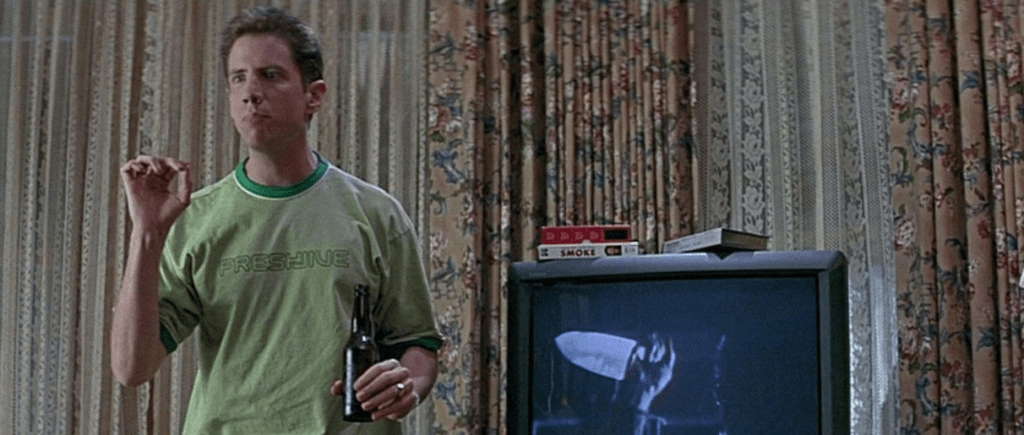
The evils of pop culture and stylised violence, which Scream itself is a fine example of, are continually lampooned, culminating with Billy Loomis’s memorable line…. “Don’t blame the movies, movies don’t create psychos, movies make psychos more creative.” Scream laughs at blame and then dodges accountability with the same breath.
The rules of slasher cinema may have been understood before Scream, but it was Jamie Kennedy’s Randy Meeks who declared them loud and proud as being something patently obvious to any self-respecting horror lover worthy of their Blockbuster video card.
The recounted “rules of slashers” are simplified tropes from the late 70’s through to the 80’s, which Halloween (78) made famous, and to which Scream pays most obvious homage. Scream 96’s focus on this set of “rules” both reduces the genre’s wider appeal and solidifies its lesser achievements in the eyes of inexperienced audiences. It’s a crowd-pleaser, sure. It also turns genre into a checklist, with consequences for everything that follows.
The only adult characters that are focused on are morally opposite and exist as an “Odd Couple” for both comic and romantic relief. Although both Dewey and Gale are sold as functioning adults, they are both heavily caricatured, with Dewey playing the role of a naive and bumbling sheriff’s deputy, and Gale as an overly ambitious uber-bitch journalist. It’s to the film’s credit that the cast extends beyond the overly earnest teens and allows the initially hateful Gale to soften, via her romance with the hapless Dewey, and inveigle her way into the audience’s affections.
With slashers being primarily focussed on teenagers and the issues that loom largest for televisual ideas of teens, i.e., sex and schoolwork, Billy and Sidney’s relationship ties in nicely with the overt influences of 90’s patriarchal pop culture. Billy spends virtually the entire film gaslighting his girlfriend into increased sexual activity, and Sidney is even reduced to apologising for her understandable reactions to a whole load of very recent familial and personal trauma, as if her fear and suspicion are the problem, not the fact that she’s being hunted.
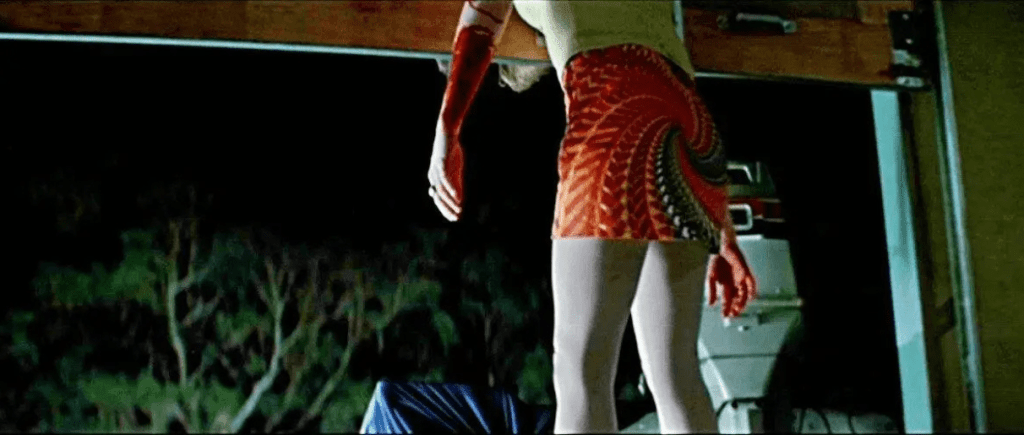
The young girls in Scream (and it’s worth remembering that they are meant to be school children) measure themselves against their perceived desirability to the boys in their lives and whether they feel they are performing the duties they think are befitting a good girlfriend. Objectification also expands to include the cast of Halloween 1978, and discussions are held concerning the expectation of seeing Jamie Lee Curtis’ on-screen breasts. This simplistic reduction of both teenage boys and female representation culminates in Tatum’s death. The murder of a young girl is upstaged by the peanuts she’s forced to smuggle down the front of her figure-hugging top.
The film’s fixation on female desirability and vulnerability mirrors the broader entertainment culture of the 90s, where young actresses were routinely commodified and scrutinised. Looking back, that atmosphere is hard to ignore. The unpleasant underside of 90’s culture is only further highlighted by the real-life assault of actress Rose McGowan, a year after the film’s release, at the hands of the convicted sex offender Harvey Weinstein. The #MeToo movement, a decade later, sought to tackle the institutionalised abuse that was prevalent in Hollywood throughout the 90’s.
With Scream arguably being the apex of 90’s youth culture, it also, in retrospect, suffers from the same unpleasant elements of the wider society. As much as the curtain hairstyles, baggy denim, and fitted knits spark nostalgia for the decade, the film is replete with toxic masculinity and the ghosts of “Lad’s mag” ideology.
The film’s inherent misogyny manifests in the young males’ preference to repress their emotions, avoid therapy, and indulge in laborious mansplaining, something that Sidney quickly tires of and even belittles Billy Loomis as being a “Pansy ass Mama’s Boy” in the film’s violent climax. She pushes back, but she’s still forced to do it in the language the culture hands her.
The 90’s are considered to be the shift to the modern digital age, when young people attended house parties and hung around malls experiencing life in person, and didn’t just exchange memes or selfies. The 90’s were free from the pressures of social media, and mobile phones were relatively new and were, in fact, just phones, not cameras or social media portals down which one would regularly disappear.
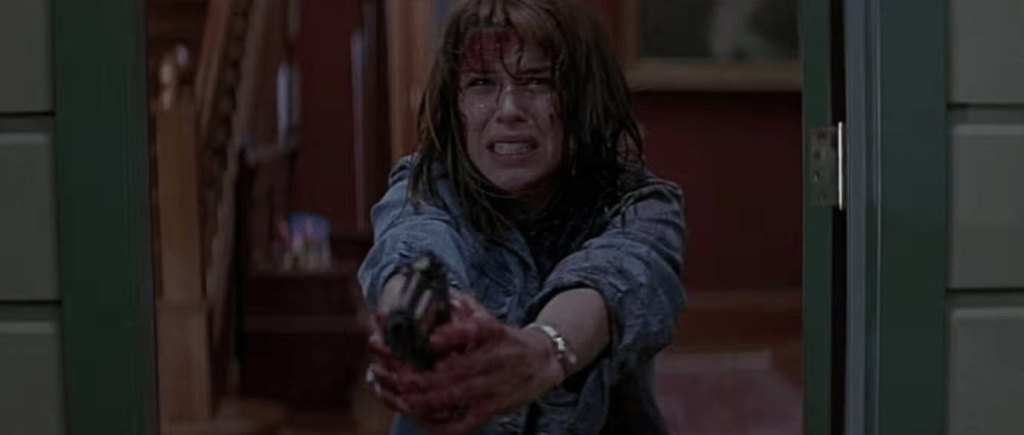
The cast of Scream 96 are all incredibly white and spend their time partying in vast isolated mansions, owned by absent parents who surely coddle their wayward offspring with trust funds and a secure future that’s never in doubt. The entitlement is writ large and is a forerunner of the Eli Roth-sponsored Bro Horror of the 00’s, which Matthew Lillard’s portrayal of a more sexually fluid Stu cannot hope to overturn. Although Sidney breaks one of the most famous rules of slashers, having been emotionally duped into having sex with Billy, she disproves the “sex equals death” guideline and survives, killing both the film’s villains.
Like much of the ‘Girl Power’ exposited by the Spice Girls and manifested in the likes of Buffy or Xena, Sidney does kick ass, as it were, fighting back against the misogyny with which she is faced. This limits the extent to which Scream can be considered feminist, however, as Sidney being a powerful female agent is different from the film empowering women. In Scream, Sidney is forced to compete with men at their own patriarchal game, which could be considered a reminder of “Ladette” culture, a period of the 90’s where women sought to join in with men and their least commendable stereotypical activities.
This supposed feminist subversion doesn’t, however, overturn the inherent 90’s misogyny that runs through the core of this film, like a Danny Dyer advice column through a copy of Loaded magazine.
Scream sequels have taken steps to include more diversity and have even mockingly acknowledged a wider range of cultural tropes. Scream 2 and 3 took on the stereotypically limited life spans of Black cast members and even acknowledged the misogyny rife within film studios. It is to the franchise’s credit that later films have continually tried to satirise many of the ongoing issues of the time, taking swipes at maniacal directors, hysterical film fans, shifting sexual politics, and attempts to reflect the more woke elements of society in which the movies are set.
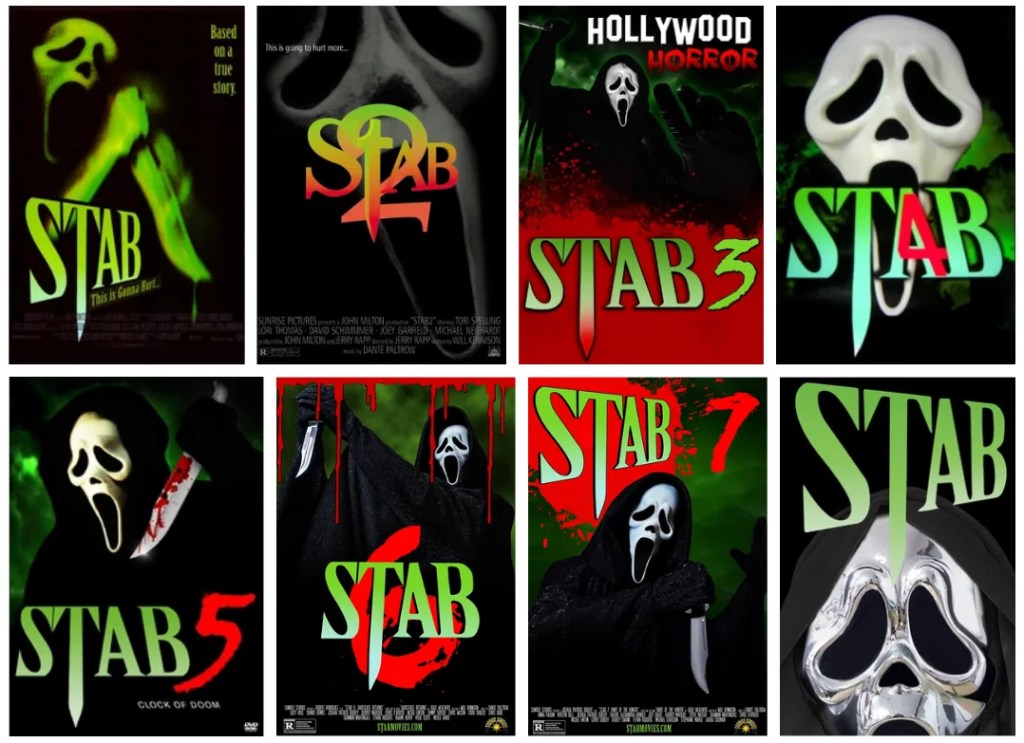
The creation of “Stab”, a satirical film within a satirical film, is an opportunity for the franchise to tie itself up in self-referential meta knots, as actors play themselves, playing characters in a film which is mocking the characters in the main film, played by other real-life actors. Such a conceit offers an Inception-style layering that heightens the levels of entertaining absurdity.
Rewatching or remembering a film through a rose-tinted haze of nostalgia can easily make a film feel exceptional, and we can delude ourselves into believing there was such a time or place as the Good Ol’ Days. As Sartre would have it, thirty is the age of reason, when one must take responsibility for the decisions made as part of maturing into adulthood. I think the Scream franchise has successfully grown, since its conception in the mid-90s, but acknowledging its flaws, and accepting it as representing both the good and the bad of the time, should not prevent it from being a much-loved genre revitalising classic.


 NightTide Magazine
Leave a comment