
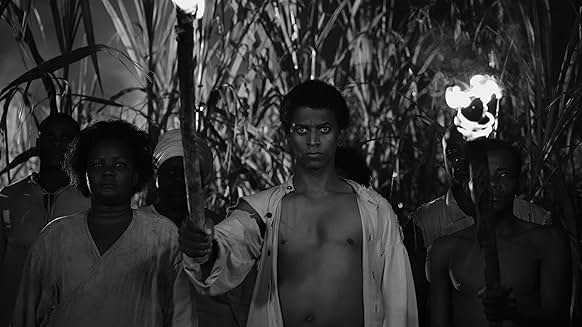
By Mo Moshaty
Black Zombie does something necessary: it returns the zombie to the context it was taken from.

Black Zombie (2026) dir. Maya Annick Bedward ⭐️⭐️⭐.5
A journey through cinema and history reveals how zombies evolved from Haitian spiritual traditions into Hollywood horror, exploring their deeper cultural significance as powerful symbols of resilience.
For audiences who have only ever encountered the figure through Hollywood, decay, infection, and apocalypse, the film reintroduces a history that has been flattened, distorted, and, at times, completely erased. The zombie, as the film carefully lays out, is not just a “monster”. It’s a body stripped of autonomy. It’s tied to enslavement. It’s a metaphor born out of the violent realities of control, of being made into something that no longer belongs to you.
That foundation is clear, and it lands with intention. Director Maya Annik Bedward is equally clear about what she wants the film to do: to make the origins of the zombie “common knowledge” and to reach as many people as possible. There’s something deeply necessary in that. Too many people still assume that Vodou is sinister, something to fear, rather than a spiritual system rooted in community, healing, and survival. In that sense, Black Zombie is doing corrective work, and it does it damn well.
But once that correction is made, the film doesn’t always push beyond it.
What emerges instead is a work that is incredibly rich in context, but less committed to following the zombie as it evolves. The film moves through history, through misrepresentation, through Hollywood’s obsession with the “exotic,” the unknowable, and the white guy teaching the world about his encounters with “the savage ways” of natives. But the connective thread, how each of these moments actively reshapes what the zombie means, doesn’t always fully take hold. The zombie becomes something we circle, rather than something that moves.
That choice isn’t accidental. In our interview with Bedward, she talks openly about wanting to “cast a wide net,” making the film accessible and meeting audiences where they are. And you can feel that throughout. The film brings in familiar figures from horror culture, recognizable touchpoints that help ease viewers into the uncomfortable conversations (for some) that follow. At times, this means the film moves through its ideas a bit quickly, rather than sitting with them long enough to really let them open up. It opens the conversation wide, creating space for people to step in, while leaving some of the more layered questions just out of reach. And it’s in that space, the present, that the absence becomes most noticeable.
Because while Black Zombie is deeply invested in what Vodou truly is and where the zombie lore comes from, it’s less concerned with where it is now. There are contemporary works already engaging with that question, like Mati Diop’s Atlantics (2019), that reconnect the zombie to diaspora, migration, memory, and systems that continue to shape and control bodies in very real ways. Films that don’t just restore the metaphor, but expand it, taking the loss of autonomy and asking what it looks like today.
What’s promising is that Bedward also points toward what comes next. In conversation, she talks about wanting more films that push the zombie into contemporary social realities, stories that explore “systems of power that still oppress people today.” You can feel that edge sitting just beneath the film itself. Black Zombie sets the stage; the question is what will grow from it, leaving the film in an interesting position. It sits adjacent to horror rather than fully inside it. It engages with the genre, references it, and draws on it, but is ultimately more interested in distancing itself from the zombie myth than in using it. And horror, at its best, doesn’t just explain, it implicates. It makes history feel immediate and unavoidable.
Here, the zombie is restored to its origins, but it isn’t always reanimated as something living or something still shifting.
None of this takes away from what the film accomplishes. There will be viewers who walk away from Black Zombie having learned something they were never taught, and that matters. That matters a great deal. But for those who already carry that knowledge, who understand the weight of that history, the question shifts. Not where did this come from, but what do we do with it?
What does zombification look like now, in a world still shaped by systems that control, extract, and erase? Who gets to reclaim this figure, and what does that reclamation actually look like on screen today? Why did the zombie shift from a controlled body to an uncontrollable mass, and what does that say about who we fear, and why? What happens when a cultural symbol is removed, reshaped, and sold back to the world? What is lost in that process, and who profits? And what does it mean that we continue to find pleasure in a figure rooted in such profound historical trauma? These are the questions the film gestures toward but doesn’t fully pursue. But maybe, as creatives, that’s our job…to move the figure forward in any way we can; past its flesh-eating splatter and brain-picking platitudes.
Black Zombie has opened the door; we just need to step through it.

Mo Moshaty is an acclaimed horror writer, lecturer, and producer whose work combines visceral storytelling with the psychological insight of her Cognitive Behavioral Therapy background. She has lectured internationally, including as a keynote speaker at Nightmares from Monkeypaw: A Jordan Peele Symposium (Prairie View A&M), No Return: A Yellowjackets Symposium (Horror Studies BAFSS Sig), The Whole Damn Swarm: Celebrating 30 Years of Candyman (University of California), and with the Centre for the History of the Gothic (University of Sheffield). Mo has also presented at the BFI, Miskatonic Institute of Horror Studies, and Final Girls Berlin Film Festival’s Brain Binge on women’s trauma in horror cinema, Cine-Excess on The Creepy Kid Horror Subgenre and Mother/Daughter Trauma in Horror, and Romancing the Gothic on Cosmic Horror’s Havoc on The Body Electric Her short film, 13 Minutes of Horror: Sci-Fi Horror, won the 2022 Rondo Hatton Classic Horror Award for Best Short Film. As a core producer with Nyx Horror Collective, Mo co-created the 13 Minutes of Horror Film Fest and partnered with Shudder in 2021 and 2022, while also establishing a Stowe Story Labs fellowship supporting women creatives over 40+ in horror. A member of the Black Women in Horror Class of 2023 and featured in 160 Black Women in Horror, Mo’s short fiction appears in A Quaint and Curious Volume of Gothic Tales (Brigid’s Gate Press) and 206 Word Stories (Bag O’ Bones Press). Her debut novella, Love the Sinner, was released July 5, 2024, with Clairviolence: Tales of Tarot and Torment released in October 2025. The first of her five-volume non-fiction series, The Annex of the Obscure: The Afterlife, will be released in 2027 from Tenebrous Press. As the Editor-in-Chief of NightTide Magazine and founder of Mourning Manor Media, Mo champions marginalized voices in horror. Under her leadership, NightTide plans to launch a film festival in 2028, furthering her mission to reshape the genre through inclusivity and representation.

Leave a Reply