
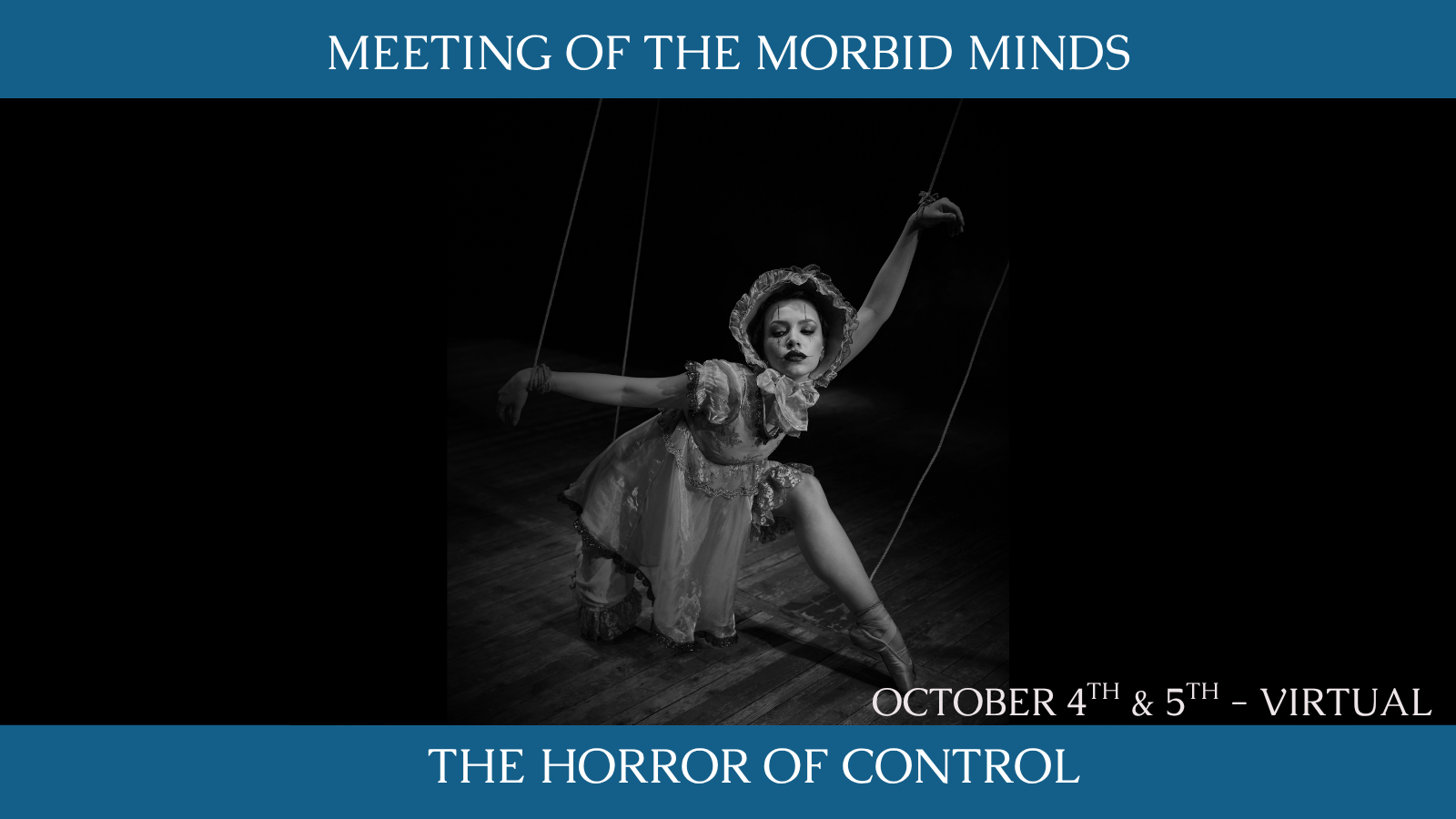

A Virtual Horror Symposium by NightTide Magazine
NightTide Magazine’s Meeting of the Morbid Minds: The Horror of Control
At NightTide, horror has always been more than a genre. It’s a lens through which we examine power, autonomy, and the uneasy systems that shape human life. With that spirit in mind, I’m thrilled to announce Meeting of the Morbid Minds: The Horror of Control, a virtual academic symposium dedicated to exploring the subgenres of horror that confront authority, domination, and the fragile boundaries of human agency.
Taking place on October 3rd & 4th, from 3 PM – 8 PM GMT, this virtual event celebrates the deeper side of horror analysis and criticism while reflecting NightTide’s ongoing commitment to elevating diverse voices and fostering thoughtful conversation within the genre.
Horror scholarship plays a vital role in understanding how fear reveals the structures that govern our lives: psychological, bodily, social, and technological. Through this symposium, NightTide provides a space for scholars, critics, and creators to explore how horror exposes the mechanisms of control that shape our world, and the unsettling consequences that emerge when power tightens its grip, or slips away entirely.
Call for Abstracts
We are now accepting abstracts again (up to 300 words, not including your bio) from August 6th-10th for 20-minute talks on the following topics:
The Governed Mind
Horror frequently turns inward, revealing how fragile the boundaries of the human psyche truly are. From gaslighting and coercive relationships to cult indoctrination and supernatural possession, psychological horror examines the terrifying ease with which perception can be manipulated, and autonomy eroded. When belief itself becomes unstable, the mind transforms into contested territory where identity, memory, and reality are no longer secure.
The Regulated Body
Few sites of control are as intimate or as violently contested as the human body. Body horror confronts the systems that claim authority over flesh, whether through medical intervention, reproductive politics, technological intrusion, or biological mutation. Across film and literature, horror repeatedly stages the body as a battleground where autonomy is challenged, and transformation becomes both a threat and a form of resistance.
The Tyranny of the Collective
Communities promise safety, belonging, and shared identity, yet horror often reveals the darker mechanisms that sustain those bonds. Folk traditions, social hierarchies, institutional power, and communal rituals can become tools for surveillance, discipline, and punishment. In these narratives, deviation is rarely tolerated, and the collective will often demand sacrifice to maintain order.
The Watching Machine
As technology increasingly mediates everyday life, horror has begun to grapple with new forms of control emerging from digital and artificial systems. Surveillance infrastructures, artificial intelligence, algorithmic governance, and networked identities raise a chilling question: what happens when authority no longer resides in human hands? Technological horror explores a world where machines observe, predict, and influence human behavior, quietly reshaping the balance of power.
As we confront these subgenres, we ask how horror reflects the systems of power that shape human experience, revealing the ways control is asserted, resisted, and sometimes lost altogether. Through stories of psychological domination, bodily regulation, communal authority, and technological surveillance, horror exposes the fragile boundaries of autonomy that govern the mind, the body, and society itself. NightTide Magazine’s Meeting of the Morbid Minds is dedicated to these intellectual explorations, offering a space for analysis that moves beyond the surface of horror’s fears and into the forces that quietly structure our lives.
Submit your 300-word abstract to nighttidemag@gmail.com between August 6th and August 10th. Please have your subject line state:
The Horror of Control – Your Name. Document format should be .doc, .docx, or .pdf.
Please make sure you list which of the four themes your work fits into.
We’re excited to hear from both new and seasoned voices. Your ideas, research, and perspectives are essential to the ongoing conversation around horror scholarship, and NightTide is committed to providing a space where those voices can be shared, challenged, and celebrated.
Not Sure How to Write an Abstract? We’re Here to Help!
If you’ve never submitted to an academic symposium before, writing an abstract can feel intimidating—but it doesn’t have to be. What matters most to us is your curiosity, perspective, and passion for horror. Whether you’re an established scholar, an independent critic, or someone exploring academic writing for the first time, we encourage you to share your ideas.
An abstract is simply a summary of the talk you’d like to give. Think of it as a preview of the argument or question you want to explore about power, autonomy, and the systems of control that horror so often reveals.
Here’s a simple way to approach it:
1. Title of Your Presentation
Start with a title that clearly reflects the focus of your talk. Your title should give readers a sense of the horror text, theme, or concept you’ll be examining and how it connects to questions of control, authority, or resistance.
2. Abstract Body (Up to 300 Words)
Your abstract should briefly describe the idea you plan to explore in your presentation.
You might consider including:
Your topic
What horror film, text, creator, or subgenre are you focusing on?
Your perspective
What argument, question, or insight will guide your talk? For example, you might explore how horror depicts psychological manipulation, bodily autonomy, communal authority, or technological surveillance.
Why it matters
What does your topic reveal about the ways horror interrogates control over the mind, the body, society, or technology?
Your abstract doesn’t need to be overly technical. Clear thinking and strong ideas are far more important than academic jargon.
3. Connection to the Symposium
In a sentence or two, explain how your presentation connects to the symposium theme, The Horror of Control, or to one of the event’s focus areas:
- The Governed Mind
- The Regulated Body
- The Tyranny of the Collective
- The Watching Machine
4. Speaker Bio (Optional)
You may include a short biography (100-200 words) about yourself. This could mention your research interests, creative work, academic background, or professional involvement with horror.
5. Contact Information
Please include your full name, email address, availability, and institutional affiliation (if applicable) so we can follow up with you.

Mo Moshaty is an acclaimed horror writer, lecturer, and producer whose work combines visceral storytelling with the psychological insight of her Cognitive Behavioral Therapy background. She has lectured internationally, including as a keynote speaker at Nightmares from Monkeypaw: A Jordan Peele Symposium (Prairie View A&M), No Return: A Yellowjackets Symposium (Horror Studies BAFSS Sig), The Whole Damn Swarm: Celebrating 30 Years of Candyman (University of California), and with the Centre for the History of the Gothic (University of Sheffield). Mo has also presented at the BFI, Miskatonic Institute of Horror Studies, and Final Girls Berlin Film Festival’s Brain Binge on women’s trauma in horror cinema, Cine-Excess on The Creepy Kid Horror Subgenre and Mother/Daughter Trauma in Horror, and Romancing the Gothic on Cosmic Horror’s Havoc on The Body Electric Her short film, 13 Minutes of Horror: Sci-Fi Horror, won the 2022 Rondo Hatton Classic Horror Award for Best Short Film. As a core producer with Nyx Horror Collective, Mo co-created the 13 Minutes of Horror Film Fest and partnered with Shudder in 2021 and 2022, while also establishing a Stowe Story Labs fellowship supporting women creatives over 40+ in horror. A member of the Black Women in Horror Class of 2023 and featured in 160 Black Women in Horror, Mo’s short fiction appears in A Quaint and Curious Volume of Gothic Tales (Brigid’s Gate Press) and 206 Word Stories (Bag O’ Bones Press). Her debut novella, Love the Sinner, was released July 5, 2024, with Clairviolence: Tales of Tarot and Torment released in October 2025. The first of her five-volume non-fiction series, The Annex of the Obscure: The Afterlife, will be released in 2027 from Tenebrous Press. As the Editor-in-Chief of NightTide Magazine and founder of Mourning Manor Media, Mo champions marginalized voices in horror. Under her leadership, NightTide plans to launch a film festival in 2028, furthering her mission to reshape the genre through inclusivity and representation.
Mo Moshaty is an acclaimed horror writer, lecturer, and producer whose work combines visceral storytelling with the psychological insight of her Cognitive Behavioral Therapy background. She has lectured internationally, including as a keynote speaker at Nightmares from Monkeypaw: A Jordan Peele Symposium (Prairie View A&M), No Return: A Yellowjackets Symposium (Horror Studies BAFSS Sig), The Whole Damn Swarm: Celebrating 30 Years of Candyman (University of California), and with the Centre for the History of the Gothic (University of Sheffield). Mo has also presented at the BFI, Miskatonic Institute of Horror Studies, and Final Girls Berlin Film Festival’s Brain Binge on women’s trauma in horror cinema, Cine-Excess on The Creepy Kid Horror Subgenre and Mother/Daughter Trauma in Horror, and Romancing the Gothic on Cosmic Horror’s Havoc on The Body Electric Her short film, 13 Minutes of Horror: Sci-Fi Horror, won the 2022 Rondo Hatton Classic Horror Award for Best Short Film. As a core producer with Nyx Horror Collective, Mo co-created the 13 Minutes of Horror Film Fest and partnered with Shudder in 2021 and 2022, while also establishing a Stowe Story Labs fellowship supporting women creatives over 40+ in horror. A member of the Black Women in Horror Class of 2023 and featured in 160 Black Women in Horror, Mo’s short fiction appears in A Quaint and Curious Volume of Gothic Tales (Brigid’s Gate Press) and 206 Word Stories (Bag O’ Bones Press). Her debut novella, Love the Sinner, was released July 5, 2024, with Clairviolence: Tales of Tarot and Torment released in October 2025. The first of her five-volume non-fiction series, The Annex of the Obscure: The Afterlife, will be released in 2027 from Tenebrous Press. As the Editor-in-Chief of NightTide Magazine and founder of Mourning Manor Media, Mo champions marginalized voices in horror. Under her leadership, NightTide plans to launch a film festival in 2028, furthering her mission to reshape the genre through inclusivity and representation.



Leave a Reply