
By: Michele Schultz

If Forbidden Fruits and Mother Mary exist on two sides of the same coin, the distinction lies in how each film frames fashion. In Forbidden Fruits, clothing functions as armor, a source of occult power. In Mother Mary, fashion becomes something more claustrophobic: a dreamlike, cloistered space where garments operate as shrouds rather than protection.
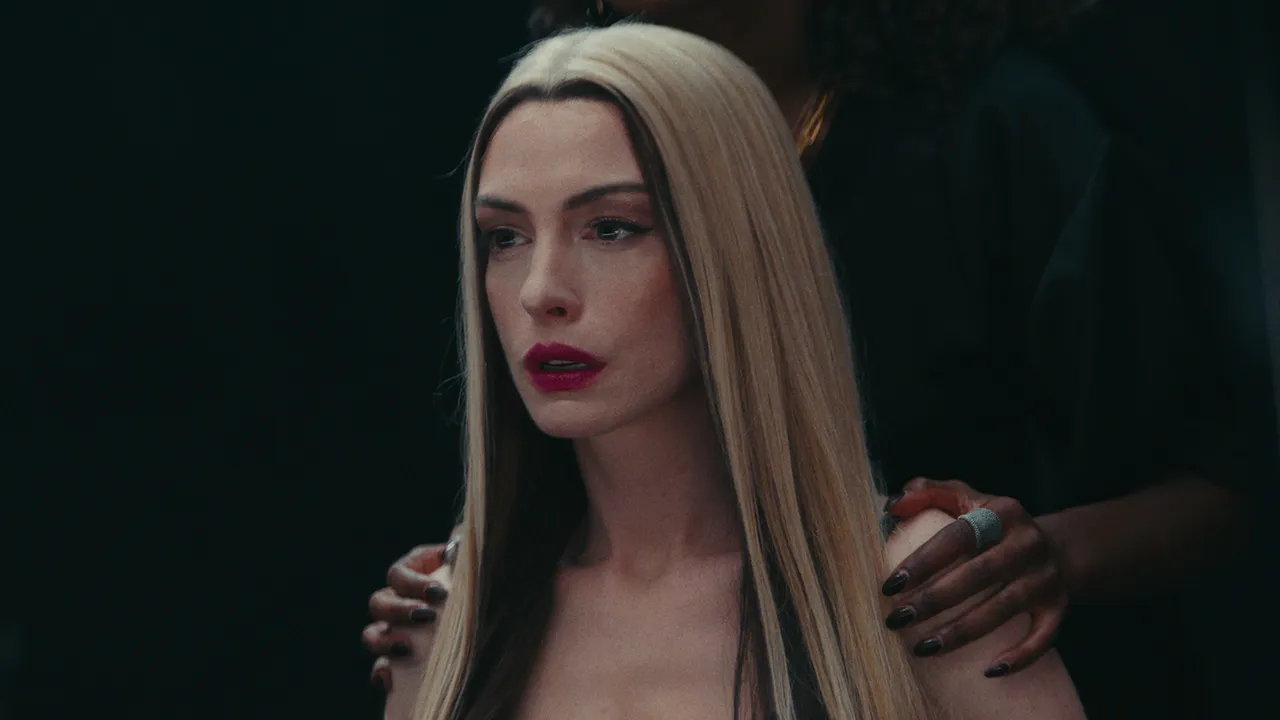
Writer-director David Lowery’s Mother Mary, a fashion-inflected body horror releasing in limited theaters on April 17 before expanding nationwide, follows a reunion charged with creative and emotional tension. Global pop star Mother Mary (Anne Hathaway) reconnects with her estranged friend and designer Sam Anselm (Michaela Coel), asking her to create a dress for the performance that will define her legacy.
The Sonic Jump-Scare and the Industry as an Occult Circle
Sound operates as connective tissue throughout the film. Rather than simply supporting the visuals, the score exposes the tension beneath the spectacle.
Mother Mary draws from the lineage of modern pop spectacle, echoing the cultural shadow of artists such as Madonna, Lady Gaga, Taylor Swift, and Beyoncé. Their influence lingers in the choreography of adoration, reinvention, and spectacle.
The film frames the pop industry as a ritualistic space where icons are continually dismantled and rebuilt. Stardom becomes cyclical: the public narrative of collapse followed by the promised “comeback,” repeated until the persona itself becomes unstable.

Designer as a Narrative and Designs within Designs
At its core, Mother Mary examines the construction of an alter ego and the haute couture that sustains it. Lowery places unusual narrative weight on the designer, allowing Sam Anselm’s career to unfold as its own story of rupture, ambition, and reinvention.
Her trajectory carries faint echoes of the late Alexander McQueen, a figure whose work similarly blurred the line between beauty and violence.
Fashion designers have appeared on screen before, yet Sam’s presence carries a self-reflexive quality. The character mirrors the work of the film’s costume designer, Bina Daigeler, whose attention to material detail shapes the visual language of Sam’s atelier.
Sam’s workspace is sparse and low-lit, dominated by racks of garments and design archives. Color is minimal. The open floor plan evokes both studio and sanctuary. When Mother Mary arrives at Sam’s secluded countryside estate, the house becomes a labyrinth of corridors and thresholds. Within this cloistered space, the reunion between star and designer unfolds as a creative tug-of-war between two disciplines, music and fashion, each vying for authorship.

The Horror of Costuming
Mother Mary’s stage wardrobe draws directly from the grammar of contemporary stadium pop acts: exaggerated silhouettes, elaborate embellishments, and garments designed for myth rather than comfort.
Yet when she first arrives at Sam’s estate, the star appears stripped of that mythology. Dressed in soaked black clothing after the rain, she presents a subdued image far removed from the haloed stage costumes associated with her persona.
The contrast extends to the other figures inhabiting the estate. Sam favors restrained, minimalist clothing, while Hilda (Hunter Schafer) appears in hand-woven garments dyed with natural pigments, her presence hovering somewhere between caretaker and apparition.
Within this environment, clothing becomes psychological. Sam’s atelier functions almost like a confessional. The process of measuring, fitting, and selecting fabric transforms into a quiet negotiation between creator and subject.
The costumes themselves intensify this tension. Dresses worn by Hathaway combine black textiles with flesh-toned panels that create the unsettling illusion of exposed skin. The garments appear less like clothing than extensions of the body.
As Sam measures Mother Mary and holds fabrics against her form, the act resembles ritual preparation. Each choice deliberately avoids a single forbidden hue, an absence that silently underscores the conflict between the two women.

When the Armor Becomes a Shroud
The film’s climactic dress merges haute couture spectacle with bodily confinement. What begins as a symbol of power gradually reveals itself as something more restrictive.
In this moment, clothing shifts from armor to shroud.
The garment traps Mother Mary within the persona she helped construct, transforming the language of fashion into something closer to body horror. Needles pierce fabric, threads pull tight, and seams strain under pressure.
Suggesting that spectacle always carries a cost. The public identity of the pop icon is assembled piece by piece, stitched together through performance, expectation, and control.
When those seams finally rupture, the result is more than a wardrobe malfunction. It is the exposure of a fractured self.

Part of the approved Cherry Picks critic community, with span across independent-run digital publications. Past experience includes contributions to FanSided’s entertainment and lifestyle verticals, notably Culturess, 1428 Elm*l, and TripSided. Journalistic roots began as a City University of New York (CUNY) undergraduate student journalist.
Armed with a signature in theatrical data analytics and out of home (OOH) marketing measurement. Outside of the digital editorial newsroom and after hours, reporting on culture continues.
Part of the approved Cherry Picks critic community, with span across independent-run digital publications. Past experience includes contributions to FanSided’s entertainment and lifestyle verticals, notably Culturess, 1428 Elm*l, and TripSided. Journalistic roots began as a City University of New York (CUNY) undergraduate student journalist.
Armed with a signature in theatrical data analytics and out of home (OOH) marketing measurement. Outside of the digital editorial newsroom and after hours, reporting on culture continues.



Leave a Reply