
By Brenda LaTorre

Female doubles have haunted horror cinema since its inception. When I began thinking about this essay, countless examples came to mind. Yet, three films in particular: Alucarda (1977), Poison for the Fairies (1986), and Huesera (2022), stood out for placing female doubling at the very center of their narratives. In each, the double is not merely a visual or narrative device, but a mechanism through which femininity itself is fractured, mirrored, and undone.
This dynamic resonates with Sigmund Freud’s concept of the Unheimlich, or the uncanny. Freud locates the uncanny in the return of the repressed: something once familiar, often rooted in childhood, that reemerges in distorted form, producing a sense of deep unease. The uncanny destabilizes the boundary between the known and the alien, revealing how fragile that distinction truly is. Among the figures Freud identifies as central to this experience is the doppelgänger, a double who both replicates and threatens the self, disrupting the idea of a singular, coherent identity.
Building on this framework, this piece examines how these films use female doubles to stage a crisis of womanhood. In each case, the “good” woman is drawn toward her double, the embodiment of forbidden desire, rage, or power. What unfolds is not simply a moral fall, but a transformation that carries an unbearable cost. She either claims that power and is destroyed by it, or relinquishes it in order to survive. Womanhood, in these films, is thus constructed as an impossible choice between moral purity and autonomy, one that cannot sustain both at once.
At their core, these are coming-of-age narratives, but profoundly distorted ones. The innocent protagonist does not mature into a stable identity; instead, she is pulled toward her double, a figure who embodies everything she has been taught to repress. In this movement, the familiar self gives way to something unrecognizable, and the boundary between innocence and transgression collapses.
ALUCARDA (1977)
Alucarda, directed by Juan López Moctezuma, stands as a landmark of Mexican horror, structured around a series of destabilizing dichotomies: reason versus faith, purity versus corruption, innocence versus desire. These tensions crystallize most clearly in the relationship between Justine and Alucarda, whose dynamic embodies the logic of the double.
The film opens with the image of a woman giving birth in a shelter, visually echoing the nativity while simultaneously perverting it. The child, Alucarda, is marked from the beginning as both sacred and profane. Alucarda’s mother hands her baby to a Roma man, who we later learn lives in the forest. He takes Alucarda to a convent where she’ll be raised by nuns.
The narrative then shifts forward to Justine’s arrival at the convent following her parents’ death. A name that deliberately recalls Marquis de Sade’s Justine, where a woman goes to a convent with the intention of becoming virtuous but is instead corrupted by the monks within.
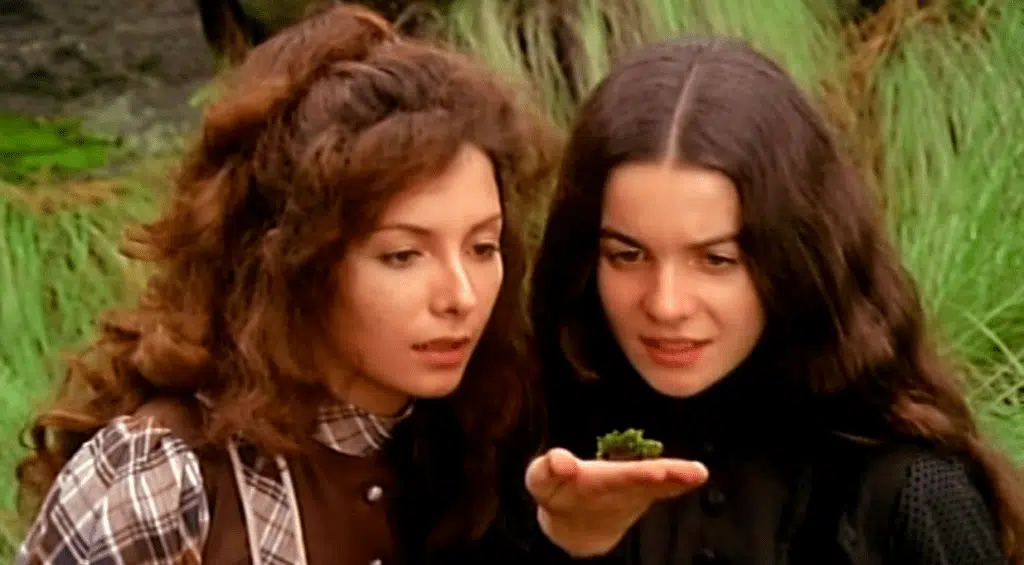
From their first encounter, Alucarda shows Justine the forest. She grabs two identical red beetles, places them on her hand, and tells Justine, “Look, they’re like a mirror. Like you and me.”
Their movement toward transgression is gradual but inevitable. Justine has questions, and Alucarda has answers. Alucarda takes Justine to visit the crypts, after asking Justine if she is afraid to die, Alucarda finds a coffin that was sealed fifteen years ago and opens it despite Justine’s protest. A demonic voice emerges, as if they opened a portal after acquiring the forbidden knowledge of death. A threshold that once crossed cannot be undone.
What follows is an escalation of darkness. Alucarda convinces Justine to make a blood pact in which they promise that if one of them dies, the other will follow. They get naked and cut each other’s breasts with the Roma man as witness. They lick each other’s blood as a form of liberation for their repressed sexual desires. What follows is a Sabbath where they meet with Satan in person, and an orgy takes place.
Justine’s subsequent illness prompts the intervention of religious authority, culminating in the exorcism led by Father Lázaro. It’s interesting to see how only a man can put a stop to this “female madness.”
Here, the film stages another doubling: eroticism and punishment, as both girls are stripped and bound to crosses. Opposing this spectacle is Dr. Ashley, a figure of secular rationality shaped by European scientific thought. He orders the exorcist ritual to stop at once, only to discover Justine has died during the ritual.
The film appears, momentarily, to restore order. Justine dies pure, while Alucarda survives as the figure of unrestrained corruption, even extending her influence to the doctor’s daughter, who is a near replica of Justine herself. But this resolution is quickly undone. When Justine reemerges from the crypt, naked and covered in blood, she is no longer the innocent victim but something entirely other, a body transformed by the very knowledge she seemed to escape. A deadly vampire-like monster.
In the end, Justine’s survival is not redemption but annihilation. Her encounter with forbidden knowledge results in total dissolution, culminating in her destruction through holy intervention administered by male authority. In a twist, it is the atheist doctor who recognizes there are otherworldly forces at work, and it is he who becomes the agent who purifies what cannot be reintegrated. He pours holy water over Justine, burning her body until she dissolves into the floor of the crypt, while Alucarda remains a free force of corruption in the world.

POISON FOR THE FAIRIES (1986)
Poison for the Fairies, directed by Carlos Enrique Taobada, shifts the terrain of the double into the intimate, enclosed world of childhood, where class, belief, and imagination intersect. Significantly, adult faces are never shown on screen. This formal choice immerses the viewer entirely in the girls’ perspective, collapsing the boundary between reality and fantasy and intensifying the psychological space in which the double operates. Flavia, who represents civilization, logic, and success. And Verónica, who stands for the fantasy world, the witch, mysticism, and who is also an orphan.
At the center are Flavia and Verónica, who function as complementary opposites. Flavia embodies order, rationality, and upper-class privilege. For example, her chauffeur picks her up in a fancy car after school, while Verónica has to walk back home.
Verónica, by contrast, is aligned with superstition, marginality, and instability. She is an orphan raised on stories of witches and fairies by her grandmother and nanny. Once again, the film stages a tension between reason and belief, but here it is filtered through class difference. Flavia’s family represents a secular, modern worldview, while Verónica’s world is saturated with myth.
Their dynamic is immediately marked by unease. Verónica tells Flavia, “Flavia isn’t a real name. It’s my spider’s name,” a remark that subtly dehumanizes her while foreshadowing her eventual transformation into something abject. From the beginning, Verónica positions herself as the one who knows, claiming she is a witch. Flavia must decide whether to believe her. When Flavia turns to her father, he dismisses the idea of witches entirely, explaining that witches were never real, only women persecuted out of ignorance, and eventually burnt to death. Yet this rational explanation fails to resolve the tension. Instead, it creates a gap that Flavia feels compelled to test.
Flavia hates her music lessons, and so Verónica offers to stage a ritual to get rid of said lessons. They stage a ceremony painting candles black, pricking their fingers, dripping blood over sheet music before burning it, while invoking Satan. The sequence blends childish play with genuine transgression, collapsing imagination and action. When Flavia’s piano teacher dies shortly after, coincidence is misread as proof: Verónica’s power becomes real in Flavia’s eyes. Although the film briefly reveals, through an overheard adult conversation, that the teacher had preexisting health issues, this knowledge never reaches Flavia. Her reality is structured entirely by belief.
From this point on, the balance shifts. Verónica leverages her supposed power to dominate Flavia, demanding her possessions, such as a beautiful doll her mother gifted her, her space, and ultimately access to her family’s ranch. What begins as fascination turns into coercion. Flavia is caught between fear and desire, repelled by Verónica’s influence yet drawn to the possibility that it might be real.
The trip to the ranch becomes the film’s ritual center. There, under the pretense of preparing poison for the fairies, creatures Verónica has been told are enemies of witches, the girls gather increasingly grotesque ingredients: snake’s skin, toads, shavings from a burnt cross, and cemetery dust. The process mirrors a descent, each step drawing Flavia further into a world where symbolic play hardens into irreversible action.
The climax occurs in the barn at midnight, where Flavia finally confronts Verónica. In a hallucinatory moment, she sees her not as a child but as an aged, monstrous figure, a projection of everything Verónica represents. In response, Flavia sets her on fire and locks the barn, ensuring her death.
This act is not simply self-defense but a decisive alignment with the logic her father articulated earlier: witches must burn. In killing Verónica, Flavia rejects the pull of the irrational but only by fully enacting its violence. Her coming of age is thus profoundly paradoxical. She resists being consumed by her double, yet in doing so, she becomes something equally transgressive, a murderer.
As in Alucarda, the encounter with the double leads not to integration but to destruction. Flavia preserves her position within the rational, privileged world, but at the cost of internalizing its most brutal mechanisms. The film suggests that even the rejection of the dark double requires a descent into it, leaving no space for innocence to survive.

HUESERA (2022)
Huesera: The Bone Woman, directed by Michelle Garza Cervera, offers a contemporary reconfiguration of the female double, relocating it within the intimate terrain of motherhood. As in the previous films, the narrative is structured around opposing models of womanhood, who a woman is versus who she is expected to become. However, here the conflict is explicitly tied to maternal identity.
The film opens with a pilgrimage to the towering, gilded image of the Virgen de Guadalupe, where a blessing for fertility is sought. From the outside, motherhood is framed as both sacred and inevitable, embedded within cultural and religious expectations. Valeria Hernández, the protagonist, is introduced as a carpenter, someone who builds, creates, and works with her hands. Yet even this identity is immediately threatened. As she and her partner Raúl prepare for their child, her workshop is converted into the baby’s room, signaling the gradual erasure of her autonomy. The yellow wallpaper that replaces her tools evokes Charlotte Perkins Gilman’s “The Yellow Wallpaper” (1892), a text similarly concerned with the psychological disintegration produced by postpartum depression.
Valeria’s body becomes the primary site of horror. The compulsive cracking of her hands (initially a nervous tic) evolves into a visceral motif, mirrored by the apparition of the Huesera, a spectral woman who contorts and breaks her own bones. This figure appears most often in reflections, collapsing the boundary between self and double. The Huesera is not an external threat but an embodied manifestation of Valeria’s fracture: the physical expression of a self that cannot accommodate the role being imposed upon it. Valeria gets flashbacks of the life she had before. When she used to date a woman called Olivia, she had a band, and she was supposed to be the first woman in her family to go to college.
As the pregnancy progresses, Valeria’s sense of identity deteriorates. She is haunted by memories of a different life, her relationship with Olivia, her involvement in music, and her aspirations beyond domesticity. These fragments of the past function as another kind of double. Not a mirror of what she is, but of what she might have been. The more she is absorbed into motherhood, the more aggressively the Huesera asserts its presence. Her relationship with Raúl grows distant, her attempts at caretaking fail disastrously, and her surroundings begin to feel hostile and alien. She even thinks someone has broken into her house one night, but there’s no one there.
After the birth of her child, the horror intensifies. The Huesera invades the domestic space completely, culminating in images like the crib set on fire, right after Valeria sneaks into the baby’s room to light a cigarette.
Once she is left alone with the baby, Valeria can’t stand the baby’s cries. Once they stop, she is finally able to rest. Until she wakes and realizes the baby had been placed inside a refrigerator. These moments do not simply represent fear for the child, but a deeper, more transgressive impulse, the possibility of rejecting motherhood altogether.
When Valeria decides she’s finally had enough, she goes to visit a house of brujas in a rundown house to get rid of the Huesera. At the house, there’s a female silhouette on the floor comprised of dried leaves, which is burned, suggesting purification through destruction. During the ritual, Valeria enters a liminal space, a forest where the sound of cracking bones surrounds her. There, she encounters multiple Hueseras, not one double, but many. These figures suggest a collective condition, the accumulated remains of women fractured under the weight of motherhood expectations.
When Valeria returns, she briefly appears reintegrated. She embraces her child, holding and kissing her with apparent tenderness, as though reconciliation were possible. Yet this resolution is unstable. The film ultimately refuses closure; Valeria leaves Raúl and the baby behind, choosing instead the life she had suppressed.
Unlike the protagonists of the earlier films, Valeria is not destroyed, but her survival comes at the cost of abandoning the role that defines her within her social world. If Alucarda and Poison for the Fairies punish transgression with death or moral collapse, Huesera offers a more unsettling alternative: the possibility of refusal. In doing so, it reframes the double not as something to be eliminated, but as a truth to be acknowledged, one that cannot coexist with the demands of normative womanhood.
What these three films ultimately share is not a simple opposition between good and evil, but a destabilization of that very binary. Through the figure of the female double, each film produces a sense of the uncanny while simultaneously interrogating the cultural construction of womanhood. These narratives center on women who choose something other than what they are expected to desire, and it is precisely this deviation that marks them as transgressive.
In each case, the loss of innocence is not merely symbolic but catastrophic. Once these women encounter forbidden knowledge, whether through ritual, violence, or self-realization, they cannot return to their former selves. Their transformation renders them incompatible with the roles they were meant to inhabit.
Each film stages a perverse coming-of-age, in which the “bad” woman initiates the other into a darker mode of being. In Alucarda, Justine’s awakening occurs during the ritual, sealed through blood and intimacy with the faun Roma man as witness.
In Poison for the Fairies, Flavia’s transformation culminates in her act of violence against Verónica, when she sets her on fire, sealing the barn behind her and smiling while it burns. And in Huesera, Valeria’s coming-of-age is marked not by entry into motherhood, but by her refusal of it, ultimately walking away from her family to embrace the life she hadn’t had the courage to claim before. A life where she can go to college, play in a rock band, and build her own furniture to sell.
Across these films, becoming a woman is inseparable from destruction. Not as punishment, but as a necessary rupture. To step outside prescribed desire is to undo the self entirely.

Brenda LaTorre is a Mexico City native, author of BRUJA’S NEST, coming out in 2026 with Creature Publishing! She holds an MFA from the University of Southern Maine and lives with her son and an assortment of cursed objects.


Leave a Reply