

By Jonathan Helland
With the outbreak of WWI, the practice of Egyptology ground to a halt. As a result, respected Egyptologist Margaret Murray turned her attention to the study of the European witch trials of the early modern period. The conclusion Murray came to, explained at length in 1921’s The Witch-Cult in Western Europe, was wild, fascinating, revolutionary, and utterly unsupported by the so-called “evidence.” No serious historian or anthropologist accepts or supports her theory, but it was so influential, interesting, and inspiring that it still casts a shadow over the popular imagination.
The Witch Cult in Western Europe
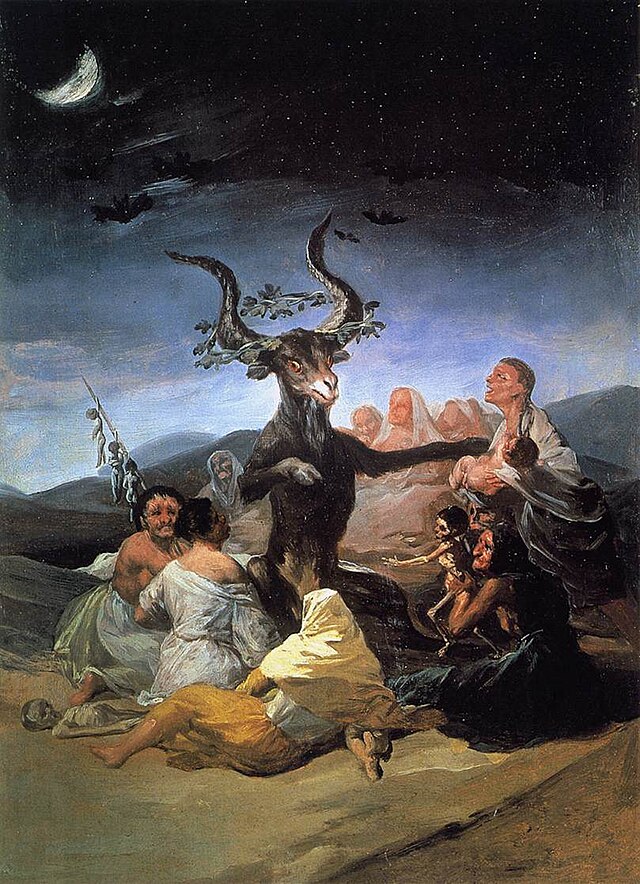
In The Witch Cult in Western Europe, Anthropologist Margaret Alice Murray (1863 – 1963) presents her pioneering and seminal witch-cult theory – an enigmatic history of European witchcraft and the rituals, beliefs and practices of an ancient, secretive pre-Christian religion that persisted covertly amidst fierce Christian persecution. The witch cult hypothesised herein unveils an underground and organised old religion, devoted to the worship of a horned god and mother goddess which survived from its pre pre-Christian origins and through the hysteria of the witch trials.
While Murray’s theories of witchcraft as an organised and surviving pagan religion have been discredited by subsequent research, her work vividly depicts the old and widely held beliefs, ideas and traditions surrounding witches which, naturally, may have long informed the operations of individuals and sporadic groups attempting to undertake a practice of witchcraft historically, and into the present. Many of her own more innovative ideas too have been hugely influential and have provided the blueprints to various modern day witchcraft traditions, leading to Margaret Murray being referred to, justifiably, as the ‘Grandmother of Wicca.’
The Witch Cult in Western Europe thus remains a valuable sourcebook for practitioners and students of the witch’s craft today.

Her theory was this–the accused witches who were tried and executed in the thousands between roughly 1400 and 1775 were members of an underground, organized, pagan religion that had survived in secret since pre-Christian times. Because she was influenced by James Frazer’s The Golden Bough, she presumed it was a fertility cult. By playing a game of find and replace with the confessions and accusations at the witch trials, she imagined an entire system of beliefs and ceremonies. Witches are accused of worshiping the devil, so they must have worshiped a horned god.1 Since this “devil” was described as being physically present to invite witches to sign his book and pay homage, the horned god must have been represented by a human in a costume, and when the devil in a witches confession takes the form of an animal, it must mean that costume consisted of ceremonial furs. Many persisting beliefs about witches and their practices come from Murray’s writings, including the idea that a coven should have thirteen members (which she took from a single historical account and took pains to nevertheless present as a universal truth.)2
Murray was a skeptic and a philosophical materialist, who therefore ignored any of the impossible and supernatural occurrences reported in the witch trial confessions, unless she could explain it away. For example, when qouting a passage about a “witches feast,” which she hoped to portray as a sort of pagan pot-luck, she simply left out the moment in the party when the witches transformed themselves and “went through a little hole like bees,” a pretty critical detail of the story for Murray to simply leave out.3 In other instances of the supernatural, such as with stories of witches transforming into animals, Murray suggests that they’re describing a totemic ritual transformation in which the practitioner “changed his shape to the eye of faith alone.”4
The most damning flaw in her reasoning was one she raised herself in her introduction–the likelihood that any consistency found in the confession of witches came from the beliefs of the inquisitors extracting these confessions (often through torture), not the beliefs of the alledged witches themselves.5 She supports her reasoning by pointing out that torture was not a universal practice in witch trials, as if torture were the only method of securing a false confession, as if confessions can not also be falsified, as if all torture would be recognized as such and admitted to by the authorities, et cetera. It is easy, when reading The Witch-Cult in Western Europe, I find Murray’s arguments compelling. It’s well written and the holes in her reasoning are well hidden unless you also study the primary sources. But this is one fatal flaw is hard to ignore–church doctrine and books on witch hunting such as the famed Malleaus Maleficarum and King James’ Daemonology taught the witchfinders and inquisitors what confessions to look for, and they inevitably found them; no further explanation is necessary.
When Murray first proposed her theory, there were few scholars who fully supported it, and plenty of critics of her methodology. W.R. Halliday, one of her harsher contemporary critics, said,
“[A] good deal of the so-called evidence consists, in fact, of an interpretation of the documents, the plausibility of which depends upon the previous acceptance of the main thesis of the book. Further, Miss Murray rationalises arbitrarily; sometimes the evidence is taken at its face value, at others it is ‘interpreted.’”6
According to scholar Jacqualine Simpson, other anthropologists and folklorists welcomed a new hypothesis to break the stalemate that existed between scholars (mostly devoutly religious) who claimed the witches were truly satanists and other scholars asserting, reasonably, that those accused of were all innocent victims of hysteria or malice.7 (Another popular theory–that the accused witches were ‘wise women’ practicing folk medicine–is older than Murray’s, dating back at least to Jacob Grimm.8 Like Murray’s this is a compelling idea with no supporting evidence.) Murray’s hypothesis, at least, invited discussion and further study. Murray wrote the Encyclopedia Britannica entry on “witchcraft” that was in print from 1929 until 19699, which helped get this fascinating but unfounded theory into the wider public consciousness, where it had a lasting impact on popular culture.
You cannot prove a negative, so I can’t say for certain that there’s no truth to Murray’s theory, no matter how flawed her methodology and reasoning. Which is part of what makes it so exciting and why this book is still fun to read. It’s hard to believe it’s true, but it’s even harder not to want it to be true. There is something deeply romantic about the notion of people throughout Europe keeping an ancient religion alive in the face of centuries of complete Christian hegemony in the region. It certainly doesn’t hurt that the alleged practitioners of this secret, occult religion were primarily women and the rural poor, making it fertile ground for revisionist fantasies of empowerment. For fans of folk horror, a subgenre built upon secret cults and country mysticism, it’s ground so fertile we’re harvesting it still.

Genres and subgenres are always difficult to define–whatever rigid guidelines critics might create are swiftly ignored by readers. Just as dark fantasy doesn’t mean “fantasy that’s dark but not as dark as grimdark, and sword and sorcery doesn’t mean “any story with both swords and magic,” folk horror is not “horror that involves folklore.” If it was, every vampire, werewolf, and ghost story would qualify. When it comes to defining folk horror, we do have something of a canon. The term was first applied to three films, The Witchfinder General (Michael Reeves, 1968), Blood on Satan’s Claw (Piers Haggard, 1971), and The Wicker Man (Robin Hardy, 1973). Of this “unholy trinity of folk horror,”10 the latter two can be shown to be direct ancestors of The Witch-Cult in Western Europe. In his book about the film11, David Evans-Powell explores the witch-cult theory had on The Blood on Satan’s Claw: “The Blood on Satan’s Claw betrays the influence of Murray’s beliefs in this witch-cult and its rituals.The village in Satan’s Claw is exactly the sort of community that Murray identifies as where the witch-cult would thrive; a sparsely populated, isolated and remote community.” (64) He goes on to point out that the nature of the rituals carried out in this film, as well as their organization under a single charismatic leader closely matches Murray’s description. Except, where Murray stuck to naturalistic explanations, Haggard’s film features an actual, supernatural devil.
The Wicker Man is also centered on the Murrayite conceit of an ancient pagan religion existing in secret in an isolated and remote community. Although the cult involved is based on the real-world religion of the ancient Celts,12 and probably inspired in part by the rise of neo-paganism and new age religions in the 1960s, those religious movements also owe a great debt to Margaret Murray. Gerald Gardner, one of the founders of modern Wicca, was an acquaintance of Murray’s–they were both members of the The Folklore Society in the 1950s, and Murray wrote the introduction to one of Gardner’s books and his writings are clearly strongly influenced by her ideas.13 Furthermore, there was a very successful reprinting of Witch-Cult in 1962, just in time for the new age movement to take off in popularity. The human sacrifice that is so important to The Wicker Man (and many other folk horrors) was directly inspired by history, but it’s not absent from Murray’s speculative religion. In Witch-Cult, she acknowledges that tales of witches killing animals and even killing and eating babies might be based on sacrificial practices, although in later works she back-peddled on that idea, preferring to present the witch-cult as more benevolent.
The remaining film of the “unholy trilogy,” The Witchfinder General, is probably not inspired by The Witch-Cult in Western Europe despite being set in the historical period Murray studied. It’s based on the life and deeds of Matthew Hopkins (played by Vincent Price in a career-best performance), a historical figure whose persecution of witches was motivated by sadism and misogyny. Naturally, Witchfinder takes the only view of witchcraft appropriate to its subject matter–Hopkin’s victims were innocent women murdered by a psychopath who had conned his way into a position of authority. But while it’s an important film in British horror and one of the three originally labeled folk-horror, it has had by far the least influence on the folk-horror that followed. You can see how films like The Witch (Eggers, 2015) and Hagazussa (Feigelfeld, 2019) are descendents of The Blood on Satan’s Claw, and films like Midsommer (Aster, 2019) and Apostle (Evans, 2018) are descendents of The Wicker Man, but where are the folk-horror descendants of The Witchfinder General? As the genre has grown, it seems it has grown away from this particular elder brother; I’d argue it hardly fits any modern viewer’s definition. Nevertheless, thanks to the prevalence in the last century’s zeitgeist of Murrayite witches, their representation here as falsely accused, innocent, Christian women stands out in contrast; we are no longer used to the idea of witches being imaginary.
Although the term “folk horror” was originally coined to refer to these three films, it has since been retroactively applied to works of literature that predate The Witch-Cult in Western Europe. Arthur Machen’s The Great God Pan (1894), Algernon Blackwood’s “The Wendigo” (1910), and M.R. James’ “The Ash-Tree” (1904) can certainly owe nothing to Murray’s 1921 book (or even her 1917 article in Folklore.) But the absence is felt, I think, by any reader searching for the tone and tropes they’ve come to expect from the genre in film and in later novels like Thomas Tryon’s Harvest Home (1973), Adam Nevill’s The Ritual (2011), or Andrew Michael Hurley’s The Loney (2014).
Folk horror has always been nebulously defined, and there are many fine examples of the genre that have no hint of pagan fertility cults, ancient rituals, or secret occult practices lurking in rural villages forgotten by the passage of time. I mentioned above that The Loney may owe a debt to Witch-Cult, but his Starve Acre manages to be one of the best folk horrors ever written without any such connection. But themes and tropes established by Murray remain the beating heart of the genre. There aren’t many century-old, discredited scholarly texts worth reading, but this is one I recommend to writers and readers of fantasy and horror. For all it’s flaws, it is an excellent example of fictional world-building that paints a picture of a history more interesting than our own. I suspect her conception of the witch-cult will continue to permeate depictions of Europe’s rural past. Some ideas are just too haunting to ignore, even when they’re almost certainly wrong.
- One of the earliest and most lasting changes made to Murray’s theory by later adherents was to replace the patriarchal worship of a horned god with the worship of a mother goddess. ↩︎
- Simpson, Jacqueline. “Margaret Murray: Who Believed Her, and Why?” Folklore 105 (1994): 89 ↩︎
- Simpson: 91 ↩︎
- Murray, Margaret. The Witch-Cult in Western Europe. (1921): 171 ↩︎
- Murray: 14 ↩︎
- Halliday, W. R. Folklore 33, no. 2 (1922): 228 ↩︎
- Simpson: 90 ↩︎
- Shen, Qinna 2008. Feminist Redemption of the Witch: Grimm and Michelet as Nineteenth-Century Models. Focus on German Studies. Vol. 15: 19-33. ↩︎
- Simpson: 89. ↩︎
- Scovell, Adam. “Where to Begin with Folk Horror.” BFI, June 8, 2016. https://www.bfi.org.uk/features/where-begin-with-folk-horror ↩︎
- Evans-Powell, David. 2021. The Blood on Satan’s Claw. Liverpool: Auteur, an imprint of Liverpool University Press. ↩︎
- As reported by outsiders, mostly Greeks and Romans. The story of the wicker man itself comes from Julius Caesar, who had political motives to portray the Gauls as dangerous savages. ↩︎
- Simpson: 93 ↩︎


 NightTide Magazine
Leave a reply to 5 Must Read Horror Articles 30 September 2024 – This Is Horror Cancel reply