
By Dan Roberts
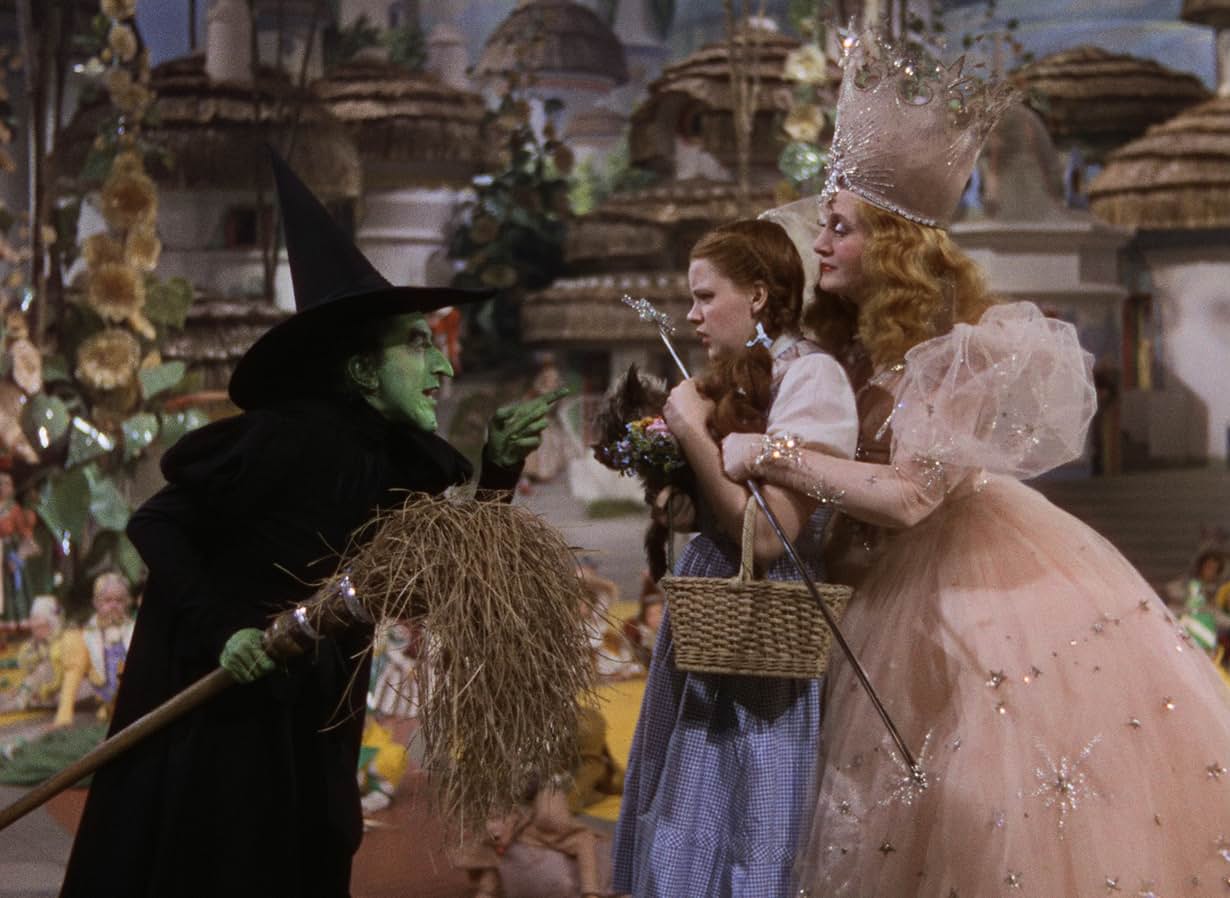
The first instance I remember seeing my daughter recoil in fear was at a cardboard standee of Margaret Hamilton as the Wicked Witch of the West. She spotted Hamilton in iconic green make-up and black pointed hat and froze. I wrapped my arms around the standee, but my daughter still didn’t trust it. She refused to step into the room where the visage of the Wicked Witch of the West stood. It remained terrifying in only two dimensions.

So, imagine my surprise, a year later, when my daughter declared that she wanted to play Wicked (2024), and be “Wicked,” the name she attributed to Cynthia Erivo’s Elphaba Thropp, the future Wicked Witch of the West. My daughter declared Wicked a must-repeat and strongly identified with Elphaba. The terrifying figure of her past had now become her hero, much as the musical intended.
My daughter has grown. I am proud. She identified with a heroic character who pursues a virtuous path. Gregory Maguire had triumphed. His revisionist tale, Wicked: The Life and Times of the Wicked Witch of the West, rescued the Wicked Witch by making her misunderstood, rather than wicked. Finally, the musical, further simplified things. The Wicked Witch was not even misunderstood. She was, in fact, a hero and divinely moral figure.
After all, I am a historian. I know and understand the origins and the injustices dealt to the wicked witches of the past. Power-hungry charlatans like the Wizard of Oz were, and remain, one of humanity’s chief problems (as Frank L. Baum made clear in his original work). I also didn’t like Sam Raimi’s theme park ride, Oz The Great and Powerful (2013). The Wizard was never the hero of the story. Mila Kunis’ sexy-tormented-woman scorned Wicked Witch of the West seemed forced. Plus, the Wicked Witch always had plenty of reason to naturally hate the Wizard. She has real power, he’s a phony.
I love the musical Wicked and enjoyed Maguire’s work. I am having a great time singing “Popular,” and “Defying Gravity,” with my daughter. So, to quote the Munchkins of Munchkin-Land, “Good News!”
Except, there is one problem, I worry my daughter has missed out on something special because Hollywood revised the “wickedness” of witches. Especially because the Wicked Witch of the West from The Wizard of Oz (1939), may have been the most wicked and terrifying of all time.


Margaret Hamilton, Ray Bolger, Jack Haley, and Bert Lahr in The Wizard of Oz (1939)
Margaret Hamilton’s Wicked Witch of the West from The Wizard of Oz (1939) terrified four generations of American children, this includes me, my mother, and even my grandmother. This arguably makes Hamilton’s Wicked Witch of the West one of the scariest characters in human history. The 1939 Wicked Witch of the West lit people on fire. She enchanted murderous trees. She nearly put Dorothy to sleep, forever. She commanded an army of flying monkeys and ordered the Scarecrow disemboweled. The Wicked Witch committed herself to vengeance on a child who did nothing to intentionally invite ire. And those are just the scenes that made it into the film. MGM executives cut other scenes with the Wicked Witch because they deemed them too terrifying for children1. The Wicked Witch of the West was scary, and, when The Wizard of Oz started airing annually on color television, she was in every Ame rican child’s house complements of network television. When she appeared on Sesame Street in 1976, parents wrote to Children’s Television Workshop to complain she was too terrifying for educational television. The episode never aired again and has only recently been leaked.2
The Wicked Witch of the West left such an enduring sense of fear in America’s children that Margaret Hamilton herself, completely without make-up, spent the rest of her life an object of terror. Local children in Hamilton’s Gramercy Park, New York, neighborhood avoided her out of fear. Even adolescents cringed at her cackles when she visited schools. The irony is that Hamilton, unlike her iconic character, loved children. She studied to be an elementary school teacher before taking up acting. It disturbed her to discover that her most famous role left an unescapable legacy of terror. In 1975, Hamilton appeared on Mister Roger’s Neighborhood to demonstrate that she was not a witch and, in fact, just an actress playing a witch. More than a generation after the release of the film Hamilton was still inadvertently scaring children on the street3. What other actress can say that?!
It is also worth noting that playing the Wicked Witch came with lasting physical cost. Both Hamilton and her stunt double, Betty Danko, suffered severe burns filming The Wizard of Oz. Hamilton spent six weeks recuperating from third-degree burns she got while on scene. Danko spent eleven days in the hospital after her smoking broomstick exploded. She had to be replaced by another stunt double named Aline Goodman while recovering4.
Now, it is entirely possible that the more media-savvy youth of today would not be as affected by Hamilton’s Wicked Witch of the West. Images come at us fast and leave less of an impression than the era of four channels. But, I wonder if the Wicked Witch of the West, at her most wicked, would still stop my daughter in her tracks.
This leaves me, a cinephile, historian, and American cultural enthusiast worried. Is my daughter missing out on a 75-year-old cultural touchstone of American childhood? Did I make a mistake not saving the revisionist Wicked for a later time? And if so, did Wicked reinvigorate a classic character, or just dump a bucket of water on an American horror icon? The Munchkins of Wicked may sing “No one mourns the wicked,” but, to be honest, I think I do.
My advice, scare your kids, watch The Wizard of Oz first, don’t live with my regrets. “Oh, what a world…”
Rest In Peace, Wicked Witch of the West; green queen of terror: 1939 – 2024.
- Wizard of Oz DVD commentary track. ↩︎
- Potempa, Philip “Wicked Witch of the West not always a fright sight,” Post-Tribune, Crown Point, IN: Chicago Tribune Media Group, Retrieved March 28, 2018. ↩︎
- Harmetz, Aljean The Making of the Wizard of Oz: Movie Magic and Studio Power in the Prime of MGM (New York City: Hyperion Books, 1998), p. 297. ↩︎
- Harmetz, Aljean The Making of the Wizard of Oz: Movie Magic and Studio Power in the Prime of MGM (New York City: Hyperion Books, 1998) p. 274-279. ↩︎


Daniel Roberts is a historian and author, with multiple publications on the history of the United
States Navy. He is also the author of: The American: The Life, Times and War of Basil Antonelli.
Recently he has decided to get into the fiction game. He is currently seeking a publisher for three
novels. For more information, visit his author site.
Twitter (X): @thegreatlostdan
Instagram: @realworldwitbirds
Leave a Reply