
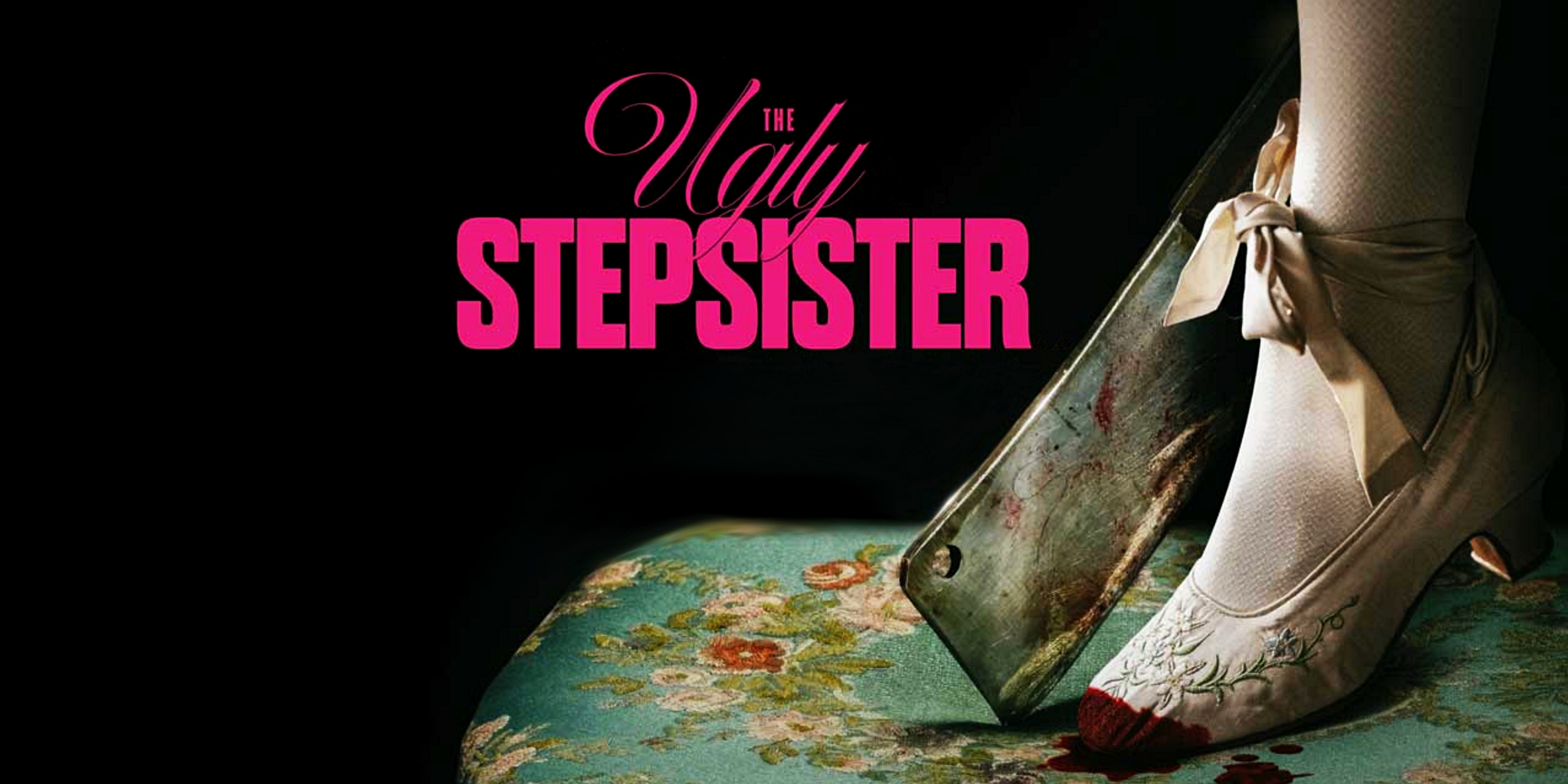
By Mo Moshaty

The Ugly Stepsister (2025) ⭐️⭐️⭐️⭐️⭐
Follows Elvira as she battles against her gorgeous stepsister, Agnes, in a realm where beauty reigns supreme. She resorts to extreme measures to captivate the prince, amidst a ruthless competition for physical perfection.
Ahh, that old chestnut.
In the blood soaked ballroom of The Ugly Step Sister, (2025) director Emilie Blichfeldt does more than chop, screw, scratch and remix the fairy tale, she excavates the bones of beauty itself. It’s been 10 days since it’s release and we can’t stop thinking about it!
Behind the lace gloves and the candlelight corridors is a horror film that lashes out at centuries of impossible beauty standards: of women forced to contort themselves, literally and figuratively, for survival and status. What begins as a twisted Cinderella tale told from the perspective of the ugly stepsister, becomes an indictment of the violent systems that turn women against women, and women into monsters when the mirror turns against them.
We’re all familiar with the tale; a widowed woman and her two daughters, forced to survive, marry into a family that is perceived to have more wealth than them. A glaring symbol that, throughout time (and in many instances, today) marriage has been more of a business transaction than a love exchange.
This time we find Rebekka (Ane Dahl Torp), widowed mother to Elvira (Lea Myren), the ‘homely,’ brace-teethed and doe-eyed eldest and Alma (Flo Fagerli), the flame haired tom-boy. Although tired from the trek to get mom married to her new, perceived-to-be wealthy widower Otto (Ralph Carlsson), Elvira is fascinated by the vast and opulent surroundings and her new gorgeous blonde stepsister, Agnes (Thea Sophie Loch Næss).


Lea Myren, Ane Dahl Torp, Ralph Carlsson and Thea Sophie Loch Næss in The Ugly Stepsister (2025) Mer Film
Just as we settle into the fabulous digs, Otto bites it at the dinner table, just after cutting the wedding cake (and unceremoniously throwing it at Elvira). Had that happened at a Real Housewives table, there would be pointing fingers and hissing cats. But this is a fairy tale after all. Through Elvira’s sheepish nature, she never thinks once to step up and defend herself, from the onslaughts of her mother’s insults to the way society perceives her, she is humbled to a fault. She is also deeply in love with Prince Julian (Isac Calmroth), a sensual sonnet writer whose collection of works have captured Elvira’s heart, mind, soul and shaped what she believes is her destiny.
Days after the death of Otto, a man from the Royal Court arrives at the castle, with the news that the Prince is inviting all unmarried virgins to the castle for a Flavor of Love ballroom speed-date to see who’ll snatch the crown of Princess-to-be. Invitations are handed out to Agnes and Elvira. Elvira sensing this is destiny at work pings her mother to get started on what can only be described as a horrific journey to “greatness.”
And before you get all “Mo, you’re spoiling it for me!” Am I? Have we not seen this story umpteen times animated and live action? Chill, B. Stick with me because there’s new information afoot (ahem).
Rather than bury old Otto, Rebekka decides to lay him out, surrounded by flowers (ya know, for the stench) in a far room in the castle while she spends what little money they have collectively on Elvira’s geek to chic makeover, complete with crude plastic surgery, diets and grueling dance and manner classes. Agnes is having none of it and shames Rebekka and Elvira for being so callous to her grief. Don’t nobody care, and the surge forward to get Elvira looking “worthy” and get her married off commences. This hollow echo, when women are bartered through dowries and marriage, was one of the only paths to upward mobility. To be chosen was to survive. To be overlooked was to wither in poverty, spinster hood, being accused of a witch or an institutional exile. The Ugly Stepsister smartly mirrors this with chilling precision. Elvira’s desire to be seen, to be wanted, isn’t driven by love, but by destiny and desperation, and by a system that punishes women who fail to conform to these rigid ideals. Ugliness is not a flaw, but a fatal liability in the economy of appearance. Her body is not unmarriageable because it’s monstrous, but because it’s deemed unprofitable. She’s not considered worthy of affection, attention, or alliance unless she can offer beauty as her currency. If you cannot be desired, you cannot be saved.


Lea Myren in The Ugly Stepsister (2025) Mer Film
The camera smartly lingers on mirrors, corsets, and surgical implements not just as props but as tools of control. Historical beauty torture from rib-crushing corsetry to lead-based face paint, and horror is the perfect genre because her body is literally at stake. And Elvira takes this one step forward by swallowing a tapeworm, because, as they say, “a moment on the lips, a lifetime on the hips,” and here’s where things get gnarly.
Elvira’s idea that she deserves more and that she’s owed a better life transforms her from victim to avenger. And yet, the film suggests that even this rebellion is shaped by toxic soil. The constant battering ram of her mother’s notions that she must get married, she must bring money into the family, she must be worthy, she must be beautiful because right now she is costing them dearly. That type of pressure would do a number on anyone, but coupled with her “rightful destiny,” echoes the entitlement of fairy tale heroines, but through a darker lens: what happens when you internalize society’s rules so deeply that you seek validation through your own destruction? It’s a monstrous form of self-love born from deprivation, because it’s not like Rebekka is a warm-fuzzy with her girls.
Elvira’s desperation to break herself, literally, figuratively, and mentally into pieces speaks to a greater crisis. One that has, unfortunately, stood the test of time. Meeting impossible beauty standards is just that, impossible. We’re never going to be perfect. We’re never going to BBL our way into a better personality. And we can strip, bleach, peel whatever we want to. But in Elvira’s case and in many of ours, swimming in the shallow end comes with its own consequences. The consequences are bloody, desperate, gory, impassioned and heartbreaking, and this perspective shines a light on what we’ve always thought was just mean girl energy, when in actuality; it’s a young woman scratching and clawing to be relevant in a society that does not deem her important unless she’s beautiful. The narrative unearths how transactional love is cultivated and how women are shaped and reshaped to appeal to patriarchal gatekeepers. Even today, echoes of this remain in the obsession with being “wifey material.”


Lea Myren, Isac Calmroth and Thea Sophie Loch Næss in The Ugly Stepsister (2025) Mer Film
I want to bounce back to the manners classes. The Ugly Stepsister does an incredible job of showing femininity as performance honed through ritualized violence. The classes are in quiet and stifling rooms where young women are herded in to rehearse every blink and every breath, and it quickly becomes a theatre of desperation. The flick of a fan, the precise dip of a curtsy, the way one holds eye contact just long enough to entice but not to offend. These aren’t charming social graces, they’re survival skills. In each gesture is a coded signal in a brutal language where the price isn’t love but elevation: out of poverty and into proximity to power. The girl’s aren’t taught to be kind, clever or smart, well-read, or humorous; they’re trained to be chosen. And the horror lies in watching them weaponize softness and practice submission like soldiers drill for war, all under the illusion that perfection will protect them. But it won’t.
The Ugly Stepsister isn’t just a film; it’s a feral waltz through the grotesque pageantry of femininity, and it executes its themes with unflinching brilliance, and we have Sabine Hviid and Klaudia Klimka‘s production design for that! Visually, it’s a baroque nightmare. Marcel Zyskind’s cinematography displays each frame in candlelit menace and decadent decay. Manon Rasmussen’s costuming gives excruciating corsets, tight enough to cut and gowns like gaudy gilded cages, transforming the body into both weapon and prison. The psychological horror cuts deeper than its gore, which is gloriously and gorgeously unrestrained. Set amongst John Erik Kaada and Vilde Tuv piercing score, we dig into the raw nerve of what it means to be overlooked, objectified and reshaped for male consumption. This is horror at its most operatic and intelligent, dragging beauty myths into the light and shredding them with glass (or in this case, satin) slippers. The Ugly Stepsister doesn’t ask for your attention, it demands it and devours you whole, like a tapeworm egg.


Mo Moshaty is an acclaimed horror writer, lecturer, and producer whose work combines visceral storytelling with the psychological insight of her Cognitive Behavioral Therapy background. She has lectured internationally, including as a keynote speaker at Nightmares from Monkeypaw: A Jordan Peele Symposium (Prairie View A&M), No Return: A Yellowjackets Symposium (Horror Studies BAFSS Sig), The Whole Damn Swarm: Celebrating 30 Years of Candyman (University of California), and with the Centre for the History of the Gothic (University of Sheffield). Mo has also presented at the BFI, Miskatonic Institute of Horror Studies, and Final Girls Berlin Film Festival’s Brain Binge on women’s trauma in horror cinema, Cine-Excess on The Creepy Kid Horror Subgenre and Mother/Daughter Trauma in Horror, and Romancing the Gothic on Cosmic Horror’s Havoc on The Body Electric Her short film, 13 Minutes of Horror: Sci-Fi Horror, won the 2022 Rondo Hatton Classic Horror Award for Best Short Film. As a core producer with Nyx Horror Collective, Mo co-created the 13 Minutes of Horror Film Fest and partnered with Shudder in 2021 and 2022, while also establishing a Stowe Story Labs fellowship supporting women creatives over 40+ in horror. A member of the Black Women in Horror Class of 2023 and featured in 160 Black Women in Horror, Mo’s short fiction appears in A Quaint and Curious Volume of Gothic Tales (Brigid’s Gate Press) and 206 Word Stories (Bag O’ Bones Press). Her debut novella, Love the Sinner, was released July 5, 2024, with Clairviolence: Tales of Tarot and Torment released in October 2025. The first of her five-volume non-fiction series, The Annex of the Obscure: The Afterlife, will be released in 2027 from Tenebrous Press. As the Editor-in-Chief of NightTide Magazine and founder of Mourning Manor Media, Mo champions marginalized voices in horror. Under her leadership, NightTide plans to launch a film festival in 2028, furthering her mission to reshape the genre through inclusivity and representation.



Leave a Reply