
By J. Simpson

To see something clearly, sometimes it’s necessary to stand slightly outside. To paraphrase the philosopher and media critic Marshall McLuhan, “a fish knows nothing about water.” You often can’t see something clearly when you’re inside it.
In no universe can either When a Stranger Calls (1979) or its sequel, When a Stranger Calls Back (1993) be considered slasher movies. There’s no Killer Cam; no sequence of victims being picked off one by one like lame sheep; no third-reel body dump – and yet, in spite of this, both are considered some of the finest Slasher movies ever made. In the introductory essay to the collection Style and Form in the Hollywood Slasher, film theorist Wickham Clayton lists four reasons why formalism alone isn’t enough to evaluate Slasher movies.
“The major arguments against formalism are outlined below:
- Formalism is a method that is too cold, clinical, and dull for an approach to the arts, which are designed to elicit passion and emotion: ‘The effort to set art free from life, to declare it a craft self-sufficient unto itself, devitalizes and kills art’ (Trotsky 1923/1996, 57).
- By its very nature, formalism cannot engage with questions of value, which is of utmost importance in discussing art: ‘It is, of course, the that case, there are a variety of sociological and formal enquiries, from Moretti’s distant readings to Bordwell and Thomson’s (sic.) statistical analysis of classic Hollywood, which must, by their very methodology, ignore questions of value’ (McCabe 2011, 9).
- By attempting not to adopt, bear or communicate an ideology, Formalism either works contrary to socio-political/economic positions that are more progressive, or it upholds dominant ideologies: ‘Although Žižek finds it necessary to address science as “knowledge in the Real” (i.e., Marxism) and therefore criticizes some of the reigning practices in cultural studies, particularly a certain variety of historical relativism, he considers this silent passing over of the tough ideological questions by post-Theorists to be somewhat of a spontaneous ideological attachment to the reigning political power’ (Flisfeder 2012, 90; parentheses in original).
- By focusing on microcosmic elements of film form, formalists risk missing, and failing to engage with, the ‘big picture’ or larger ‘meaning’, even to the point where formalists ignore basic representative indicators (i.e., this image is a series of patterns, lines and colours, not a mountain at sunset): ‘This focusing on the way of talking, rather than on the reality of what is talked about, is sometimes taken to indicate that we mean by literature a kind of self-referential language, a language which talks about itself’ (Eagleton 2008, 7).” (Clayton 2 – 3)
Although lacking many of the familiar signifiers of Slasher movies, both When A Stranger Calls manage to improve the genre both on and off the screen, sanding down some of the rough misogynistic edges and adding some much-needed psychic weight and resonance to killers and victims. They also serve as effective mirrors for many of the anxieties and complexes the genre often reflects.
Released in 1979, When A Stranger Calls is best known for the “it’s coming from inside the house!” tagline. It may not have created the trope, as the same line appears almost word-for-word in 1974’s Black Christmas. It didn’t even invent the story, which is based on an urban legend known as “The Babysitter and the Man Upstairs.” Nonetheless, it’s a particularly eerie transmission from a world just about to change beyond recognition. Unfortunately, some of the realities of When a Stranger Calls seem depressingly universal.
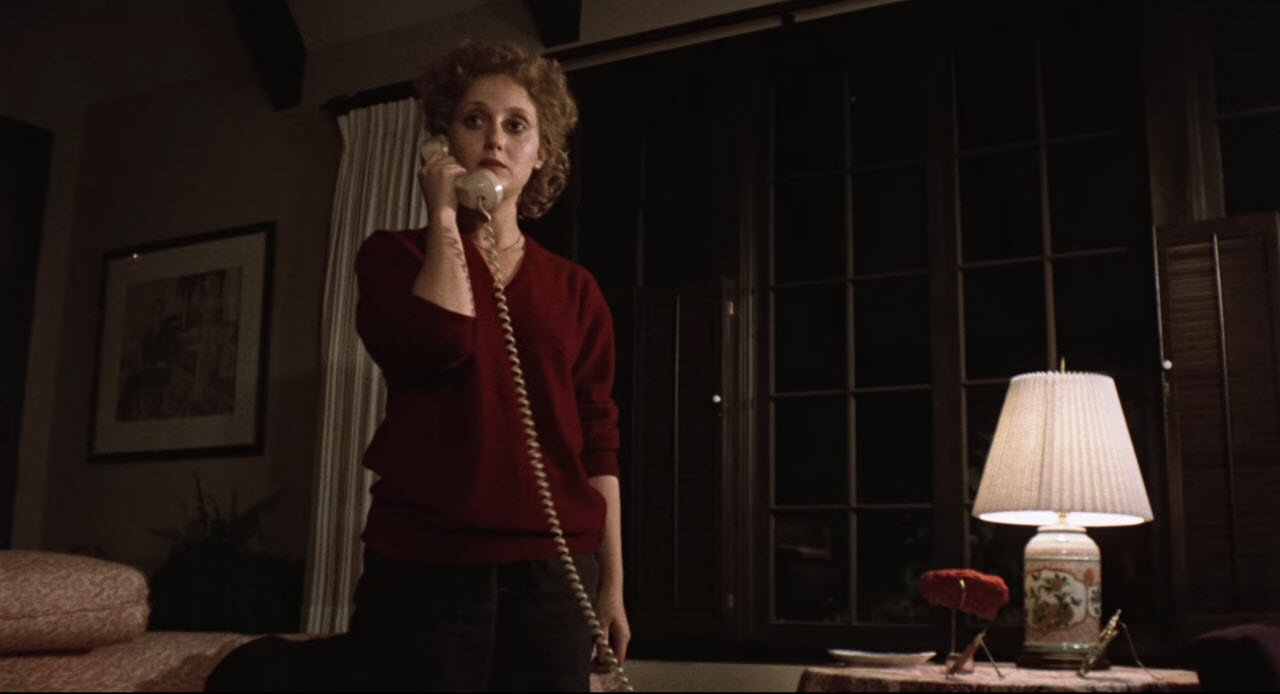
When A Stranger Calls focuses on Jill (Carol Kane), a quiet teenage babysitter hired to watch two children for the night by a doctor and his wife. Everything is normal until an unexpected phone call shatters the stillness. On the other end of the landline, a muffled, ominous voice inquires, “Have you checked the children?” At first, she’s able to write it off as a wrong number or a prank call. The phone calls persist, however, with Jill becoming increasingly alarmed as the caller becomes more threatening. She finally manages to convince the police to take her seriously when the caller reveals his true intent. “I want your blood… all over me.” Once the police are finally convinced to trace the call, it’s revealed that the call is coming from inside the house, causing Jill to flee in panic at the police’s behest. Once outside, it’s revealed that the children had been brutally murdered in their beds hours before.

Fast forward seven years. The father of the murdered children contacts John Clifford (Charles Durning), the detective who had been in charge of investigating the children’s murder, who had since left the police force to become a private detective. The father informs Clifford that the killer, Curt Duncan (Tony Duncan), has escaped from the mental hospital where he’d been locked up since the murders. This instigates the film’s second act, which is largely spent with Duncan in his sad attempt to connect with the world around him. Clifford manages to flush Duncan out using a woman, Tracy (Colleen Dewhurst), as bait.
This catapults the narrative back to Jill, now happily married with two children of her own. After hiring her own babysitter, her date night is interrupted by a familiar voice on the other end of a phone line. “Have you checked the children?” Jill and her husband race home in a panic, only to discover their children are safe. Jill’s fears aren’t entirely unwarranted, it seems, as she discovers her son with a piece of candy she didn’t buy for him. On edge, she still manages to get some rest until she goes to investigate a noise in the night. Discovering it’s nothing, she tries to rouse her husband, only to discover Duncan, not her husband, in bed next to her. Thankfully, Clifford arrives just in time to pump a few rounds into Duncan’s chest in time to save Jill’s husband, discovered unconscious but unhurt in the closet, and the children.

The sequel, 1993’s When A Stranger Calls Back, follows a similar structure but is taken to even more unhinged extremes. In When A Stranger Calls Back‘s cold open, Julia Jenz (Jill Schoelen) plays the babysitter, who is terrorized not by phone calls but by an anonymous stranger knocking on her door. After a similar bout of cat-and-mouse, the stranger informs Julia she’s not alone in the house, allowing her to escape the shadowy figure in the living room. Five years later, Julia is a traumatized college student attempting to move on with her life. She’s finally moved to contact the authorities after discovering one of the children’s shirts in her closet, who are revealed to be not dead, but missing. Julia tells the police she’s being stalked, detailing a series of strange, subtle disturbances that have been happening around her apartment. Unsurprisingly, the police are of little help, believing she’s being paranoid or simply making a mistake. It isn’t until Jill (Carol Kane), who’s gone on to become a trauma counsellor following the events of the original movie, arrives that she’s taken seriously. She wastes no time in preparing Julia on how to protect herself while attempting to unravel the mystery of the killer’s identity. Towards this end, she brings in John Clifford (Charles Durning) to consult and help keep Julia safe. Despite their preparation, they’re unable to do so, resulting in Julia’s hospitalization following an attempted suicide, leaving Jill and Clifford to solve the mystery for themselves. Clifford’s finally able to decipher the killer’s identity as a psychologically disturbed ventriloquist, William Landis (Gene Lythgow), who’s as adept at camouflaging himself as he is at throwing his voice. This launches an especially unhinged final act, with Clifford arriving to save the day in the nick of time following a home invasion at Jill’s house.

Both When A Stranger Calls and When A Stranger Calls Back are odd, messy films that still manage to be more feminist than many traditional Slashers despite their seeming sympathy for the villains. This doesn’t prevent both films from reflecting patriarchal anxieties, however. Like the best Gothic texts, the When A Stranger Calls movies transcend duality to unearth and explore the shining heart of darkness in both films. It’s telling that the main character in both films is a babysitter, a role almost exclusively held by girls and women in the West. The fact that the children are murdered in the first film and abducted in the second reflects societal anxieties of women leaving the house to pursue independence and personal freedom, reinforcing Slasher movies’ traditional patriarchal threat against women who step outside of patriarchal norms. Neither film lingers on the victimization, however, although both candidly explore the effect it can have. This is made especially explicit in When A Stranger Calls Back, with Jill using the trauma she experienced as a catalyst to learn self-defense and protect other women, while offering her extra empathy and insight into other survivors of trauma and abuse. Better still, she uses that insight to change systems that otherwise overlook victims, like when she convinces the police to take Julia seriously.
When A Stranger Calls manages to transcend the conservative politics of the Slasher genre, as well. Traditionally, the Final Girl of the Slasher movie is the most chaste and “pure” of her friend group, allowing her to survive while more intoxicated or promiscuous women get butchered. When A Stranger Calls doesn’t fixate on Jill’s dating life at all. She’s also shown as neither especially good nor terrible. She’s just a teenager doing her best to do a good job in a very important job.
In spite of its feminist tendencies, both When A Stranger Calls movies are more sympathetic to the killers and kidnappers than the traditional Slasher film, as well. The original movie spends much of its runtime following Duncan, depicting him more as a pathetic, mentally ill lowlife desperate for some form of human connection than a murder machine. He’s more Travis Bickle than Leatherface, a connection made even more overt with When A Stranger Calls‘ grimy urban setting. It’s scary and disturbing, but it’s also sad and unsettling, staying with you far longer than your usual derivative Slasher film. The ventriloquist in When A Stranger Calls Back is even more psychologically resonant, making himself invisible and projecting his voice, as a commentary on his utter powerlessness and lack of agency. Rather than the simplistic “Beauty and the Beast” narratives of most Slasher movies, the When A Stranger Calls movies reflect on the ways that everybody is damaged in atomized late capitalist societies.
Source: Clayton, W. (2015). Style and Form in the Hollywood Slasher Film. Palgrave Macmillan.




Leave a Reply