
By Victoria Hood

We are women who want to consume. Women who were warned against consumption, for wanting too much, for looking or behaving against how people wanted, for craving autonomy.
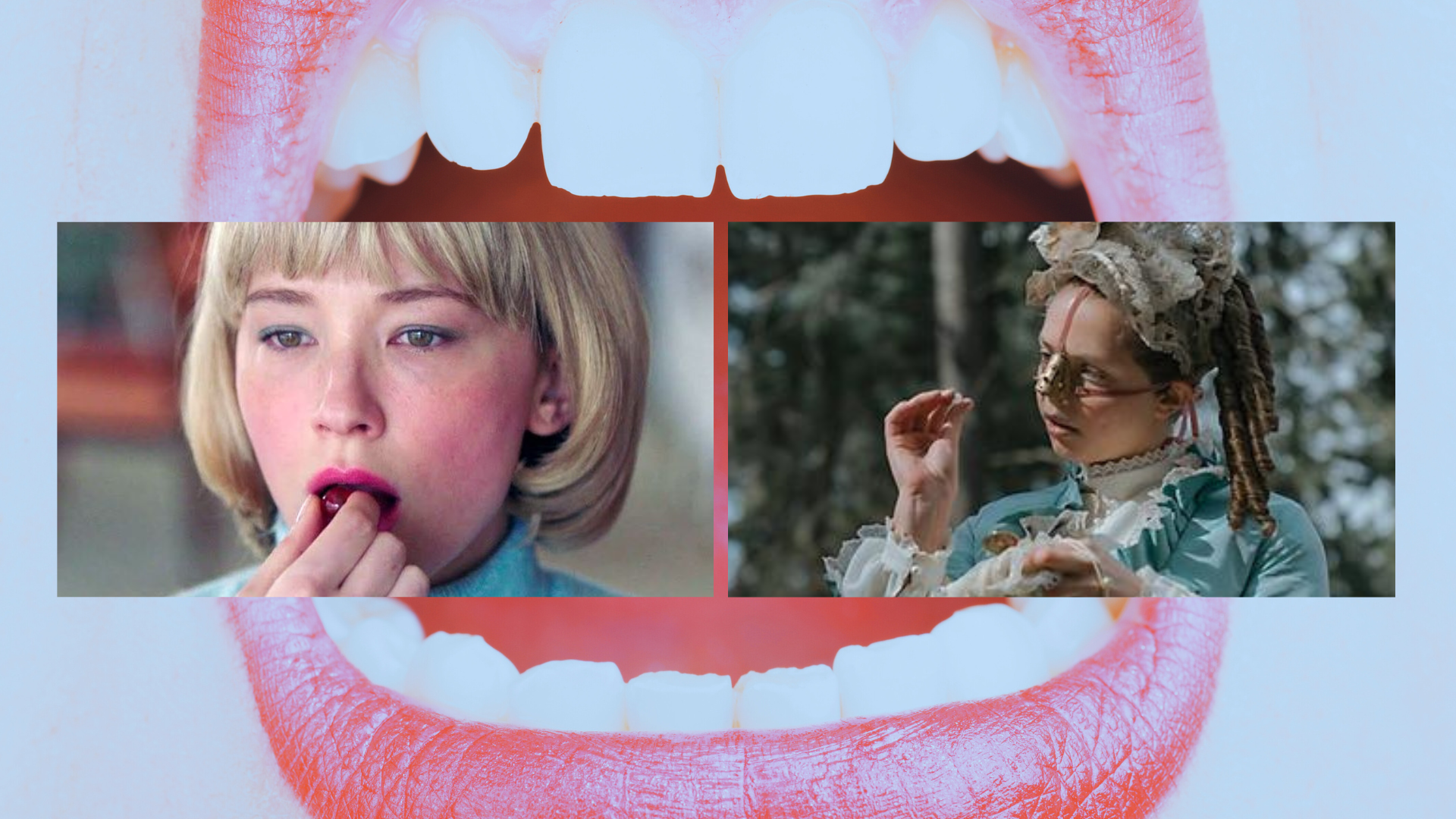
In Swallow (2019), written and directed by Carlo Mirabella-Davis, we follow Hunter Conrad (Haley Bennett), diagnosed with pica early in the film, who feeds herself more and more inedible objects. Hunter wants to consume and yearns to feed on what she wants to eat. Her husband, Richie Conrad (Austin Stowell), “helps” her without thinking of her. Hunter attempts to advocate for herself, but both Richie and his mother consistently talk down to her and attempt to hide and shame her, reminiscent of the “mad woman” depiction of spouses who were locked away.
Across the globe in 2025, The Ugly Stepsister (Den Stygge Stesøsteren in Norwegian), a film written and directed by Emilie Blichfeldt, follows Elvira (Lea Myren), the ugly stepsister of Agnes (Thea Sofie Loch Næss). Following the traditional tale of Cinderella, The Ugly Stepsister takes a turn for the hungry in Elvira’s point of view. She is desperate for the hand of the Prince, but knows she cannot have him as she looks now. This is made clear by the surrounding characters at large, but notably by her mother, Rebekka (Ane Dahl Torp), who sells her own body to afford braces and plastic surgery for Elvira. Elvira is set on a path from the moment she tells Agnes she wants to marry the Prince, her honesty rewarded with starvation and disfigurement.

Both of these movies focus on the hunger and consumption of women. Hunter begins her journey of overconsumption with a marble. The fear and excitement of this act are palpable as she contemplates whether or not she should eat it. She knows she shouldn’t. Society has told us all not to consume inedible objects, but beyond that, society has made it clear to women that we should consume as little as possible—that we should withhold from consuming until we can no longer take it. This notion is mirrored by Elvira as she contemplates whether she should consume a tapeworm egg, given to her by her dance instructor. After being humiliated by the Prince, she decides she must swallow the egg in order to lose weight and stand a chance at winning him over.
The desire to consume without consequence is something that echoed throughout many of our lives. I can recall my own mother’s verbal jealousy when she was not able to get recalled diet pills that contained tapeworm eggs that had made her own friend sick. Thinness always at the forefront of my mother’s mind and at the forefront of the media we consumed growing up; shows like America’s Next Top Model and What Not To Wear constantly on rotation in my own, and many of my friends, homes tell us how to look to be seen as beautiful, acceptable, and worthy.
It is no wonder, then, that movies of women consuming the wrong way speak to generations of women who were discouraged, sometimes forbidden, from consuming anything at all. It is estimated that 8.60% females and 4.07% males will suffer from an eating disorder in their lifetime, showing that consumption is at the forefront of many of our minds; this is heightened by the knowledge that every 52 minutes, 1 person dies as a direct consequence of an eating disorder.1 Eating disorders and disordered eating are rampant in our society. I grew up with a mother wanting to restrict not only her own consumption, but her children’s consumption as well—my brother put on Slim Fast in middle school, while my sister was told she should be practicing what I was, I was already anorexic and fainting frequently. My own stories, circulating around the prominence of thinness first were only a drop in the bucket.

There is a measure, in many of our brains, of some amount of something that will be able to make us feel whole. For Hunter, it is the amount of inedible objects she can fit inside her body, a body that is also growing a baby. For Elvira, it is a level of beauty that will finally grant her the Prince and thus the future of her dreams. Both women yearning for a sense of satiety in their lives that leaves them unable to cope with the emptiness that haunts them, leading them to feed again and again—Elvira feeding an ever-hungry worm, and Hunter attempting to fit larger and larger inedible objects inside of her stomach.
We feel hungry alongside these women. We hear Elvira’s stomach churn and gurgle, causing her to become debilitated until she overconsumes to satisfy the worms within her. We see objects protrude out of Hunter’s stomach, asking to be set free. Both of these films sit with the stomachs of these women without sexualizing them, something we are seldom allowed to do in the media. Women’s bodies are often platforms for sexualization and commodification, but they become breeding grounds for disease, want, and gore. Hunter’s organs burst from within, unable to hold her objects inside. Elvira vomits tapeworm eggs and then slowly has a tapeworm pulled out of her mouth and stomach, followed by hundreds of smaller worms. These women are punished, once again, for wanting to consume—for giving in to their dreams.
Bodily autonomy is on the line for these women, and for us. In Georgia, Adriana Smith is being kept alive to support the fetus growing within her, even though it is against the family’s wishes. Due to abortion bans, doctors refuse to take Smith off of life support after being declared brain dead, because it would kill the fetus. With the overturning of Roe v. Wade, this was a future many of us who are able to give birth feared—our bodily autonomy taken from us yet again, and forcing us into the state of being an incubator. Though Smith and Smith’s family are some of the first facing these real-life horrors, the fictional women of these movies can provide insight into the lack of autonomy many of us regularly face. Who owns our bodies? As the answer seems to veer away from women owning their own bodies, I hope we see a rise in the consumption of women’s narratives across horror media. I want to feed alongside these women. I want to fill my body with more than it can hold, only to find myself spilling out. I’ve learned, as many of us have, that neither starvation nor consumption will provide me with rights. I’ve also learned, as I hope all of us do, that consuming is the only way to stay alive, and one of the scariest things in our world is a living woman.


Victoria (Tori) Hood holds an MA in English Literature with a concentration in Creative Writing from the University of Maine where she continues to work as lecturer and mentor. Tori also teaches and tutors at Husson University. She is the winner of FC2’s 2021 Ronald Sukenick Innovative Fiction Prize, for her collection of short stories My Haunted Home released by FC2. Victoria’s poetry chapbook Death and Darlings was published in 2022 by Bottlecap Press; her hybrid chapbook Entries of Boredom and Fear was published in 2023 by Bottlecap Press. Her book of poetry, I Am My Mother’s Disappointments, released on Mother’s Day from Girl Noise Press (2024). Victoria is currently working with Girl Noise Press on her next collection of short stories, Destroy Me, Desecrate My Bones, which is set to release February 2026. Her work has been published in Split/Lip Magazine, Tiny Spoon, Interpret Magazine, pioneertown, Querenica Press, The Hooghly Review, Bitchin’ Kitsch, ergot., Cult Magazine, and other various places. Tori now reads for Querenica Press year round and Split/Lip Press for the flash fiction/short story reading period. You can find her on instagram @toriiellen and Bluesky @toriiellen.bsky.social. Overall, she hopes to discomfort, humor and charm.


Leave a Reply