
By Megan Kenny

Women and their appetites have always been a source of societal concern, and it is society’s determination to keep women thin and starving that the cannibal woman challenges. The insidious driving force here is to keep women weak and focused on policing their own bodies and appetites, to prevent the externalisation of their gaze onto patriarchal structures that oppress them. Under these oppressive structures, women’s appetites become a source of shame, both internally and externally inflicted, and the relationship between women and consumption is often fraught with disgust and danger, leading to the notion of enjoyment and fulfillment, through the act of eating being reviled in women.
In many cultural contexts, particularly those influenced by Western narratives and colonialism, women are encouraged to be small, thin, and never hungry; fragile creatures who peck at salads, rather than sinking their teeth into bloody steaks. Food, like sex, is to be endured rather than enjoyed. The widespread public culture around ‘fat shaming’ and the policing of women’s consumption shows us that women’s appetites are expected to be externally regulated. This regulation forms part of the patriarchy’s wider concerns around the dangers of an unregulated appetite. As Kristeva suggests, satiated physiological hunger gives way to insatiable spiritual hunger, to striving for “what could it possibly mean?” (Kristeva, 1982). This spiritual starvation is a recurring theme in the films explored here as the protagonists seek to understand themselves and their place in the world, with the metaphor of cannibalism used to signify this hunger. As a result, it is possible to see how cannibalistic desire for flesh acts as a metaphor for desire for autonomy, control, and pleasure under capitalist structures.
Despite a well-established history of cannibalism at various geographical and temporal points in human history, it has remained the ultimate taboo appetite and so has been fertile ground in horror cinema. The cannibal is a potent figure in what Tim Palmer termed cinema du corps (cinema of the body) (West, 2016), defined as a subgenre that is radically focused on the body. The films discussed here capture the essence of cinema du corps as they focus on the “acute sensation of consumption which breeds isolation” (West, 2016). This isolation intersects with the widespread loneliness prevalent under neoliberal capitalism (West, 2016). Under this system, consumption is necessary but encouraged to excess. These films explore this by pushing their characters to their physical, psychological, and spiritual limits, and challenging the viewer to relate to these extremes. When the women in these films delight in taboo appetites, they choose to disrupt the socially accepted norms about women and hunger. The act of consuming human flesh violates the social order and inspires disgust, positioning it in the realm of the abject. Stories involving cannibalism often have a recurrent theme of sex (Santich 2003), linking to social concerns about women’s dangerous, and sometimes deadly, desires.

In Der Fan (1982), written and directed by Ekhart Schmidt, Simone (Désirée Nosbusch) is fixated on pop star R (Bodo Steiger), writing obsessive letters and waiting impatiently for a response. The tumult of adolescence is represented through these letters and her relentless pursuit of the object of her desire. Simone is made abject by this obsession, physically unclean but spiritually pure in her devotion to R. This fidelity is rewarded when R notices her, and Simone’s ultimate fantasy is realized when she and R have sex. However, afterward, Simone’s rage is unleashed at his rejection, and she lashes out with incandescent violence. Her breakdown as a result could be interpreted as indicative of the “psychic suffering” of late modernity (Kay, 2021). After R’s murder, Simone interacts with his body with a reverence that escalates to his dismemberment and consumption in the ultimate expression of love; through devouring his flesh, Simone achieves physical union with R (Santich, 2003), a union that goes beyond dissatisfying sex. There is also a religious connotation, with Simone’s consumption an act of communion, as she consumes the flesh of her idol. The ending of the film is ambiguous, but could be interpreted as an act of transubstantiation (Santich, 2003) as Simone becomes R, whilst also being pregnant with his child. She is transformed into her idol, whilst also being the mother of his rebirth.

In Trouble Every Day (2001), written by Claire Denis and Jean-Pol Fargeau and directed by Denis, an American doctor, Shane (Vincent Gallo) tries to track down a former colleague, Léo Sémeneau (Alex Descas), and his wife Coré (Béatrice Dalle). It is revealed that both Shane and Coré have the same affliction, a desire for human blood. In Trouble Every Day, capitalism, colonialism, and scientific rigour are all explored. As part of the wider exploration of capitalism and power, Denis also looks at social stratification, particularly social class. This divide is emphasised when Shane, a cypher for white male colonialist violence, murders Christelle, a working-class woman, and thus a disposable woman. She is targeted in a locker room, where hotel staff go to strip themselves of identity and become a uniformed servant. Coré also represents middle-class consumption, as she visits truck stops, targeting working-class, and thus disposable, men to satiate her desires. In Trouble Every Day, Coré barely speaks. Her communication is mostly physical, either seducing her prey with her eyes and body or fighting with Léo, who seeks to keep her trapped indoors. It is unclear if Coré’s lack of speech is due to disease, a primal regression, or if she has “evolved beyond the niceties” to take what she desires (West, 2016). When Coré attacks a teenage burglar, she “surveys the youth’s skin like an undiscovered country, noting smooth undulating valleys and stiff little peaks, tufts of blonde grassland and pockets of curly forest” before she “swallows whole villages, towns, municipalities with her capacious mouth” (Vera, 2017). There is a cruelty to her as she laps up blood and mimics his moans of agony. This scene places the audience at the same level as Coré, a predator gorging on the tastiest morsels.

Dans Ma Peau (2002), written and directed by, and starring Marina de Van, follows Esther, a woman who appears, on the surface, to have it all. But after an incident at a party leads to an injury, she begins to probe the site, fixated on her (lack of) pain. As she transcends the limits of her flesh, she finds herself increasingly treated as an outsider. Her probing renders her abject as she violates normative social boundaries, evident in the disgust of those around her when glimpsing her scabbed and oozing flesh. From the start of the film, Esther is failing at capitalism. She is surrounded by pressures to transform into a good “monogamous heterosexual bourgeois patriarchal capitalist” subject (Wood, 2003), but finds the prospect unbearable. As a result, she is searching for subjectivity and identity as she is consumed by urges to mutilate. This urge can be seen as an externalization of bodily malaise and an expression of the stressors of productivity in a capitalist business setting (Palmer, 2007). She is held in the Western trap of body (object) and mind (subject), confronted by the disconnect between the mind and the body (Dooley, 2019). Through auto cannibalism, she seeks to reconnect to the body she is alienated from, to understand what it means to exist within a body in the capitalist, patriarchal world she resides in. According to Kristeva, to be a masochist is to abject the self, and Esther’s bodily breakdown presents a willing shift into abjection. Esther’s inability to control her body leads to her alienation, but rather than this being a source of pain, it is a relief, allowing her to turn her attention inward, to explore the limits of herself. Freed from the weight of other people’s expectations, she can turn to internal exploration, to understand herself and what gives her life meaning. In the final sequence, she moves into an intimate, captivating tenderness, carving into herself with reverence. As she laps at her blood and takes pictures of her broken flesh, it is clear that she has rejected the safe path of convention to take an ambiguous path, killing the life she has been forced into, to allow for her rebirth.

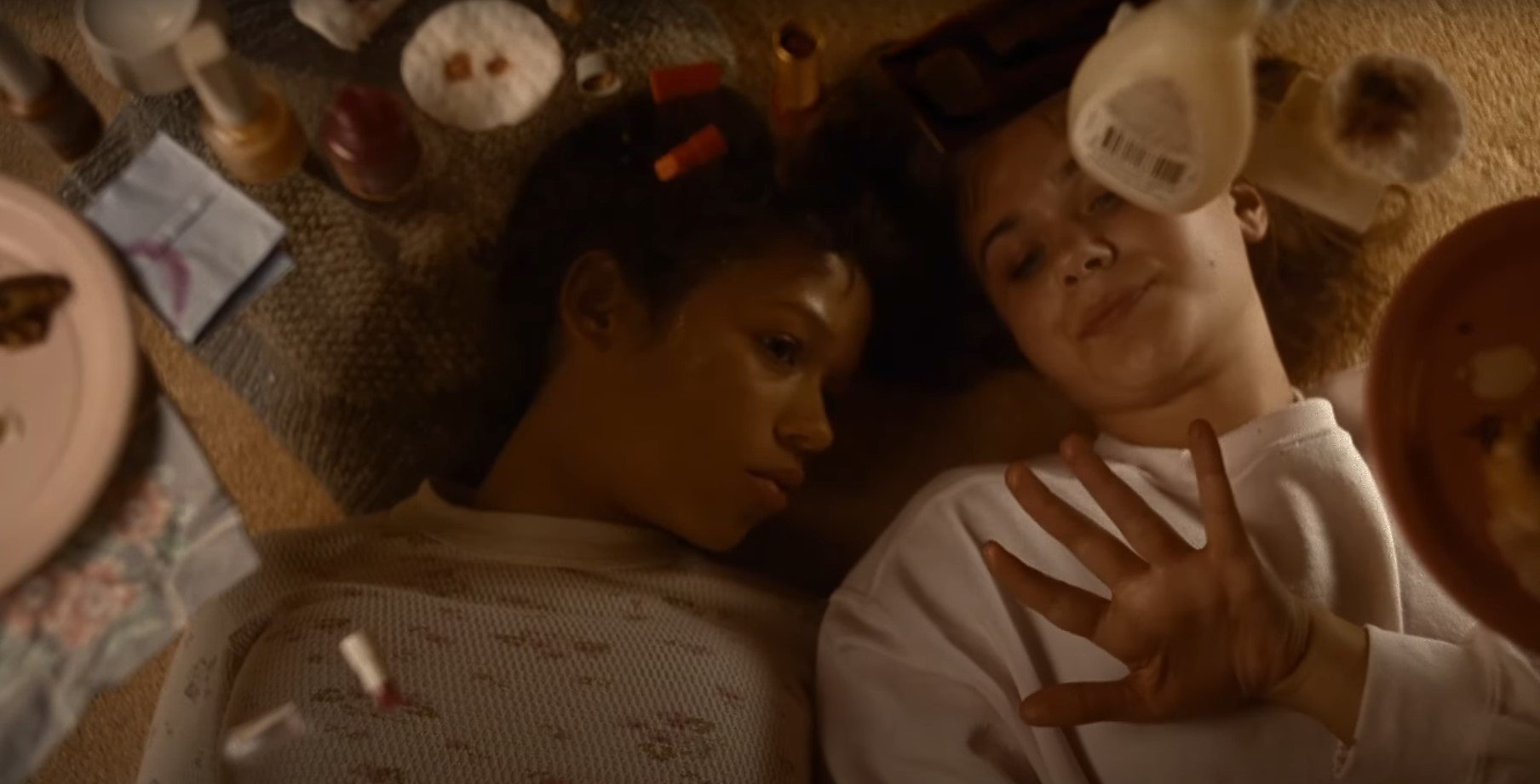
Bones and All (2022), directed by Luca Guadagnino and written by David Kajganich, follows Maren (Taylor Russell), a lonely, isolated young woman learning to survive in a hostile world. When she is abandoned by her father, she sets off on a journey of self-discovery, meeting others who share her dangerous appetites. Her appetites are revealed in tandem with a flicker of desire and sensual experimentation, in the intimacy between teenage girls when, at a sleepover, attention shifts from parted lips to irresistible flesh. In the chaos that ensues, Maren, blood-soaked and confused, is compelled to begin her journey. On this journey, she must feed but is never brazen in her appetites; despite the breathless and orgiastic feasting she partakes in, she is desperate for rules. The link between sex and cannibalism is explored sweetly here as the relationship between Maren and Lee (Timothée Chalamet) develops, eyes meeting over a gushing chewed artery. The bond between them is deeper than sex, a greater intimacy. In the finale of the film, we see that Maren, much like Simone in Der Fan, expresses her love and devotion through cannibalistic communion. The titular ‘bones and all’ refers to the ritualistic consumption of the entirety of a person, literally eating their bones and all. By completing this ritual with Lee, she is able to keep a link with him after death.
For the women discussed here, cannibalism is a means of self-discovery. It is also an act of transubstantiation, turning often orderly lives into chaos, allowing them to break free and build anew. A shared component is the idea of communion; for Simone and Maren, this is with a lover, for Esther, with the self. Sex is intertwined with cannibalism, more explicitly in Der Fan, Trouble Every Day, and Bones and All, but it is also evident in Dans Ma Peau, in which Esther’s self-reverence has a masturbatory quality, as she soaks in the pleasure of her own bodily fluids. Reverence for the flesh is also a recurring theme, with all the women explored here cherishing their bodies and the bodies of others. Returning to the transgressive nature of cannibalism, it is clear how this most taboo of desires is doubly monstrous in women. When these women indulge their appetites, they choose to transgress socially accepted norms about women and hunger. A cannibal woman is a liminal woman, one who resides outside the well-established social stratum, indulging her appetite for sex and blood.
References
Kay, Jilly Boyce. “Abject desires in the age of anger: Incels, femcels and the gender politics of unfuckability.” In Imagining” We” in the Age of” I”, pp. 29-46. Routledge, 2021.
Kristeva, Julia. Powers of Horror: An Essay on Abjection. Translated by Leon Samuel Roudiez, Columbia University Press, 1982.
Vera, Noel. 2017. “Trouble Every Day (Claire Denis, 2001)”. Critic After Dark.
https://criticafterdark.blogspot.com/.
Palmer, Tim. “Under your skin: Marina de Van and the contemporary French cinéma du corps.” Studies in French cinema 6, no. 3 (2007): 171-181.
Santich, Barbara. “Revenge, Cannibalism and Self-Denial.” Food and History 1 (2003): 85-94.
West, Alexandra. Films of the new French extremity: Visceral horror and national identity. McFarland, 2016.
Wood, Robin. Hollywood from Vietnam to Reagan… and beyond. Columbia University Press, 2003.






Leave a Reply to 5 Must Read Horror Articles 3 November 2025 – This Is HorrorCancel reply