

By Ray Walton
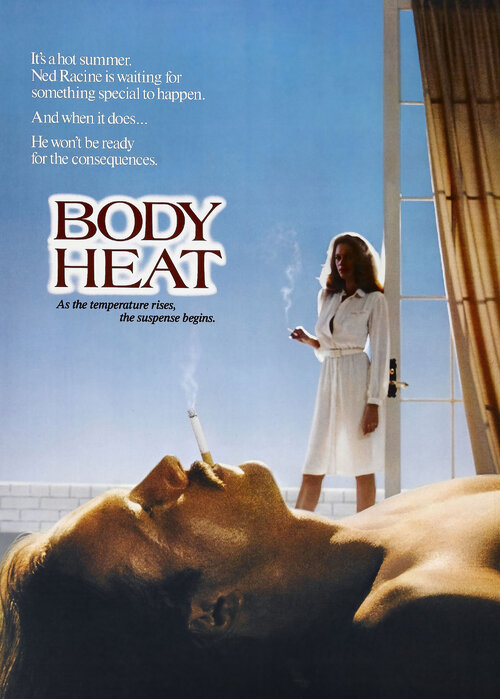
Body Heat (1981) Director: Lawrence Kasdan
During an extreme heatwave, a beautiful Florida woman and a seedy lawyer engage in an affair while plotting the murder of her rich husband.
Released in 1981, Body Heat arrived during a period when American cinema was actively revisiting classic noir through a contemporary lens. Directed by Lawrence Kasdan, the film draws heavily from earlier templates such as Double Indemnity and The Postman Always Rings Twice, filtering their fatalism through heightened sexuality and sun-drenched menace.
Set in oppressive Florida heat, the film reflects an era fascinated by excess, desire, and moral collapse. Unlike its mid-century predecessors, Body Heat leans openly into eroticism as both motivation and distraction, using sensuality to blur judgment and complicate culpability. Its reputation rests on atmosphere and performance as much as on plot, situating it as a neo-noir that knowingly courts both homage and exaggeration.
Body Heat feels like a blend of Double Indemnity and The Postman Always Rings Twice, while still trying to establish its own identity. That tension gives the film both its strengths and its weaknesses. The performances are unquestionably strong, and the chemistry between William Hurt and Kathleen Turner carries much of the film’s appeal.
I also enjoyed seeing Richard Crenna in a small but memorable role. Having listened to episodes of the radio series Our Miss Brooks, it was fun to see him play against the image of the squeaky-voiced Walter Denton in something far more restrained and ominous.
The plotting around Edmund Walker’s murder and its aftermath is effective for the most part. Where the film stumbles for me is in the sheer number of twists. In trying to combine classical noir mechanics with its own ambitions, the story occasionally veers into the implausible. I found myself wondering whether a slightly longer runtime and more attention to the mechanics of the plot, rather than the erotic elements, might have allowed those twists to land with more credibility.
I recognize that this places me in the minority, given how highly regarded the film is. Body Heat is solid and stylish, but it asks the audience to suspend disbelief more than I’m comfortable with. Still, its place in the neo-noir canon is understandable.
Why tonight?
Because this is a film about temptation clouding judgment, and winter nights make excess feel distant but dangerous.





 NightTide Magazine
Leave a comment