
By Mo Moshaty
Humans have spent thousands of years trying to tame the calendar, name the seasons, map the weather forecast, and the storms (and are wrong 75% of the time), and convince ourselves that if we study nature closely enough, it will eventually behave. Agriculture became industry. Almanacs became meteorology. The sky itself now arrives with hourly updates on our phones. Thanks, Weather Channel!
And yet horror films keep telling the same inconvenient story: the seasons are not systems that we can manage. They are cycles we can only hope to survive.
Over and over again, characters step into landscapes, convinced they are there to solve something, study something, restore order, document history, or conquer the unknown. They bring science, religion, cameras, maps, or perceived institutional authority. And nature responds by quietly dismantling all of it. Spring, Summer, Autumn, and Winter expose a different version of humanity’s favorite delulu: that the world operates according to the rules we wrote.

Spring: Fertility, Faith, and the Outsider Who Thinks He’s the Hero – The Wicker Man (1973)
Spring is the season most associated with hope, rebirth, and renewal. Lambs returned to the fields. Crops began to grow. Flowers bloom. Folklore has always understood something far less comforting: that spring is basically a negotiation.
Historically, agricultural communities depended entirely on whether the land cooperated. Failed harvests meant starvation. Fertility rituals, seasonal festivals, and Pagan rites developed around the simple reality that human survival depended on forces beyond their control. Spring didn’t just arrive; it had to be coaxed, celebrated, and sometimes appeased.
Enter Sergeant Howie (Edward Woodward) in The Wicker Man, perhaps one of the most gloriously confident outsiders in horror cinema. A devout Christian policeman, he arrives on Summerisle with the unshakable belief that he is stepping into a moral disaster that only he can correct. The Islanders drink, sing bawdy songs, dance around Maypoles, and openly celebrate sexuality and fertility. To Howie, this is less a cultural difference and more of a moral collapse…and naturally, he assumes it’s his job to fix.
What he fails to grasp is that Summerisle isn’t disordered. It’s operating according to a seasonal logic far older than his rigid theologies. The missing girl he believes he’s rescuing isn’t a victim; she’s bait. The rituals he condemns aren’t evidence of madness, but part of a carefully curated and maintained ecological and spiritual balance. Howie’s fatal flaw is his certainty that his worldview automatically outranks everyone else’s.
He arrives convinced that he’s the righteous intruder exposing corruption. Instead, he’s the imbalance the island needs to correct, and by the time he realizes this, the wicker structure towering above him has already been built. Spring and folklore rarely offer gentle rebirth. It offers fertility with terms and conditions.

Summer: When Nature Stops Following Human Rules – Annihilation (2018)
If spring negotiates with the land, then summer unleashes it. Growth accelerates, forests thicken, and heat intensifies. Life expands in every direction at once. Historically, summer has always carried an undercurrent of anxiety: abundance is wonderful, but abundance can also be really overwhelming. Crops can rot in extreme heat. Storms can flatten entire fields. Nature’s productivity isn’t inherently stable.
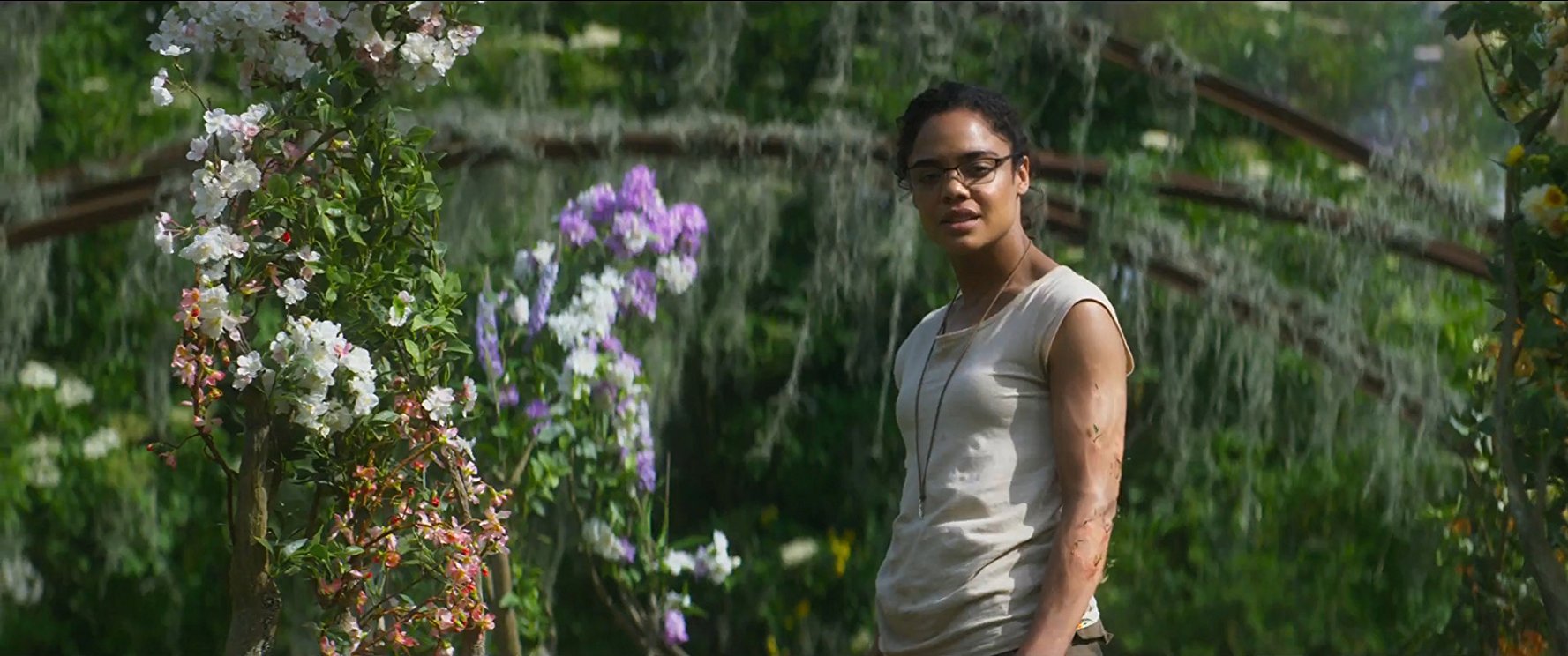
In Annihilation, Alex Garland imagines what happens when nature simply decides to stop obeying human categories altogether. The Shimmer, a strange environmental anomaly expanding across the Florida coastline, is initially treated as a scientific problem. Military expeditions enter it hoping to gather data, scientists attempt to map its boundaries, and everyone just assumes that with enough research, the phenomena will eventually become understandable. This assumption doesn’t last long.
Inside The Shimmer, biology becomes experimental. Plants grow in fractal patterns, and animals combine genetic traits in grotesque ways. The now infamous bear-ish creature carries the distorted screams of its previous victims inside its throat. The environment refracts DNA the way a prism refracts light. Each character in the film responds differently to the collapse of familiar natural laws.
Josie (Tessa Thompson) drifts into something almost peaceful, slowly dissolving into the vegetation. Anya (Gina Rodriguez) attempts to confront the chaos head-on, only to be violently destroyed by it. Lena (Natalie Portman) reaches the lighthouse expecting answers, and instead encounters a silent, unsettling imitation of herself.
Summer horror often reminds us that nature doesn’t need to destroy humanity outright; it just needs to evolve beyond our understanding. And when that happens, the idea that we were ever in charge starts to look a little ridiculous.

Autumn: The Forest Where Confidence Goes to Die – The Blair Witch Project (1999)
Autumn has always carried a quiet hum of either disappointment, coziness, or a mix of the two. Harvest season determines whether communities will survive winter. Farmers tally what the land has provided and hope it’s enough. In horror, autumn often represents the moment when humans discover that the landscape has been keeping its own score.
A trio of student filmmakers at the center of The Blair Witch Project enter the Maryland woods convinced they’re producing a brilliant piece of investigative journalism. Armed with cameras, microphones, and the confidence of film students who have been told they’re brilliant (by their peers), they approach the legend of the Blair Witch as a quirky local myth rattled off by the locals they’ve been making fun of.
In their minds, the forest is a backdrop. The woods disagree.
At first, the disruption is subtle. Sounds echo strangely. Small piles of stones appear outside the tent. Children’s laughter drifts through the trees at night. Twig figures hang from the trees. And then the geography itself begins to collapse. The map becomes useless. Paths lead nowhere. Hours of walking return them to the same downed tree they crossed earlier. The forest isn’t chasing them; it just removes the tools that they’ve been relying on to navigate it. Soon, the confidence that launched their expedition begins to erode, and their project, once framed as a triumphant discovery, becomes a slow, humiliating realization that they do not understand the environment they’re standing in.
Autumn horror rarely needs monsters stomping through the woods. Sometimes the forest just waits patiently while human arrogance exhausts itself.

Winter: The Season That Ends the Argument – The Thing (1982)
Winter has always been the season that strips civilization down to its fragile nakedness. Long before modern heating systems and international supply chains, brutal winters regularly erased entire settlements. Crops died, roads vanished beneath snow, and food became scarce. Unless you’re cannibals, then hey, dig in.
In The Thing, Antarctica transforms an isolated research station into one of the most claustrophobic environments in horror cinema.
The men stationed there already exist on the edge of the world. They’re scientists, pilots, mechanics, and technicians, all stationed in a place where survival depends on cooperation and routine. When the shape-shifting alien organism infiltrates their camp, that fragile trust holding the group together begins to disintegrate. Anyone could be the creature.
Winter amplifies the paranoia because escape is virtually impossible. The landscape offers nothing but lethal cold and endless white, and there is no civilization to run back to, no quick evacuation plan waiting for them beyond the horizon.
Instead, the station becomes a pressure cooker of suspicion. Alliances form and collapse. Tests are devised to determine who is human and who is something else. Every decision carries the possibility of utmost catastrophe. By the time the film reaches its final moments, the alien organism has almost become secondary to the environment itself. MacReady (Kurt Russell) and Childs (Keith David) sit opposite one another in the ruins of the station, two men who have never trusted each other and certainly don’t start now. The fire dies down. The wind howls through the wreckage. Neither man has the strength, or perhaps the will, to continue the fight. One of them could be the creature. One of them could still be human. At this point, it hardly matters.
The weather has already sealed their fate. They’re two stubborn figures staring across the cold at one another, sharing a bottle of whisky while the Antarctic darkness settles in. Winter has always understood that when the temperature drops far enough, nature doesn’t need monsters to threaten humanity; the environment itself is already doing a hell of a job.
Across these films, the pattern becomes impossible to ignore. Every character enters a landscape believing that they are the one in control.
A policeman arrives to correct Pagan superstition. Scientists attempt to map an ecological anomaly. Filmmakers document a local legend. Researchers are forced to study a mysterious organism.
Each group brings its own form of authority, and each season breaks it apart.
Spring demands balance. Summer rewrites biology. Autumn disorients the map. Winter waits for exhaustion to finish the work.
The seasons don’t care how confident we are when we arrive, and horror, bless it, never lets us forget that.

Mo Moshaty is an acclaimed horror writer, lecturer, and producer whose work combines visceral storytelling with the psychological insight of her Cognitive Behavioral Therapy background. She has lectured internationally, including as a keynote speaker at Nightmares from Monkeypaw: A Jordan Peele Symposium (Prairie View A&M), No Return: A Yellowjackets Symposium (Horror Studies BAFSS Sig), The Whole Damn Swarm: Celebrating 30 Years of Candyman (University of California), and with the Centre for the History of the Gothic (University of Sheffield). Mo has also presented at the BFI, Miskatonic Institute of Horror Studies, and Final Girls Berlin Film Festival’s Brain Binge on women’s trauma in horror cinema, Cine-Excess on The Creepy Kid Horror Subgenre and Mother/Daughter Trauma in Horror, and Romancing the Gothic on Cosmic Horror’s Havoc on The Body Electric Her short film, 13 Minutes of Horror: Sci-Fi Horror, won the 2022 Rondo Hatton Classic Horror Award for Best Short Film. As a core producer with Nyx Horror Collective, Mo co-created the 13 Minutes of Horror Film Fest and partnered with Shudder in 2021 and 2022, while also establishing a Stowe Story Labs fellowship supporting women creatives over 40+ in horror. A member of the Black Women in Horror Class of 2023 and featured in 160 Black Women in Horror, Mo’s short fiction appears in A Quaint and Curious Volume of Gothic Tales (Brigid’s Gate Press) and 206 Word Stories (Bag O’ Bones Press). Her debut novella, Love the Sinner, was released July 5, 2024, with Clairviolence: Tales of Tarot and Torment released in October 2025. The first of her five-volume non-fiction series, The Annex of the Obscure: The Afterlife, will be released in 2027 from Tenebrous Press. As the Editor-in-Chief of NightTide Magazine and founder of Mourning Manor Media, Mo champions marginalized voices in horror. Under her leadership, NightTide plans to launch a film festival in 2028, furthering her mission to reshape the genre through inclusivity and representation.
Leave a Reply