
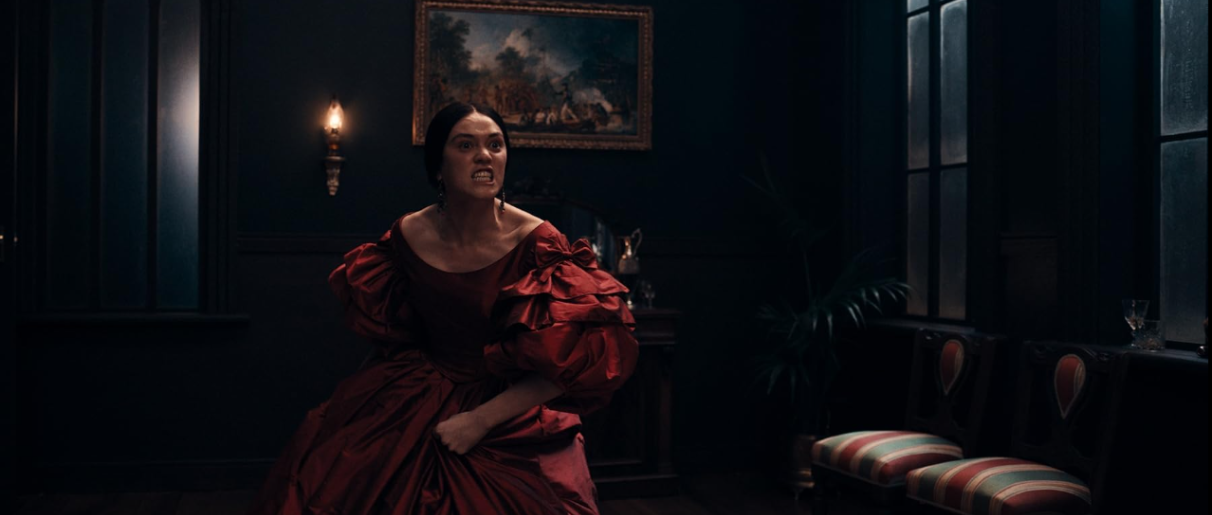
Mārama is a gothic horror film unafraid to get its hands dirty as it explores identity and unspeakable loss.

Mārama (2025) dir. Taratoa Stappard ⭐️⭐️⭐⭐
A young Māori woman steps into her full power while discovering unspeakable atrocities women in her family have suffered at the hands of her new employer.
The horrors of colonization have ripple effects. The violation of our ancestors is felt and seen for generations after the abuse. Many of us who benefit from colorism (the proximity to whiteness) have to contend with it being part of our identity. To make it more confusing, it’s the part of our identity that grants us access to white spaces where any Eurocentric feature is celebrated. We see this on TV as even biopics cast actors with lighter skin tones than their subjects. Like when Nina Simone was played by Zoe Saldana in dark makeup and a prosthetic nose. Which begs the question, is this more or less offensive than 80s films gleefully using Brownface in cultural touchstones like Aliens, Short Circuit, and Scarface? Many POC live with the constant fight to decenter whiteness as we try to follow breadcrumbs to form a picture of where our families come from. This is one of the ways Mārama claws at its audience.
Writer-director Taratoa Stappard’s Mārama is set in 1859. The film follows an orphaned Māori woman, Mary Stevens (Ariana Osborne), who travels to North Yorkshire, England. She has been summoned and given a one-way ticket by a man she discovers died months ago upon her arrival. She is soon offered a job as a governess by Sir Nathaniel Cole (Toby Stephens). While looking after his eight-year-old daughter, Anne (Evelyn Towersey), Mary begins to unravel horrific secrets about Nathaniel. His fetishization of Māori culture becomes too much to bear, and Mary has understandable feelings about his collection of her people’s treasures. As the film cranks the knob from a simmer to a boil, Mary discovers Nathaniel did not just stop at collecting inanimate items. Mārama sheds its haunting gothic vibes and goes full tilt toward a rage-induced vengeful ending.
Mārama is a gorgeous exploration of identity in part because the team behind it put in the extra work. Director of Photography Gin Loane put a lot of thought into the framing of this narrative. This is why each scene feels like a living painting. Nick Williams’ production design, in tandem with Sarah Voon’s costumes, gives us an almost operatic vibe. Which is interesting, as opera houses were still defending their right to yellow face even in 2019. As one of the many art forms that make it unnecessarily difficult for POC to find their footing and get work, it makes Mary inhabiting this space that much more intriguing. This also made it easy to swallow some of the parts of the film that could have been finessed a bit more. Watching an Indigenous character run around places where her ancestors were not welcomed as she discovers the tragic fate of her mother and twin sister made it easy to excuse the occasional hiccup.
Osborne is also a captivating actress. We instantly feel for her and willingly take this emotional rollercoaster with her. Every betrayal hurts. Every microaccression is relatable. We even hold some of her rage as she realizes how much has been taken from her and her ancestors. She, all of us, cannot undo the past and cannot heal the lost parts of herself. So, when she turns on her gaslighting benefactor, it’s a thing of beauty. He stole everything from her and then made her work for an allowance as if what she’s lost could ever be repaid piecemeal. Mārama does not mince words when it comes to the way women, culture, and land are taken. Colonization kills, and the film is very aware of that. It refuses to romanticize it or excuse any level of racism practiced by its characters.
Stappard’s script feels like being stabbed in the heart repeatedly. Meanwhile, his direction is beguilingly gorgeous. The film might seem unassuming, but it has teeth as it navigates these ideas. Identity and unspeakable injustices drive this vehicle to its conclusion. Mārama lulls you into thinking it’s going to be another film filled with beautiful gowns and beautiful dresses. Then it forces you to unpack some difficult conversations about a past that will never fully be reckoned with. It’s a film that sits with you well after it’s over and forces you to think about it. It knows creating art, especially horror, is a political act, and it does not back down from screaming where it stands in the faces of its audience. It’s a very bold first feature that gives us a glimpse of a filmmaker we should keep an eye on.

Sharai is a writer, horror podcaster, freelancer, and recovering theatre kid. She is the host of the podcast A Nightmare On Fierce Street and is also one-half of Blerdy Massacre. She has bylines at Fangoria, HorrorBuzz, Neon Splatter, and is Co-EIC of Horror Movie Blog. She spends way too much time with her TV while failing to escape the Midwest.

Leave a Reply