


Trauma Or, Monsters All (2026) dir. Larry Fessenden ⭐️⭐.5
A writer investigating her town’s dark past for a newspaper article stirs up fears about lurking monsters. Larry Fessenden’s final chapter of his quadrilogy works as a standalone or series finale.
There’s a particular kind of frustration that comes from watching a film try very hard to be thoughtful… and still miss the mark.
Larry Fessenden’s Trauma Or, Monsters All arrives as the fourth entry in the filmmaker’s loose monster cycle, following Habit (1995), Depraved (2019), and Blackout (2023). Fans of those earlier films will recognize the connective tissue immediately. Characters and mythologies from each story continue their trajectories, and part of the film’s appeal lies in watching those threads finally converge in the same small-town setting.
The premise is promising. Fessenden brings together his vampire, werewolf, and Frankenstein creation into one uneasy narrative, turning the upstate New York town into a meeting point for monsters who have spent the previous films navigating their own tragic circumstances.
And if you’re wondering why I’m about to spend more time talking about identity than the monsters themselves, it’s because the film does too. Loudly. In ways that become difficult to ignore.
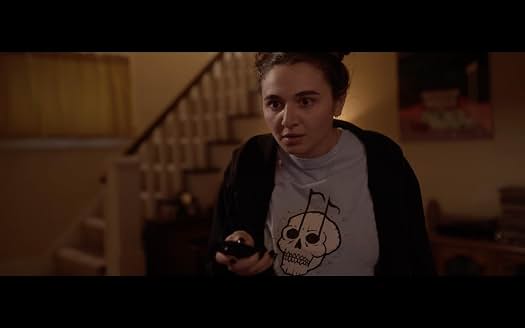
The story centers on Cassandra (Laetitia Hollard), a new librarian in town and a woman of color who grows curious about the strange monster lore circulating among the locals. Her curiosity eventually pushes her to dig into the town’s past and publicly question whether those creatures might still exist among the residents. Around Cassandra is a small web of characters who may or may not be connected to those stories.
Her co-worker Agnes (Aitana Doyle) forms a romantic connection with Cassandra that strains as the town grows increasingly tense about the new attention drawn to its history. Charlie (Alex Hurt), the troubled figure at the center of the town’s werewolf legacy, is missing, leaving his wife Sharon (Addison Timlin) searching for answers. Meanwhile, Adam (Alex Breaux), the Frankenstein creation introduced in Depraved, continues trying to carve out something resembling autonomy while remaining tethered to the shadow of his former unethical “father figure”, Polidori (Joshua Leonard).
And hovering quietly through the town is Sam (Larry Fessenden), the vampire first introduced in Habit, whose presence reminds us that the monster stories in this world rarely stay buried for long.
On paper, bringing all these figures together should feel like a culmination of Fessenden’s long-running fascination with monsters as reflections of human fragility. In practice, however, the film often feels distracted by another goal: trying to comment on identity politics in ways that feel strangely heavy-handed.
Cassandra is researching Black queer inventor and activist George Washington Carver for a book she’s working on, and the script returns to that detail repeatedly. There are moments where she’s simply walking through town, the voiceover of her written passages lingering in the wind. After a while, the question becomes unavoidable: why?


Laetitia Hollard, Larry Fessenden, Alex Hurt, and Alex Breaux in Trauma Or, Monsters All (2026), dir. Larry Fessenden/Glass Eye Pix
A character being a woman of color doesn’t need narrative proof. Cassandra could simply exist that way without the script constantly reminding us through exposition and dialogue. Representation tends to work better when it’s allowed to breathe. The town’s reaction to her unfolds through a series of microaggressions meant to mirror its fear of monsters and outsiders. Horror has always been good at using monsters to explore social anxiety. Here, though, the dialogue often sounds more like commentary than conversation. There’s also a strange mind fart Cassandra has that speaks of people you think are all Black are actually mixed, Obama, for example, or Jordan Peele. Again, why? Rodney King’s famous inquiry of “can’t we all just get along?” is spoken because of course it is.
A similar awkwardness appears in a brief moment involving a trans character who introduces themselves with a visible “TRANS” tattoo before making a line comparing themselves to monsters. The intention seems to be empathy through metaphor. Instead, it lands strangely. Trans viewers may well feel differently, but the scene reads like a well-meaning attempt at progressiveness that becomes so literal it collapses the metaphor entirely.
Which is unfortunate, because there are still interesting ideas underneath the film. Watching characters like Adam, Sam, and Charlie move through the same space does carry a sense of culmination for viewers who have followed Fessenden’s monster cycle, with Adam’s story being just as heartbreaking as his first introduction.
Yet Trauma Or, Monsters All often feels caught between telling a monster story and making a statement about identity. Honestly, it just wasn’t what I expected from this movie. Fessenden’s monsters usually work because they’re people carrying damage and trying to survive on the fringe. Cassandra isn’t that kind of outsider. She’s a regular American who just happens to be Brown. So when the film starts folding her into the same “aren’t we all a little monstrous” metaphor, it feels a little soft and oddly misplaced. That disconnect is part of why the film ultimately left me disappointed. The themes are there, but the film rarely trusts them enough to unfold organically. And when the metaphor becomes that loud, the monsters almost stop being the strangest thing in the room.

Mo Moshaty is an acclaimed horror writer, lecturer, and producer whose work combines visceral storytelling with the psychological insight of her Cognitive Behavioral Therapy background. She has lectured internationally, including as a keynote speaker at Nightmares from Monkeypaw: A Jordan Peele Symposium (Prairie View A&M), No Return: A Yellowjackets Symposium (Horror Studies BAFSS Sig), The Whole Damn Swarm: Celebrating 30 Years of Candyman (University of California), and with the Centre for the History of the Gothic (University of Sheffield). Mo has also presented at the BFI, Miskatonic Institute of Horror Studies, and Final Girls Berlin Film Festival’s Brain Binge on women’s trauma in horror cinema, Cine-Excess on The Creepy Kid Horror Subgenre and Mother/Daughter Trauma in Horror, and Romancing the Gothic on Cosmic Horror’s Havoc on The Body Electric Her short film, 13 Minutes of Horror: Sci-Fi Horror, won the 2022 Rondo Hatton Classic Horror Award for Best Short Film. As a core producer with Nyx Horror Collective, Mo co-created the 13 Minutes of Horror Film Fest and partnered with Shudder in 2021 and 2022, while also establishing a Stowe Story Labs fellowship supporting women creatives over 40+ in horror. A member of the Black Women in Horror Class of 2023 and featured in 160 Black Women in Horror, Mo’s short fiction appears in A Quaint and Curious Volume of Gothic Tales (Brigid’s Gate Press) and 206 Word Stories (Bag O’ Bones Press). Her debut novella, Love the Sinner, was released July 5, 2024, with Clairviolence: Tales of Tarot and Torment released in October 2025. The first of her five-volume non-fiction series, The Annex of the Obscure: The Afterlife, will be released in 2027 from Tenebrous Press. As the Editor-in-Chief of NightTide Magazine and founder of Mourning Manor Media, Mo champions marginalized voices in horror. Under her leadership, NightTide plans to launch a film festival in 2028, furthering her mission to reshape the genre through inclusivity and representation.

Leave a Reply