
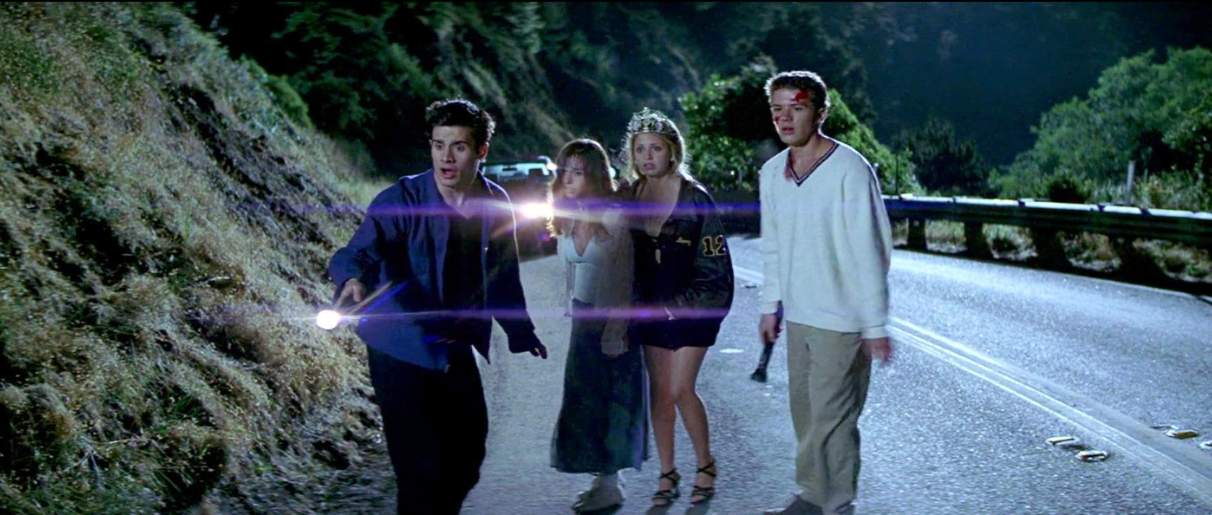
A certain franchise gets very popular every summer, which reminds me of its humble origins like clockwork. Lois Duncan crossed my path as a small child, the same way many genre authors did. I saw her young adult paperbacks in a thrift store and gave them a whirl, hoping for some murder and mystery. I still own (and move cross-country) with old copies of The Twisted Window and Killing Mr. Griffin. So, picture me as a very young nerd seeing that Duncan’s book, I Know What You Did Last Summer, would be adapted for the screen. When I found out Sarah Michelle Gellar would also be there, I reread that book and then waited for what felt like an eternity for it to hit pay-per-view. I eagerly threw down my childhood dollars and watched what was not my favorite Kevin Williamson script. Although it was another reminder that adapting someone’s work is tricky business.

The Book vs. The First Movie
As a pretentious child, this was not my favorite book by Duncan. I didn’t understand that a suspense novel didn’t need a high body count. I wanted blood, but all four main characters were left standing. I also thought our foursome was a little boring for my tastes. These are two things that Williamson’s script does fix. There is an actual body count (and a killer about business), and we at least get Helen Shivers (Geller), who should’ve been the final girl simply because she was engaging and wanted to live. Trey Callaway penned I Still Know What You Did Last Summer, but kept the Helen tradition alive with Karla (Brandy).
Julie James (Jennifer Love Hewitt) is written to be the perfect victim, which is why she doesn’t have the makings of an interesting survivor. She wasn’t created to battle slashers or solve mysteries like our favorite genre ladies. She’s the default lead in a suspense novel who didn’t truly get the required upgrades when moving to the screen and a different subgenre. She kind of runs around these first two films waiting for someone to save her while her sidekicks do all of the cool stuff. During a conversation on my podcast, we got into how the character could’ve been a commentary on white feminism, but she never quite goes there. To give Jennifer Kaytin Robinson’s 2025 sequel a small credit, the film at least gives Julie a backbone and some agency. Instead of waiting to be saved, she helps save the new final girl and passes the baton.
Like any good urban legend, many of us have fallen down the rabbit hole of rumors about the first I Know What You Did Last Summer film. We’ve all heard that director Jim Gillespie wanted to avoid having a ton of blood on screen. We also have heard that various things were added, or made to be bloodier, in post-production. This makes sense because Williamson had just become a household name with Scream. So, of course, Hollywood would want to pick up a script with his name on it and try to get lightning to strike again. Even if it meant shoehorning in a few things and hoping no one would notice. (Variety) We hear these stories all the time, and most of us never seek out specifics because it’s on brand for the slasher boom of the late 90s.
Duncan’s tale was a lot less bloody and more interested in building suspense than releasing tension. I remember it being more of a mystery that I wasn’t too mad at. As a kid, I just wanted more blood, and it didn’t scratch that itch for me. However, a lot of the violence in the film also fell flat for me. I also questioned the endings of both IKWYDLS and the first sequel. Yet, as a good aspiring horror fan, I also watched I Will Always Know What You Did Last Summer and wanted my time back. I even tried the first episode of the short-lived Prime Video series in case the formula would finally work for me. It didn’t, and I again had to admit I am just not here for this premise. The Scooby Dooification of the slasher isn’t a new concept. Yet for whatever reason, I am always left wanting more from this franchise.

Before I Continue
I’m not trying to take away from Duncan’s work. Her supernatural YA genre titles not only added another woman to my bookcase in my youth, but were also gateway novels for some of my friends and acquaintances. It’s not her fault; I was having tea parties with Michael Myers and Freddy Krueger before I could read and was born chronically unimpressed. I think her work is important and love that her Summer of Fear became one of the movies directed by the late Wes Craven. As a horror writer, none of my favorite or least favorite directors are talking to me about adapting any of my work. Most of them aren’t helping women get anything adapted at all.
Duncan’s contributions deserve all of the belated flowers. She also accomplished these things in a time when women were boxed in and not supported if they wanted to go buck wild like Nicholas Pike or Stephen King. So, I am forever indebted to Duncan, Richie Tankersley Cusick, and Diane Hoh for inspiring me to follow my dreams of scaring people. Any representation is good representation when you’re a youth not seeing many women working in your favorite genre. We probably owe them more than we think we do, as I am making my way through Pretty Little Liars for the first time. They are possibly also the reason that, as adults, we latched onto Little Fires Everywhere, Big Little Lies, and so many other femme-forward series adapted from novels written by women. They gave us a foundation to appreciate these stories and proved that work through our lens is just as valuable as all of the men clogging the bookshelves.

A Word About Our Original Author
I Know What You Did Last Summer isn’t the first story repackaged to become a slasher, and it will not be the last. While none of the versions of it are for me, it’s not even the flimsiest premise I have seen kick off a franchise. However, I always wonder if being a book nerd who has read the book and knows enough about Lois Duncan is part of the reason I just can’t get into this franchise.
Duncan’s work being turned into a slasher feels weird when you look at who she became. Duncan’s genre streak almost completely ended with the murder of her 18-year-old daughter, Kaitlyn, in 1989. Kaitlyn was fatally shot, and Duncan’s focus understandably shifted. Her daughter’s murder became a cold case, which led her to do her own investigation. She also wrote a non-fiction book, Who Killed My Daughter?, and began working on children’s picture books. Her suspense novels, putting young women in danger, were too close to home. After witnessing police negligence, Duncan took matters into her own hands. She hired psychics, private detectives, and tried to get the FBI involved. (The Washington Post)
Duncan acknowledged the differences between her book and the first movie. She had conflicting feelings, but didn’t seem to harbor any ill will:
“It was my characters and my plot gimmick, but then it went in all directions,” she said. “I was quite horrified by the sensationalized violence. Several years earlier, my own teenage daughter, Kait, had been chased down in her car and shot to death, and I had seen, right in front of my eyes, what real violence is. To have people screaming and laughing about it did not go down well… So I was not happy with the movie, but I have to admit I was happy with the fact that the book had been made into a movie, because that made all my backlist suddenly very popular. It was like getting a rebirth, but in a very strange way.” (Variety)
As a person who knows too many people who have been murdered and became instant cold cases before their funerals, my heart always went out to this woman. On the surface, we have nothing in common aside from being part of a painful club of people who lost someone to gun violence. Not having answers is hard, and having someone abruptly taken from you leaves a hole that cannot be explained. I have lost a sibling and too many friends because someone decided they shouldn’t be alive anymore. However, I cannot comprehend how hard it is to lose a child right when they are on the cusp of adulthood.
So, Duncan not being able to completely return to the genre that made her is understandable. Her being consumed by a need for answers is relatable as well. Which is why her quest to find the killer spanning decades is heartbreaking and frustrating. That didn’t stop Duncan from funneling her pain into helping other families, though. She became an advocate and helped other parents of murdered children via the Resource Center for Victims of Violent Deaths. (LA Times) She sadly died at the age of 82 without ever getting any form of justice or finding out who murdered her daughter. Duncan passed away on June 15, 2016 (The Washington Post). A man confessed to murdering Kaitlyn on August 23, 2021. (KOB.com) It’s upsetting to know that just over five years after her death, there would be some small form of closure for her family regarding the tragedy that haunted them for decades.
I Know What You’ll Do Next Summer
I always assume part of my generation’s fascination with this franchise is we are seeking nostalgic comfort during these never-ending, unprecedented times. Or, perhaps, people like liking things, and I am a natural-born hater. However, as someone who grew up in Kevin Williamson’s 90s (Scream to Dawson’s Creek pipeline for the win), this was the one title that wasn’t for me. To be clear, I am one of the kids who wanted to live in the world of Teaching Mrs. Tingle for a whole summer. I also love seeing writers get paid to write for my own selfish writer reasons. So, I’m not so much anti-IKWYDLS as I am always curious about it.
I want to know why I can’t seem to get into it just as much as I want to know why some people will go to bat for Julie James as a final girl. After all, getting outshone by your sidekicks in two different movies is wild work. However, I don’t really have a dog in this fight. I’m just nosy. I also realized many people don’t know Lois Duncan’s story, as I have been dropping the bits I recall in conversations over the last couple of years. I implore you to read her work and pass it on to the youth. By all means, start with I Know What You Did Last Summer if you need a safe gateway. As a professional busybody, I also encourage you to research Duncan. Most women writing fiction in the 70s and 80s simply never got the love and attention they deserved. She’s just the one I happen to know the most about because her story sticks with me.

Sharai is a writer, horror podcaster, freelancer, and recovering theatre kid. She is the host of the podcast A Nightmare On Fierce Street and is also one-half of Blerdy Massacre. She has bylines at Fangoria, HorrorBuzz, Neon Splatter, and is Co-EIC of Horror Movie Blog. She spends way too much time with her TV while failing to escape the Midwest.

Leave a Reply