
By Leanna Renee Hieber

The last time NightTide let me traipse across their lovely pages, I waxed rhapsodic about 25 years with my favorite band and all the weird sh!t Muse taught me since their debut, “Showbiz”, launched in 1999, and I was really annoying about it. Now 27 years (and 9 full additional albums with numerous stellar B-sides) later, the UK alternative rock band Muse, made up of the unwavering talents of Matt Bellamy, Dominic Howard and Chris Wolstenholme, is back with their 10th studio album. “The Wow! Signal” was released on June 26th, and the genre-defying band’s recurring themes coalesce into something really special in this album titled after a wild space mystery.
When I first heard the album title, admittedly I made a face, wondering what the hell “The Wow! Signal” meant, but I knew I had to go look it up because if something is an odd title, Muse chose it because it’s weird, true sh!t. Learn all the weird sh!t they taught me here: 25 YEARS OF WEIRD SH!T MUSE TAUGHT ME – NightTide Magazine (MK Ultra, wtf?!) And true to form, I learned about The WOW! Signal.
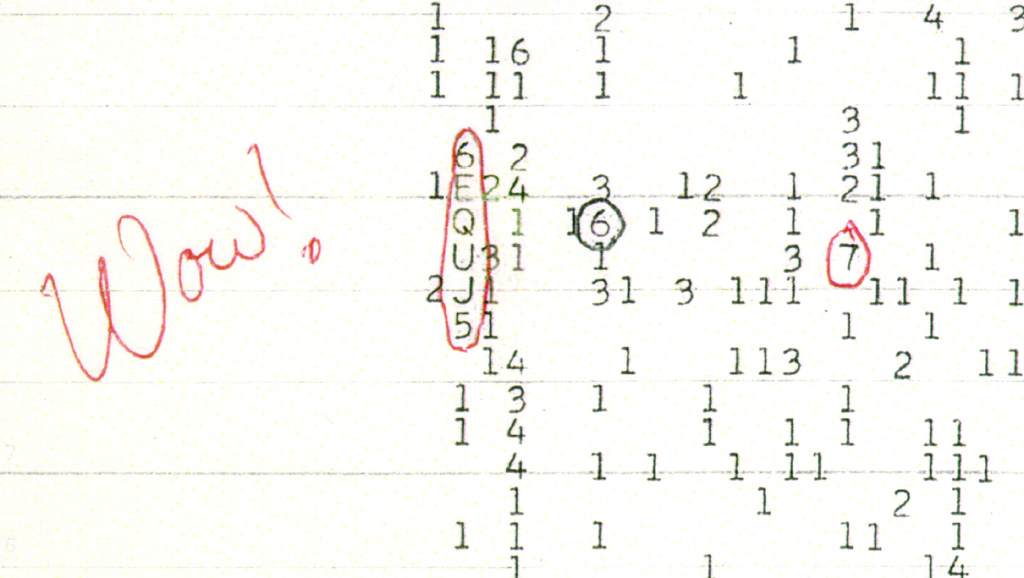
In 1977, at Ohio State University’s “Big Ear” satellite station, Jerry Eheman noted an enormous, 27-second signal from no discernible source. On the printout, he wrote in red letters, WOW! With an exclamation point. wowcl.jpg (1024×578)
Rolling Stone France, celebrating Muse’s new album, boasts a killer cover where that very script is emblazoned on lead singer Matt Bellamy’s face in bold red light: Interview exclusive: Muse en couverture de notre numéro de juin – Rolling Stone
SETI.org https://www.seti.org/research/seti-101/the-wow-signal/ breaks The Wow! Signal down thusly:
“What: A strong, narrow-band radio signal (print-out sequence “6EQUJ5”) detected on Monday, August 15, 1977 by the Ohio State Radio Observatory (operated by Ohio State University) during a routine sky survey.
Where: The observatory’s 25-metre telescope in Ohio, scanning overhead skies in search of narrow-band signals.
Key feature: The signal rose and fell in a way consistent with the telescope beam sweeping across a fixed point in the sky — suggesting a celestial, rather than terrestrial, origin.
Why it matters: It remains the most famous single-event candidate for an intentional extraterrestrial transmission — or at least an unexplained signal — because despite numerous follow-ups, it has never been seen again.”
Perhaps Muse, who began releasing tracks from this album last year, foretold interest and progress because, as of this year, according to a Popular Mechanics article, scientists may have cracked the WOW! Signal as massive hydrogen flares (even though the WOW! Signal is over 30 times more intense than any such recorded disruption, one that has never seen the like since). Did Scientists Solve the Mysterious ‘Wow’ Signal From Deep Space? But that’s boring. The thing about the WOW! Signal is that it seemed like our planet was being scanned by something from outer space. It has lived in collective consciousness as a form of alien communication. A confirmation that we’re not alone. An unsolved, unrecognizable statement with no way to answer back. That’s more on brand here. So let’s talk about this kick-ass album and the terror of the cosmos!
The cold, empty, breath-killing violence of space is the major through-line in this album. While the album doesn’t create a story so much as a conversation, there’s a push and pull between external (possibly alien) communication, internal emotion, manipulation both human and otherworldly, and profound disconnect across all of it. There is a tension in all of Muse’s work that’s like a tantalizing, unresolved chord, while always being beautifully melodic, that speaks to the existential human condition. (This album is also a breakup album but I’m not here to gossip about Matt Bellamy’s personal life; frankly, I’m just here for the killer guitar riffs, the pipe organ, and the fact that in space no one can hear you scream).

Art Direction: Jesse Lee Stout + MUSE
The blending of reality and another dimension is rife across Muse’s back catalog; from their albums Origin of Symmetry to Uprising, there’s a thread of conflict and resistance through the bulk of their work. The anti-establishment message of ‘it’s us against the world’ rings particularly true here. But so does the fact that sometimes humanity is its own worst enemy. Sometimes it’s us against us. Heart against heart. Freezing, breaking and floating away.
The wide expanse, the honest-to-goodness cosmic horror that is the sheer, numbing, cracking, ice-cold, weightless, helpless, lifelessness of space’s inconceivable abyss and the idea that something might come from that dimension to us is the animus. The lyrics, beats, riffs, technological manipulations, and orchestrations grapple with mysterious inner and outer antagonists across 10 stellar tracks.
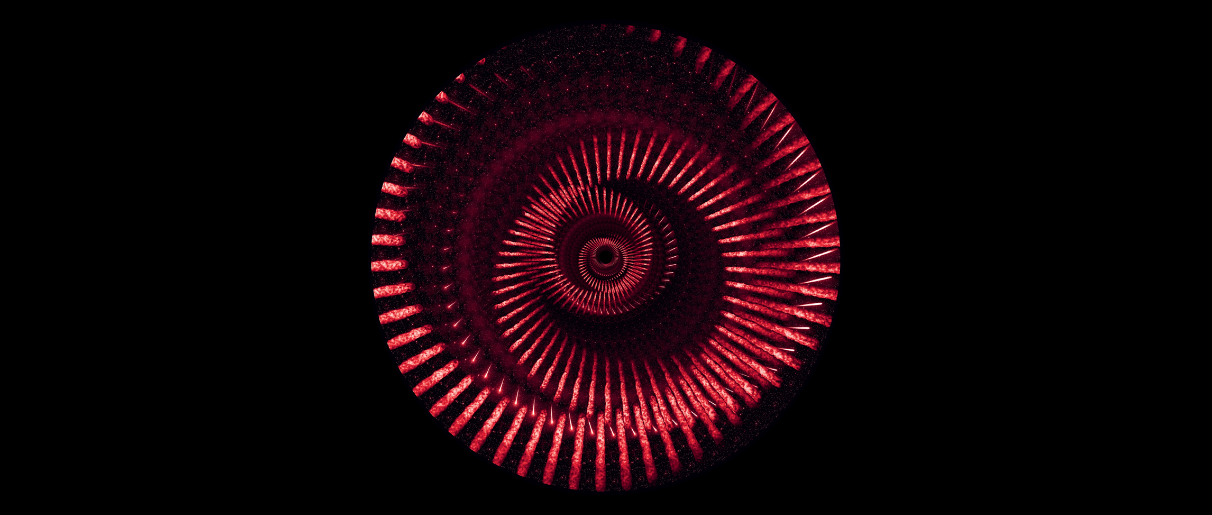
The album art features a circular, alien-looking, ring-shaped sort of space station against a celestial backdrop where a molten-red laser line, like a scan, descends in a meteoric drop through the center of the open circle towards the rising crescent of a cold lunar surface with the hint of a sunrise. It took me until I saw the packaging of the CD for the shape of the vessel to click. OH, the “ship” is the audible segments of the signal if read out in radio waves. The frequency of that recorded signal has been folded and bent into a circular satellite. If it were stretched back out into an audio recording line, it would be the WOW! Signal. Clever.
Everything about the red and black imagery of the album art, visualizers, press tour, videos, and global tour marketing is edgy and at times quite sinister. Nothing is to be trusted, but Muse will guide us through with entrancing beats and killer riffs. They are, after all, a rock band. So let’s rock.
The Dark Forest – Rejoice, Knights of Cydonia fans, we have a new anthem! This glorious epic has everything. It’s sweeping, it’s spooky, its lyrics are mysterious and threatening; this definitely embraces ‘it’s us against the world and possibly an alien’ vibes, it’s atmospheric, then orchestral, an intense journey into some kick-ass rock, then it morphs again. This song transforms several times over the course of its 5:15 minutes, a journey that’s no surprise to any Muse fan. It has a driving rhythm very akin to Knights of Cydonia (an unexpected breakout song from the Black Holes and Revelations album, and btw, Cydonia is an area of Mars). This song combines elements of the classic Lawrence of Arabia theme with other nods. Among them, a nod to Telstar by The Tornadoes (the song is named for the first telecommunication satellite, The Tornadoes famously innovated uses of synth in rock and rhythm guitarist George Bellamy is Matt Bellamy’s father) and a little I Will Survive orchestral bit sneaks in there as a treat, driving home our survival instinct as the song details begging for extinction amidst surviving a god of “nickel and cyanide”. In the final throes, this song transforms again into an invocation-style choral Kyrie Eleison chant that seems to be summoning a dark entity. Or maybe just the band Ghost. (Can we have a team-up?!) What an album opener.
Nightshift Superstar – A decidedly pop song with a 1980s feel that conjures up Muse’s “Simulation Theory” album, but because there’s always a bit of a twist with anything these guys do, there’s a creepy kid choir towards the end just to remind you that nothing is as it seems and that you might be under the influence of something.
Shimmering Scars – A stunning, expansive song of pain that doesn’t wallow but makes something beautiful out of shredding damage. At the 2:20 mark, Hanz Zimmer’s haunting soundtrack for Christopher Nolan’s Interstellar is truly evoked here with an aching pipe organ refrain that carries into the existential question surrounding every heartbreak as Bellamy’s gorgeous voice asks “was I not enough?” and wonders “what still remains”; leaving a heart coated with shimmering scars.
Cryogen – The track opens like a rusty, creaking maw, heading right into one of their best guitar riffs (I see you, Plug in Baby!). They’re freezing over with lonely emptiness and beset by the killing force of nitrogen and toxic relationships. It rocks.
Be with You – A Pipe Organ intro, hallelujah! The church of Muse, in this cosmic context, puts us in mind of Interstellar again, as Zimmer’s soundtrack really put space and pipe organ into an inextricable partnership for the modern ear. Don’t count this song out as a mere pop-anthem love song; ride with it until 2:26 and then it hits.

Hexagons – Yes, this is track 6, and the time signature is in 6. As the cosmos intended. A true classic-rock homage, this is a study in building something magnificent. A song about manipulation and predation crafted with massive guitar distortions and long holds, Matt Bellamy’s soaring falsetto is counterbalanced with some exquisite synth glissandos. A plea of “reach out, touch me, draw me from the sixth dimension” pulls us between fraught, dangerous worlds. This song marches eerily and directly into the next track, The Sickness in You & I, with seamless beauty that made me shout when I heard it. Hell yeah, I love a rock suite!
The Sickness in You & I – This track is just dead sexy, with another round of killer guitar licks. Classic and modern at the same time, a Muse specialty. The whispered lyrics of “the sickness in you and I” become an intimate invitation into a relationship that is as good as it is bad, and you want it all. It has a delicious Prince vibe (an artist that the band has credited as an influence more than once) that shifts into a harder guitar mode more like Rage Against the Machine (another influence Muse has been vocal about). THIS song carries the listener directly into Unravelling. This is why you should listen to the album in order, beloveds; some things are meant to be heard this way.
Unravelling – Whew, I love this song. This was the first single released off the album back in fall of 2025, and considering the current climate, “Unravelling” has felt really apt. This song is very complex, another Muse specialty, garnering praise from the hardcore loyalists like myself to those who had fallen away from the band, thinking they’d lost their edge. “They’re so back,” multiple friends said the moment that the bridge goes, and it goes hard. The progressive rock term “djent” applies here, to signify the harder metal aspects of the song that are in concert with voluminous orchestration. It’s another song that has everything. “A hymn for our love with no God” indeed.
Hush – A gradually building, poppy, hyper-modern duet with Ellie Goulding that relishes swirling, morphing, distorting, glitching tech and synth sounds as it heads into a driving, pulsing directive full of caution and care. Bellamy and Goulding’s voices are a great pairing in that they’re each such singular voices. Muse has very smartly listened to and utilized a range of spectacular producers who try to make sure that they’re still appealing to new listeners while never shirking their genre-defying identities. Muse can sometimes sound like other musicians or bands for a few bars, but they always come back to a combination that is inimitably their own.
Space Debris – the album finale, a quiet, contemplative outro. One of the initial theories about the Wow! Signal was that it had come from reflected space debris. This slow, aching, melancholic song about a relationship drifting away is a ballad of pure mourning, “as our bond decays like space debris, love can drift away”. To end with a certain entropy is poetry indeed, reflecting the stillness of space and the stark heartbreak of the abyss.
Live on tour, Muse brings dazzling showmanship to every song. Even in a themed album, Muse still intends for each song to stand on its own. I delightedly attended their July 25th show at Jones Beach, where each song became its own epic universe. Nothing felt out of place, changing worlds and realities from one song to the next. Seamless transitions wove Wow! Signal tracks into touchstones from every studio album, a whirlwind tour featuring some of their greatest hits. The Wow! Signal’s themes of cosmic threats existing hand-in-hand with interpersonal strife and psychological distress came through in magnificent performances of the new album’s singles. The band’s energetic, big, bold, high-powered setlist highlighted their ongoing themes of resistance and societal critique that fit nicely alongside unsettling mysteries of space. A masterful audio-visual experience swept a rapt crowd of nearly 15,000 into an explosive, cosmic light show and expertly mastered soundscape. Grand, outer-space vistas displayed on moving screens doubled as versatile lighting modules, super-high-tech, state-of-the-art, and stunningly choreographed. With occasional arrays of fire-canons and streamer-bursts for apex punctuation, lasers cut through fog and star charts to make us all feel like we were achieving weightlessness. It was meteoric. If the Wow! Signal was indeed a scan of this planet, then I hope whatever’s listening out there tuned in to rock out.
I have a feeling this album will be held up to the silent stars as one of their best; a spectacular ongoing signal from a band who formed as kids (this rock trio won their school’s “Battle of the Bands” in the early 90s and that charted their unending course). There’s so much that seeks to break the world apart; we’re all under vise grips. Earth is its own cosmic horror. But the fact that this trio has just been steadfastly doing their thing since they were teens, I find that a comfort against the splintering abyss. This band, and their fans, are bonds that don’t decay, no matter the internal or cosmic pressure.
Leanna Renee Hieber is a professional actress, playwright, ghost tour guide, and an award-winning, bestselling author of fiction and non-fiction. A Haunted History of Invisible Women: True Stories of America’s Ghosts, co-authored with Andrea Janes, was a Bram Stoker Award Finalist for Superior Achievement in Non-Fiction, and their follow-up, America’s Most Gothic: Haunted History Stranger than Fiction, was an Instant USA Today Bestseller and also a Bram Stoker Award nominee. Leanna’s Gothic novel Ravenfield Hall releases 2/16/27 from Hachette. A 4-time Prism Award winner, three of which went to her Gothic Strangely Beautiful saga and a Daphne du Maurier finalist for Darker Still, Leanna’s novels have received translations into multiple languages, and her short stories have been featured in notable anthologies such as Queen Victoria’s Book of Spells while her non-fiction essays have appeared in Apex Magazine, The Deadlands, Haunted Magazine and more. A guide with New York’s Boroughs of the Dead, founded by Andrea Janes, Leanna has been featured in film and television on shows like Mysteries at the Museum and Beyond the Unknown discussing Victorian Spiritualism. Leanna lives in New York and lectures around the country on Gothic and paranormal themes. https://leannareneehieber.com


Leave a Reply