
By Emma Cole

I think if you ask a lot of people about their favorite horror films from the late 1990s/early 2000s, you’ll probably get a mix of slasher fans who love Scream and the like, and people who are into the bombastic monster action movies like Blade or Deep Blue Sea. But the movies I have gone back to recently from that time period are predecessors to the elevated horror that permeates the genre now. Films like Stir of Echoes, What Lies Beneath, and Cure take horror elements and surround them with a different genre framework, usually a mystery, usually starring actors that are more well-known for non-horror work. These films were marketed as more upmarket and broadly appealing to adults than the teen-centric slashers or more fantastical horror genres; these were serious pictures (okay, some are more serious than others). Two of the films of that era that I went back to recently star Keanu Reeves, involve gifts that could be considered curses, and take place (for part of the film at least) in the southern United States: Sam Raimi’s Southern Gothic-tinged The Gift and Taylor Hackford’s legal thriller with a twist, The Devil’s Advocate.
The Gift is a perfect example of movies of the time period, featuring big stars working on genre or genre-adjacent stories but trying to keep the plot fairly grounded. Though Raimi was perhaps best known for The Evil Dead, his adaptation of Scott Smith’s neonoir crime drama A Simple Plan was released a few years earlier in 1998, setting the stage for a quieter, more atmospheric yet still tense psychological horror film in 2000.
Raimi follows Cate Blanchett’s Annie Wilson, a widow who provides for her family by giving psychic readings. She’s barely making ends meet after her husband is killed in a mining accident (which she warned him about), but she’s doing her best to raise her three sons while feeling isolated, unable to grieve her loss. Raimi paints her as a caring woman, so much so that she gives too much of herself to solve others’ problems. She is determined to help the troubled Buddy Cole (Giovanni Ribisi) figure out why he’s struggling to stay on an even keel by helping uncover the secrets of his past. And she puts her own family at risk when she tries to help Valerie Barksdale (Hilary Swank) leave her abusive husband Donnie, played with a very unsettling menace by Keanu Reeves. In the midst of these more domestic challenges, Annie finds herself immersed in the murder of a young woman, Jessica King, who isn’t as innocent as she seems (Katie Holmes).
It’s a much quieter and introspective piece of filmmaking than many of Raimi’s films, though we do see hints of his kinetic camera work, particularly when Annie is in touch with the supernatural. The camera slows down and speeds up often, disorienting the viewer just enough to make the entire movie feel a little bit off. It’s (mostly) a subtle touch, one that suffuses the story with a hint of the surreal, which obviously works quite well for a slightly supernatural Southern Gothic. Raimi keeps the speculative elements fairly vague; we’re never explicitly told just how Annie’s gift works, but she’s clearly receiving information from the supernatural, not only through her card readings but also in the form of more realistic visions, which increase as the mystery elements of the story begin to come together.
While this is far from a gory, straight-up horror film, Raimi doesn’t shy away from violence, particularly violence perpetrated against women and other vulnerable folks. Reeves’s Donny threatens his wife as well as Annie and her children, and there’s, of course, the disappearance and murder of Jessica. Even more devastating is the eventual discovery of the reason for Buddy’s repressed memories: his father spent years sexually abusing him. Annie finally helps him remember, which ultimately leads to Buddy’s death after he is arrested for the murder of his father. The supernatural elements are present throughout, but the real horror that permeates the film ends up being mostly mundane. Everyday violence between humans for the basest of reasons drives the plot forward here, and Annie’s brushes with the paranormal just allow her to bear witness to more of these moments than the average person, who can ignore them.

This wouldn’t be a piece written by me without at least a mention of the romance present in the story. Some relationships intertwine, and characters circle each other in a variety of intimate ways throughout, though nothing in the film is out-and-out romantic. The Gift portrays marriage as anything but a Happy Ever After: Annie is a widow; Valerie is trapped in an abusive relationship; Jessica is murdered before the wedding can take place. Even Buddy’s parents showcase a dysfunctional and toxic marriage, where Buddy’s mother ignores and enables her husband’s deeply troubling assault of her child. A pure and satisfying romantic pairing is simply not possible in Raimi’s film, a point he drives home as he reveals that Jessica was having an affair with Donny. Every love story, no matter how perfect it looks on the surface, is rotten at its core, or, in the case of Annie’s marriage, was doomed as her husband dies before the movie begins.
The temptation in a speculative film where the main character has a power or advantage is for the protagonist to use those powers to better their situation (something that becomes even more explicit in The Devil’s Advocate). In The Gift, that temptation is layered with a more visceral one: the potential for a new, more stable life with Jessica’s scorned fiancé, Wayne Collins (Greg Kinnear). The romance rules are used as shorthand here for a subplot that doesn’t have enough time to fully develop: Wayne is shown as a lonely and sad man after Jessica’s body is found, paving the way for some sweet interactions with the lonely Annie. Romance enthusiasts will recognize the trope of great couple, bad timing, where it’s clear that these two people are compatible but circumstances prevent them from embarking on a relationship. Several small moments nudge the viewer to think that maybe these two people are now free to find a second chance at love with each other. These scenes make the subversion of the trope even more satisfying when we discover that Wayne was, in fact, the murderer in the story, not the violent Donny.
While the film may be remembered more for its twists and unsettling atmosphere, I found when I rewatched it that the heart of the movie is really the rejection of otherworldly or supernatural gifts in favor of the power of community. When Annie is in service of people in need (whether Valerie, Buddy, or her children), the reward is much bigger for her, though spiritually or abstractly, than the more material success she may be able to get by using her gift selfishly. When she exploits her visions to punish Donny for threatening her family, or spurs Buddy into trying to remember his trauma on his own, she strays further down a path toward harnessing her power in a way that will inevitably bring about further sadness and despair in her own life. The same is true for giving in to the temptation of a potentially easier and stable relationship with the well-established, seemingly kind Wayne. When Annie tries to avoid the grief of losing her husband by entertaining Wayne’s subtle advances, she discovers his true nature. The film ends with her finally opening up to her children about the pain of losing their father so they can heal as a family.

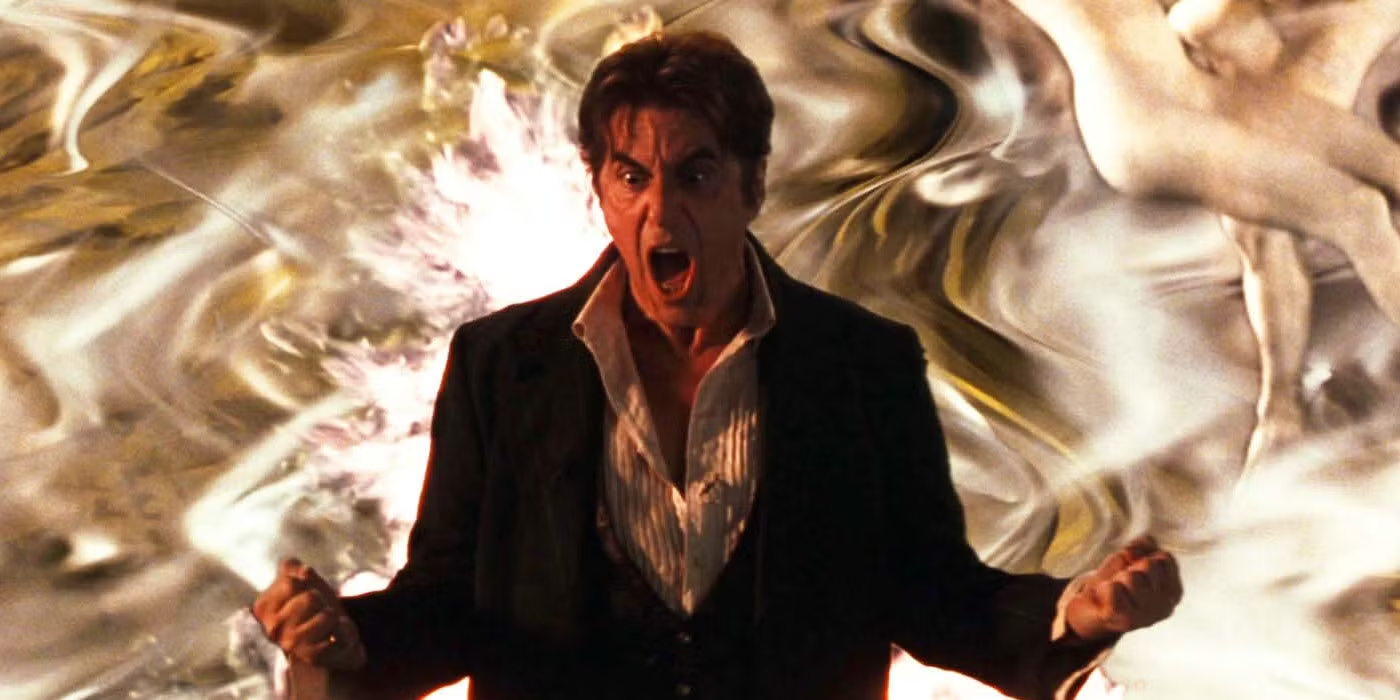
The questions of temptation and power are present in The Gift, but they definitely take a backseat to the overarching mystery. On the other hand, The Devil’s Advocate hinges almost entirely on whether Kevin Lomax (Keanu Reeves) will give in to the elaborate temptation set out for him by the ostentatious (and eyerollingly named) lawyer, John Milton (Al Pacino). The basic premise is simple: Kevin Lomax is a silver-tongued lawyer whose ambition outweighs his compassion by a wide margin. What will he do when the literal devil tempts him to forsake everything good in his life in the pursuit of power?
The film starts as a very typical legal thriller, with a high-profile case that Kevin is hoping to win (he’s a defense lawyer). His wife, Mary Ann (Charlize Theron), is as ambitious as he is, hoping they can earn some more money so they can buy a house and hopefully have children soon. When a mysterious attorney from New York City approaches Kevin after his latest victory, he’s skeptical about the opportunity, but he can’t turn it down. He’s a prideful man, and he knows he deserves more than life in this small, southern town. When he goes to visit his mother at church to tell her about the job offer, there’s a brief moment where he won’t step foot inside the building. A little too on the nose, maybe, but The Devil’s Advocate is not a subtle movie.
As Kevin and Mary Ann are drawn further into the high-powered world of John Milton and his subordinates, their marriage becomes more and more fraught. The trappings of wealth and success seem to suit both of them as they’re wooed by Milton and his associates, but Mary Ann is increasingly isolated from her husband and anyone else from her former life. Just as the romantic relationships in The Gift seem to end poorly for those involved, so too do the marriages in The Devil’s Advocate. Everyone is either unhappy and unfulfilled or, in the case of John, staunchly anti-marriage, preferring to seduce multiple women whenever he can. Kevin doesn’t even really notice how his marriage begins to fray, not until it’s too late. In a kind of reverse Rosemary’s Baby, Mary Ann has a nightmarish vision that someone has removed her ovaries, preventing her from having children. In contrast to Guy Woodhouse, who is a willing participant in the plot to have Satan impregnate his wife Rosemary, Kevin is simply oblivious.
The conceit of John being the Devil was very clearly advertised in the promotional campaign for the film back in 1997. But for some reason, the movie takes quite a long time to reveal this information to the audience, instead relying on winking lines like John saying, “I live…downtown” when Kevin wonders which apartment he lives in. Once Kevin truly begins to understand who he’s signed his life away to, the pretense of legal thriller falls away pretty quickly, and honestly, it’s great to see everyone lean into the over-the-top nature of the premise. People walk through doors, revealing the red-lit rooms they’re leaving behind; Kevin is smoking again, bringing himself closer to fire and ash; the sculpture in John’s apartment (the source of a real-life court case that held up the DVD release of the movie) hints at fallen angels and trapped souls. Pacino becomes less controlled in his mannerisms as Kevin becomes more like him, even beginning to wear darker suits and styling his hair in a similar style to John’s as the story progresses. Proximity to John changes everyone in his sphere: Mary Ann cuts her hair at his request, and the other attorneys’ wives all visit the same “doctor,” who is responsible for some of the most effective effects in the film, with writhing hands rippling under skin and demonic faces as their human masks slip.
As the audience is pulled further into the story, the stakes get higher, and the details become more lurid. Craig T. Nelson is great playing against type as a sleazy Trump-style developer, Alexander Cullen (his apartment in the film was borrowed from Trump himself), who is even worse than Kevin originally thought, involved in shady business dealings and a torrid affair that leads to the death of his family. Kevin gives in over and over again, becoming less and less shaken by the morally grey characters he meets and ethical lines he must cross. He becomes increasingly captivated by another attorney at the firm, Christabella (Connie Nielsen), who takes over his fantasies and stokes his indifference toward Mary Ann.
Charlize Theron gamely goes for broke with her performance as the paranoid, brutalized Mary Ann. When she tells Kevin John has violently raped her, he closes himself off from her and eventually sends her to be institutionalized. Mary Ann’s character echoes the wives of powerful and power-seeking men in horror films like Rosemary’s Baby, The Omen, and even Ready or Not, as they’re shoved aside or punished in order to keep the men in their lives on the path to success. Mary Ann’s ultimate sacrifice is self-inflicted, as she cuts her own throat when she realizes that Kevin is too far gone down the path of damnation to be saved. Mary Ann’s death brings about the climax of the film, and it’s as over the top and bombastic as one could hope for.

John finally reveals everything to Kevin: John is the devil, Christabella is Kevin’s half-sister, and together the two of them must conceive a child, the Antichrist, to take over the world. Kevin puts up a lot of excuses, blaming John for all the misfortune and death around him, but John says (rightly so) he merely put the pieces in place, and Kevin is the one who consistently chooses the path of evil and ill intention. In a moment of clarity, Kevin decides he can’t continue to give in to evil, and he shoots himself. John is seemingly defeated, and all is right with the world. Right?
In a scene that would probably be held for a post-credits reveal nowadays, there’s an epilogue of sorts. Kevin is back in the bathroom of the courthouse, echoing the beginning of the film. Did the events of the film only take place in a vision? Is it all a hypothetical exercise? It looks like Kevin’s given another chance, a do-over to right his mistakes. And he does; he drops the case and decides not to help his client get away with his crimes. But it’s too good to be true. He agrees to a feature article with his reporter friend, and after he leaves the room, the reporter is revealed to be John Milton yet again, who breaks the fourth wall to say that vanity is his favorite sin.
Where in The Gift, Annie appears to really appreciate the journey she takes throughout the film, and learns how to put aside her gift of intuition to be more present in her life, Kevin’s redemption feels performative in nature. He changes because he doesn’t like the specific set of circumstances he deals with, so he wants a do-over to try again, but not to benefit other people. He still just wants to win, to be successful. Will he hurt the same people in the same way this time around? Maybe not. But he’s still tempted to go down the same road, which means eventually he’ll get the same results.
The themes of otherworldly temptation and how to use the power you’re given make The Gift and The Devil’s Advocate interesting counterpoints to one another. The idea of being careful what you wish for is an evergreen concept (look no further than Curry Barker’s Obsession for a modern take on a similar theme), to be sure. But it’s great to revisit movies from the era where prestige pictures and genre pictures felt like the same thing, and appealing to a broader audience instead of continually fragmented viewership was still a possibility. What are your favorite films from the time period? I’d love to rewatch more!

Emma Cole is an editor at Harlequin and a horror enthusiast. She also writes nonfiction and is currently exploring romance in horror films. You can find her on the internet as EditrixEmma.


Leave a Reply