
By Mo Moshaty

Leviticus (2025) dir. Adrian Chiarella ⭐️⭐️⭐️⭐️
Two teenage boys must escape a violent entity that takes the form of the person they desire most – each other.
If horror is about the things society tries to bury, Leviticus digs up one of the ugliest: the idea that faith can “fix” someone’s truth.
The film follows Naim, played by Joe Bird (Talk to Me (2022)), a teenage boy who has just moved to a small, deeply religious town with his mother after the mysterious disappearance of his father. Whether he ran off, drank himself into oblivion, or simply followed his own personal demons isn’t entirely clear. What is clear is that in the aftermath, Naim’s mother has embraced the town’s rigid faith community with full devotion. Church becomes a structure. And that structure becomes safety.
Or at least that’s the promise.
The title itself signals exactly what kind of story we’re stepping into. In the Bible, Leviticus is where the rules live; the long list of codes meant to define purity, sin, and “acceptable” behavior. It’s also where some of the most frequently weaponized verses against queer people originate. Naming the film Leviticus makes the thematic intention fairly clear from the outset. This is a story about what happens when scripture stops being guidance and becomes a rulebook for controlling identity.
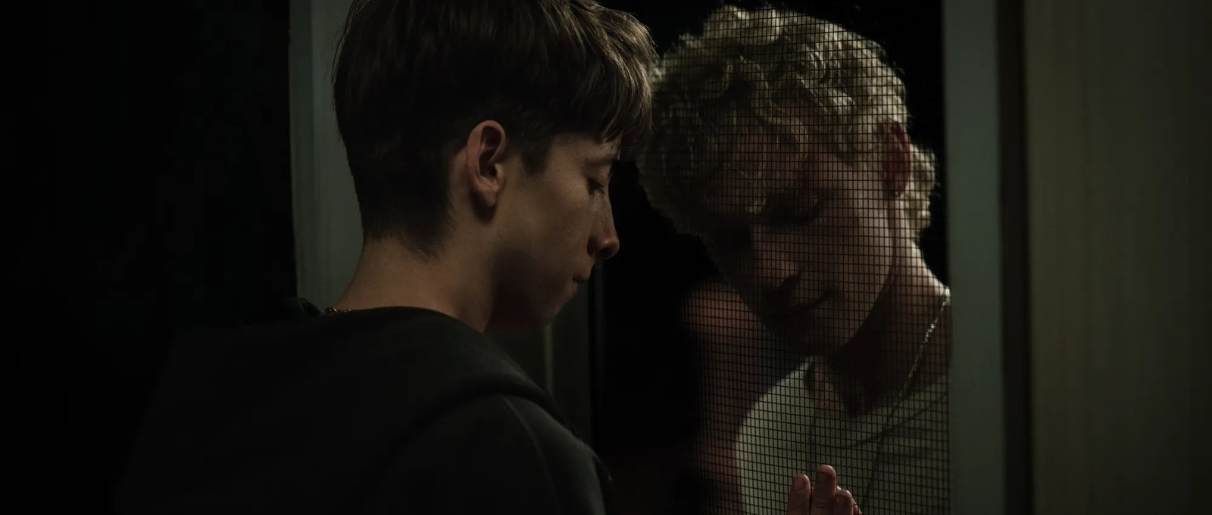
Naim soon befriends Ryan, another boy in town, and their friendship slowly begins to shift into something more intimate. The film lets that connection develop in a way that feels recognizably teenage: tentative, curious, and a little unsure of itself.
Things unravel when Naim catches Ryan kissing another boy and, in a moment of jealousy, exposes the encounter to their parents. The reaction from the community is swift. A priest is brought in to perform what is framed as a spiritual intervention; an exorcism meant to cleanse the boys of their “sin.”
Except the ritual doesn’t fix anything. Instead, it unleashes something.

After the ceremony, the boys begin encountering a supernatural entity that takes the form of the person they desire most. The creature appears whenever temptation threatens to return, turning longing itself into a kind of punishment. The implication is chilling: desire isn’t just sinful, it’s deadly.
What Leviticus does particularly well is reveal how deliberate this system is. The ritual isn’t some misguided one-off attempt to “help” the boys. It’s part of a larger structure built around controlling identity through fear, shame, and guilt…the church’s favorite hat trick. Even Naim’s mother, played by Mia Wasikowska, turns out to be quietly complicit in the process. She believes she’s protecting her son, even if the protection looks suspiciously like spiritual violence.
The supernatural entity stalking the boys works as a devastating metaphor for repression. The more they try to deny their feelings, the more aggressively the creature appears. Desire becomes a literal haunting, something that refuses to disappear simply because someone in authority says it should. The same community demanding purity from its teenagers seems perfectly capable of ignoring its own hypocrisies. Adults enforce rigid rules about sin while quietly sidestepping their own failings, revealing how easily faith can be weaponized.
Ultimately, Leviticus isn’t really about demons. It’s about the systems that create them. Horror springs from a community willing to unleash that terror in the name of righteousness.

Mo Moshaty is an acclaimed horror writer, lecturer, and producer whose work combines visceral storytelling with the psychological insight of her Cognitive Behavioral Therapy background. She has lectured internationally, including as a keynote speaker at Nightmares from Monkeypaw: A Jordan Peele Symposium (Prairie View A&M), No Return: A Yellowjackets Symposium (Horror Studies BAFSS Sig), The Whole Damn Swarm: Celebrating 30 Years of Candyman (University of California), and with the Centre for the History of the Gothic (University of Sheffield). Mo has also presented at the BFI, Miskatonic Institute of Horror Studies, and Final Girls Berlin Film Festival’s Brain Binge on women’s trauma in horror cinema, Cine-Excess on The Creepy Kid Horror Subgenre and Mother/Daughter Trauma in Horror, and Romancing the Gothic on Cosmic Horror’s Havoc on The Body Electric Her short film, 13 Minutes of Horror: Sci-Fi Horror, won the 2022 Rondo Hatton Classic Horror Award for Best Short Film. As a core producer with Nyx Horror Collective, Mo co-created the 13 Minutes of Horror Film Fest and partnered with Shudder in 2021 and 2022, while also establishing a Stowe Story Labs fellowship supporting women creatives over 40+ in horror. A member of the Black Women in Horror Class of 2023 and featured in 160 Black Women in Horror, Mo’s short fiction appears in A Quaint and Curious Volume of Gothic Tales (Brigid’s Gate Press) and 206 Word Stories (Bag O’ Bones Press). Her debut novella, Love the Sinner, was released July 5, 2024, with Clairviolence: Tales of Tarot and Torment released in October 2025. The first of her five-volume non-fiction series, The Annex of the Obscure: The Afterlife, will be released in 2027 from Tenebrous Press. As the Editor-in-Chief of NightTide Magazine and founder of Mourning Manor Media, Mo champions marginalized voices in horror. Under her leadership, NightTide plans to launch a film festival in 2028, furthering her mission to reshape the genre through inclusivity and representation.


Leave a Reply